 Skip to content
Conversion Rate Optimisation (CRO): The Ultimate Guide for E-commerce
-
2715 words · 13 min read

Is your e-commerce store attracting visitors, but failing to turn those clicks into customers? It's a common and frustrating challenge for many UK retailers. You know your website could perform better, but staring at analytics can feel overwhelming, and the fear of making a change that hurts your sales can be paralysing. The key to breaking this cycle and unlocking your store's true potential lies in mastering conversion rate optimisation. It’s the methodical, data-driven process of turning more of your hard-earned traffic into valuable revenue.
This ultimate guide is designed to remove the guesswork and build your confidence. We'll provide you with a clear, step-by-step framework to analyse your store's performance, identify opportunities, and implement actionable strategies that deliver real results. Forget random tweaks and hoping for the best. You will learn the fundamentals needed to make informed decisions that not only increase your sales but also drive sustainable, long-term growth for your e-commerce business.
What is Conversion Rate Optimisation (and Why It Matters for E-commerce)
In the world of e-commerce, attracting visitors to your online store is only half the battle. The real challenge lies in turning those visitors into paying customers. This is the core principle of conversion rate optimisation (CRO): a systematic process of refining your website and user experience to increase the percentage of visitors who take a desired action.
Put simply, CRO is about making more money from the traffic you already have. Instead of constantly spending more on advertising to attract new visitors, you focus on improving the journey for the ones who are already there, encouraging them to complete a purchase. To better understand this concept, watch this helpful video from the experts at Semrush:
Of course, a successful e-commerce strategy requires both: attracting high-quality visitors and converting them effectively. While this guide focuses on conversion, if you need help with the traffic generation side of the equation, you can visit 2X Sales for expertise in digital and traditional media solutions.
This focus on efficiency makes conversion rate optimisation one of the most cost-effective strategies for sustainable growth. It leverages your existing marketing spend to deliver a higher return. The methodical process, detailed in resources like Wikipedia's guide on What is Conversion Rate Optimization?, involves understanding user behaviour through data and testing improvements to remove friction from the buying process.
Defining 'Conversion' for Your Online Store
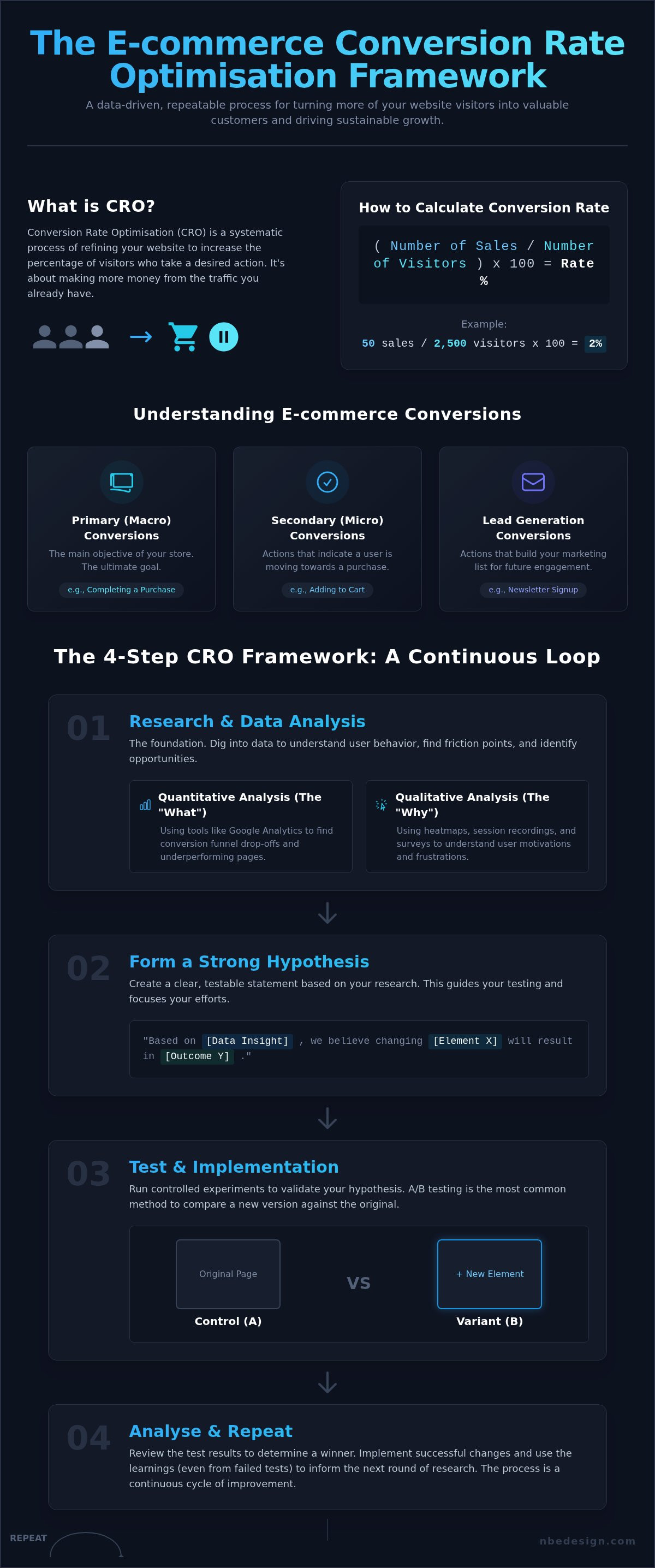
While the ultimate goal is a sale, a 'conversion' can be any valuable action a user takes on your site. Understanding these different goals, often tracked in Google Analytics, is key. They typically fall into three categories:
- Primary (Macro) Conversions: The main objective of your store, which is completing a purchase.
- Secondary (Micro) Conversions: Actions that indicate a user is moving towards a purchase, such as adding an item to the cart, creating an account, or viewing a key product page.
- Lead Generation Conversions: Actions that build your marketing list, like signing up for a newsletter or downloading a lookbook.
Calculating Your E-commerce Conversion Rate
Tracking your progress starts with a simple calculation. To find your primary conversion rate, use this formula:
(Number of Sales / Number of Visitors) x 100 = Conversion Rate %
For example, if your store had 50 sales from 2,500 visitors in a month, your conversion rate would be 2%. While industry benchmarks for UK e-commerce often hover around 1-3%, the most important number is your own. The goal of CRO is to establish your baseline and work methodically to improve it over time.
The CRO Framework: A Repeatable Process for Sustainable Growth
Effective conversion rate optimisation is not about guesswork, copying competitors, or chasing the latest design trend. It’s a disciplined, scientific process designed to deliver measurable improvements. By adopting a structured approach, you move from making random changes to implementing data-driven enhancements that foster sustainable growth. This iterative method, often called The CRO Framework, minimises the risk of launching changes that could harm your sales and ensures every decision is backed by evidence.
This process is a continuous loop of improvement built on four key stages: Research, Hypothesise, Test, and Analyse.
Step 1: Research & Data Analysis
This is the foundation of all successful optimisation. We start by digging into your data to understand user behaviour and identify problem areas. This involves two types of analysis:
- Quantitative Analysis: Using tools like Google Analytics, we look at what is happening. We analyse your conversion funnel to find where users drop off, identify underperforming pages, and segment your audience to see which groups convert best.
- Qualitative Analysis: Using heatmaps, session recordings, customer surveys, and reviews, we uncover why it's happening. This gives us crucial context behind the numbers.
Step 2: Forming a Strong Hypothesis
With solid research in hand, you can form an educated hypothesis. A strong hypothesis is a clear, testable statement that follows a simple structure: "Based on [data insight], we believe that changing [X] for [user segment] will result in [Y outcome]." For example: "Based on heatmap data showing users ignoring the shipping calculator, we believe that displaying estimated delivery times directly on the product page will increase add-to-cart rates." Hypotheses are then prioritised based on their potential impact and how easy they are to implement.
Step 3: Testing & Implementation
This is where you put your hypothesis to the test. The most common method is A/B testing, where you create a new version of a page (the "variant") and show it to a portion of your traffic, while the rest sees the original (the "control"). You then compare the performance of both. To get reliable, statistically significant results, you need sufficient traffic over a set period. For Shopify stores, powerful apps like Google Optimize or VWO make running A/B, split, or even more complex multivariate tests a seamless process.
Key E-commerce Areas to Optimise for Higher Conversions
Effective conversion rate optimisation isn't about overhauling your entire Shopify store at once. Instead, it’s about strategically focusing on the highest-impact pages within the customer journey. By applying a CRO framework to these critical touchpoints, you can achieve significant growth. The interplay of compelling visuals, persuasive copy, and a seamless user experience is paramount, with the overarching goal of building customer trust at every step. Understanding the Key E-commerce Areas to Optimise is the foundational step to turning more browsers into buyers.
Homepage & Navigation
Your homepage must make an immediate impact. You have roughly five seconds to clarify your value proposition and convince a visitor to stay. Use a high-quality hero image or video with a clear, singular call-to-action (CTA) like "Shop Now" or "Discover Our Collection." Simplify your main navigation menu to make browsing intuitive, and prominently display trust signals such as customer reviews, industry awards, and security badges to build instant credibility.
Product Detail Pages (PDPs)
This is where the purchase decision truly happens. Invest in high-resolution product photography from multiple angles, and include a video where possible. Write persuasive product descriptions that go beyond features to explain how the product solves a customer's problem. Display social proof, like star ratings and detailed reviews, near the top of the page. Crucially, ensure your 'Add to Cart' button is bold, highly visible, and stands out from other page elements.
Shopping Cart & Checkout Process
A complicated checkout is a primary cause of abandoned carts. Streamline the process by minimising distractions, form fields, and unnecessary steps. Always offer a guest checkout option to reduce friction for new customers. Transparency is key; display all costs, including shipping and taxes, upfront to avoid last-minute surprises. A cohesive brand experience, reinforced by a modern Shopify POS system that unifies your online and in-store operations, can build the long-term trust that fuels repeat purchases.
Essential CRO Tools for E-commerce Businesses
Diving into the world of conversion rate optimisation can feel overwhelming, with countless tools promising transformative results. The good news? You don't need a dozen complex subscriptions to make a significant impact. A focused, strategic toolset is far more effective.
The goal is to build a core stack that helps you understand customer behaviour, identify friction points, and test potential solutions. Many of the best tools offer free plans or generous trials, making them accessible even for businesses just starting out. Remember, the objective is to gather actionable data that informs your strategy, not just to collect numbers for the sake of it.
Analytics Platforms: Understanding the 'What'
Quantitative data tells you what is happening on your store. This is your foundation. Start with these essentials to track performance and spot trends.
- Google Analytics: The industry-standard, free platform for in-depth analysis of your traffic, audience behaviour, and conversion funnels.
- Shopify Analytics: Conveniently built into your dashboard, these reports provide a clear, at-a-glance view of your store's sales, top-performing products, and checkout progress.
Focus on key metrics like your overall conversion rate, high-traffic pages with high exit rates, and your cart abandonment rate to identify the biggest opportunities for improvement.
User Behaviour Tools: Discovering the 'Why'
Once you know what's happening, you need to understand why. User behaviour tools provide the qualitative insights that numbers alone can't.
- Heatmap & Session Recording Tools: Platforms like Hotjar or the completely free Microsoft Clarity show you exactly where users are clicking, how far they scroll, and what they ignore. Session recordings let you watch anonymised user journeys, revealing bugs or confusing navigation in real-time.
- On-site Surveys & Feedback Polls: Sometimes the easiest way to find out what's wrong is to ask. Simple, non-intrusive polls can gather direct feedback on pricing, shipping, or product information.
A/B Testing Platforms: Validating Your Changes
After developing a hypothesis based on your data, a testing platform allows you to validate it scientifically. Instead of guessing, you can prove which version of a page or element performs better.
While Google Optimize has been sunset, the principle remains vital. Enterprise-level tools like VWO and Optimizely offer powerful features, but for most Shopify stores, there are fantastic, user-friendly A/B testing apps available directly from the Shopify App Store. These allow you to easily test changes to product descriptions, button colours, and page layouts to build a robust conversion rate optimisation process.
Choosing the right tools is a critical first step. For expert guidance on implementing a data-driven CRO strategy for your Shopify store, our team of Shopify Experts is here to help.
When to Hire a Conversion Rate Optimisation Agency
Embarking on a do-it-yourself approach to CRO is a commendable first step for any e-commerce business. It can yield valuable insights and quick wins. However, as your business scales, you'll likely reach a point where your own efforts hit a ceiling. A dedicated conversion rate optimisation program requires significant time, specialised tools, and a depth of expertise that most in-house teams simply don't have. Partnering with an agency is not an admission of failure; it's a strategic investment in accelerating your growth.
An expert agency brings a fresh, unbiased perspective to your user experience, free from internal assumptions. They leverage enterprise-level testing tools and a proven, data-driven methodology to uncover opportunities you might have missed, turning stalled growth into a clear, actionable roadmap for increasing revenue.
Signs You're Ready for an Agency
Recognising when to seek external help is key to unlocking your store's next level of performance. You are likely ready to partner with a specialist if:
- You have consistent, healthy traffic, but your sales growth has plateaued or stalled.
- You and your team lack the dedicated time or statistical expertise to design, run, and analyse A/B tests effectively.
- Your own testing efforts are producing inconclusive results or failing to deliver a meaningful impact on your bottom line.
- You feel you are too close to your own website and need an objective, expert eye to identify friction points in the customer journey.
What to Look For in a Shopify CRO Expert
When choosing a partner, it's crucial to find a team that not only understands CRO but also intimately understands your platform. For Shopify merchants, this means seeking out a specialist. Look for an agency with a transparent, data-driven process and a strong portfolio of successful e-commerce projects. Deep, technical knowledge of the Shopify ecosystem-from theme architecture to app integrations-is non-negotiable, as it ensures that any proposed changes are both effective and technically sound.
A true specialist can move beyond generic advice and provide platform-specific strategies that deliver real results. See how a certified Shopify Expert can transform your store's performance.
Mastering CRO: The Path to Sustainable E-commerce Growth
Mastering e-commerce growth isn't about a single magic bullet; it's about a methodical, ongoing commitment to improvement. As this guide has shown, a structured approach to conversion rate optimisation moves your business beyond guesswork. By consistently testing and refining key areas-from your product pages and site navigation to your final checkout process-you build a powerful and reliable engine for sustainable sales growth.
While the principles are straightforward, implementing a successful CRO strategy requires expertise and focus. You don't have to navigate this journey alone. As a Certified Shopify Select Partner, we have a proven track record of helping retailers grow their sales through expert, conversion-focused design and development. We're ready to help you translate valuable customer insights into tangible revenue and build a more profitable, future-proof online store.
Ready to grow your sales? Contact our Shopify experts for a CRO consultation.
Frequently Asked Questions About Conversion Rate Optimisation
How much does conversion rate optimisation cost?
The cost for conversion rate optimisation in the UK can vary significantly. A one-off project, such as a detailed website audit with actionable recommendations, might start from £1,500. For comprehensive, ongoing CRO services from a specialist agency, monthly retainers typically range from £2,000 to £10,000+. This investment secures continuous analysis, A/B testing, and strategic implementation designed to deliver a strong return by systematically increasing your store's revenue.
How long does it take to see results from CRO?
While fixing a critical bug can yield immediate results, a structured CRO strategy requires patience. Gathering enough data for a statistically significant A/B test often takes several weeks to a few months, depending on your site's traffic levels. You can typically expect to see a measurable, positive impact on your key metrics within the first 3-6 months as initial hypotheses are validated and successful changes are rolled out across your e-commerce store.
What is a good conversion rate for a Shopify store in 2025?
In 2025, a good benchmark for a UK Shopify store is generally between 1.5% and 3%. However, this figure varies dramatically by industry. A niche store selling high-demand products might achieve 5% or more, while a retailer of high-value, considered purchases could see a rate closer to 1%. The most important goal is to focus on consistently improving your own baseline conversion rate, as this is the true measure of e-commerce success.
Can I do CRO if my website has low traffic?
Absolutely. While low traffic makes traditional A/B testing difficult, you can focus on qualitative methods. Use tools like heatmaps and session recordings to understand user behaviour, and run customer surveys or interviews to gather direct feedback. This approach helps you identify major pain points and usability issues. Fixing these foundational problems can lead to significant conversion uplifts without needing the high traffic volumes required for statistical testing.
What's the difference between CRO and SEO?
SEO (Search Engine Optimisation) is focused on attracting more visitors to your website from search engines. Its primary goal is to increase the quantity and quality of your traffic. In contrast, CRO (Conversion Rate Optimisation) is about maximising the value of the traffic you already have. It focuses on improving the on-site experience to persuade more visitors to take a desired action, like making a purchase. SEO brings people in; CRO helps them convert.
What are the most common mistakes businesses make with CRO?
One of the biggest mistakes is making decisions based on gut feeling instead of data. Without proper user research and testing, you're just guessing. Another common error is blindly copying competitors without understanding the unique needs of your own audience. Finally, many businesses treat CRO as a one-time fix. Effective conversion rate optimisation is an ongoing process of testing, learning, and refining to achieve sustainable business growth.

- Posted in:
- conversion rate optimisation
- CRO
- E-commerce
- E-commerce Tips
- Increase Sales
- Online Retail
- User Experience
- Website Optimisation





:%20The%20Ultimate%20Guide%20for%20E-commerce)