Skip to content
Design for Print and Online Graphics: The Complete Business Guide
-
3031 words · 15 min read
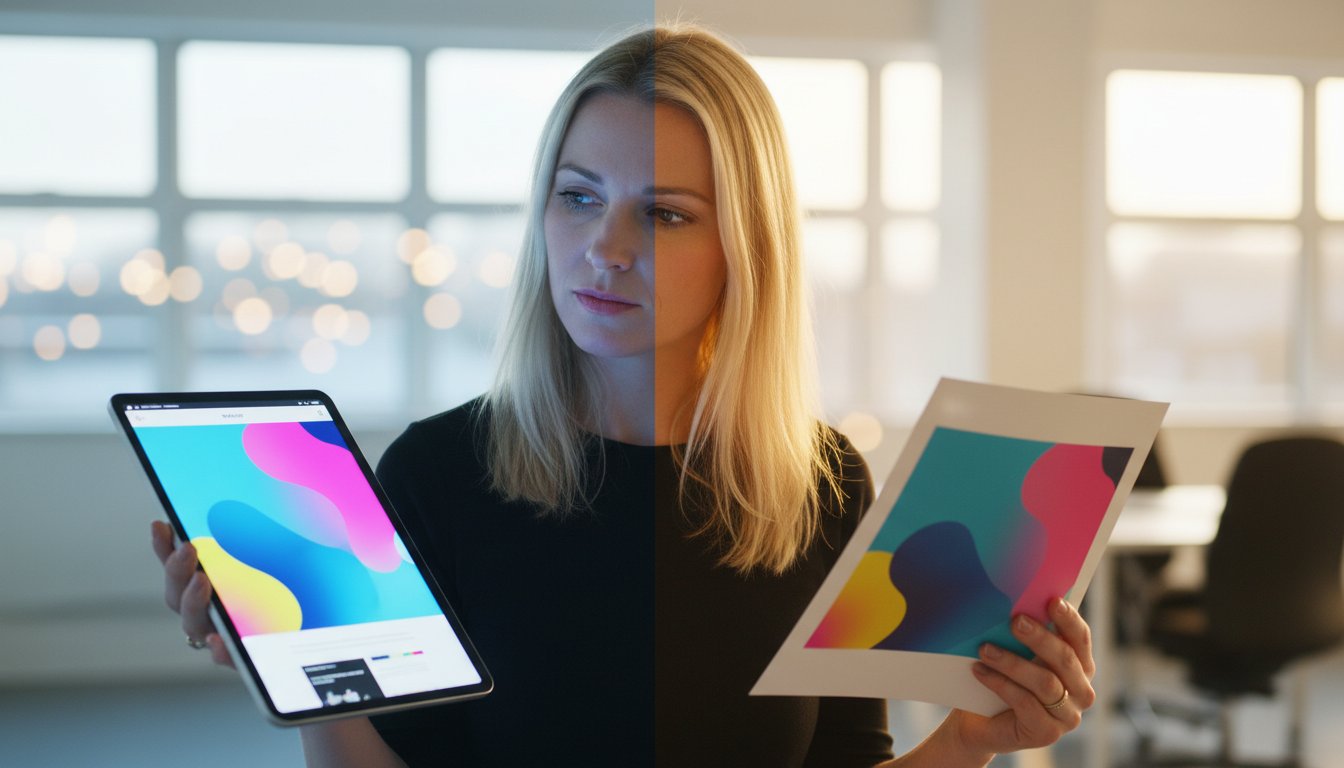
Have you ever invested time crafting the perfect social media graphic, only to see it look blurry or strangely coloured on a printed flyer? It’s a common and frustrating challenge for business owners. That vibrant red on your website suddenly looks dull on a business card, and the logo that’s sharp online becomes a pixelated mess in your brochure. This inconsistency stems from the crucial, yet often overlooked, differences in how you should approach design for print and online graphics.
In this complete guide, we will bridge that gap. We’ll help you understand the core principles that separate the digital and physical worlds, from technical terms like DPI and CMYK to the practical reasons why one design doesn't simply fit all formats. You’ll learn how to create a consistent, professional brand that looks impeccable everywhere your customers see you, avoiding costly mistakes and amateurish results.
By the end, you'll be equipped to communicate effectively with designers, produce high-quality marketing materials with confidence, and know exactly when it’s time to bring in an expert. Let's ensure your brand's first impression is always a brilliant one.
Key Takeaways
- Understand the critical differences between colour models (CMYK vs. RGB) and resolution requirements to ensure your designs look professional in every format.
- Discover how to optimise digital graphics for user experience and conversions, while leveraging print materials to build tangible, real-world brand credibility.
- Learn to master your approach to design for print and online graphics to create a seamless and trustworthy brand identity across every customer touchpoint.
- Gain clarity on when to use DIY tools for simple tasks and when investing in a professional designer is the right move for scaling your business.
The Fundamental Divide: Why Print and Digital Designs Aren't the Same
Have you ever sent a beautiful web graphic to a printer, only to receive a blurry, discoloured flyer? It’s a common and costly frustration. The truth is, a single design file rarely works for both mediums because they are built on entirely different technical foundations. Effective design for print and online graphics requires understanding three core pillars: colour mode, resolution, and file format. Mastering these basic graphic design fundamentals is the first step to ensuring your brand looks professional everywhere, saving you time and money (£) on avoidable revisions.
Colour Modes Explained: CMYK vs. RGB
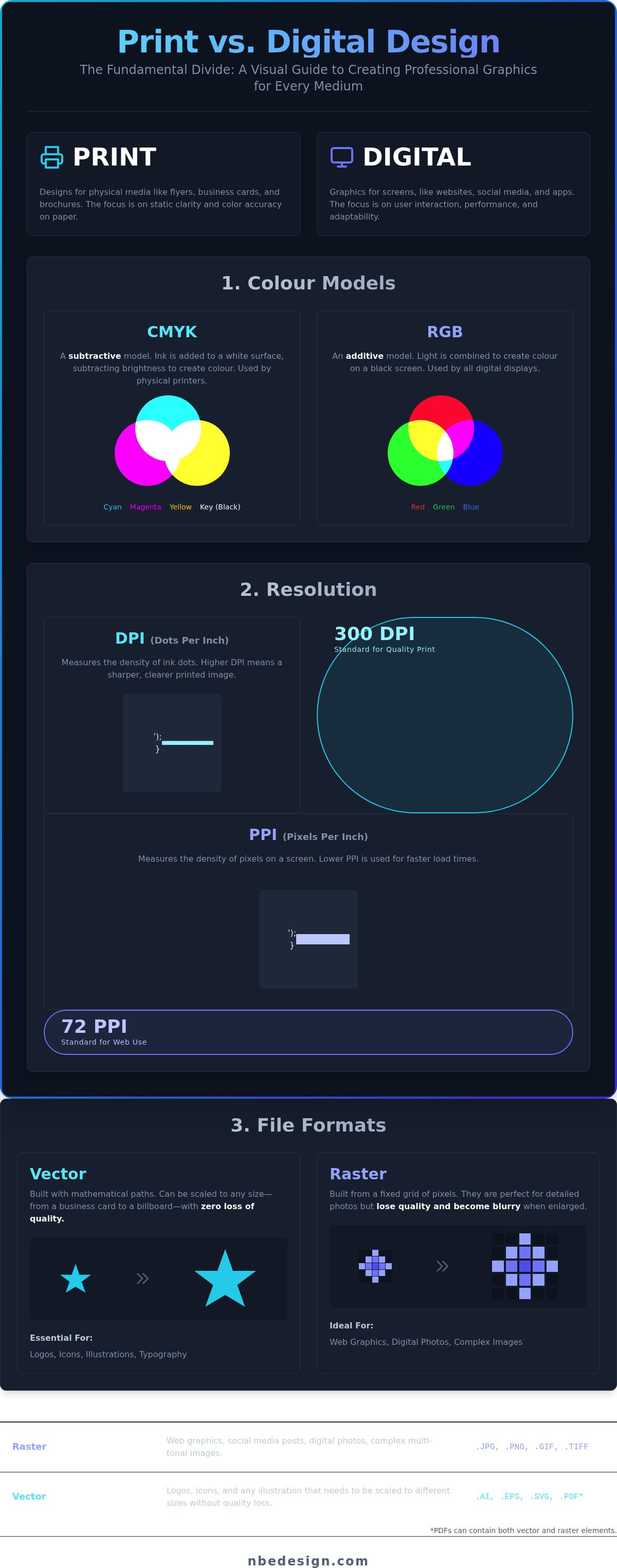
Digital screens create colour by mixing Red, Green, and Blue light (RGB) in an additive process. In contrast, physical printers use ink-Cyan, Magenta, Yellow, and Key (Black), or CMYK-in a subtractive process. Using an RGB file for a print job forces a colour conversion that often results in dull, muddy tones. For precise brand consistency, printers may use the Pantone Matching System (PMS), which uses pre-mixed inks for guaranteed colour accuracy across different materials.
Resolution and Quality: DPI vs. PPI
Resolution determines the clarity of your graphic. For screens, we measure this in Pixels Per Inch (PPI), with 72 PPI being the standard for fast-loading web use. For print, it’s Dots Per Inch (DPI), and 300 DPI is the professional standard for sharp, high-quality results. This is why a crisp 72 PPI web image looks pixelated when printed-there simply isn't enough data for the printer to create a clear image at a larger physical size. Always start your print projects with a high-resolution source file.
File Formats Decoded: Vector vs. Raster
This is where the structure of your design file becomes critical. Think of it like a photograph versus a set of building blocks.
- Raster files (JPG, PNG, GIF) are like photographs, built from a fixed grid of pixels. They are perfect for detailed images but lose quality and become blurry when enlarged beyond their original size.
- Vector files (AI, EPS, SVG) are like building with LEGOs; they are constructed from mathematical paths and points. This means they can be scaled to any size-from a business card to a billboard-with zero loss of quality, making them essential for logos and illustrations.
| File Type | Best For... | Common Formats |
|---|---|---|
| Raster | Web graphics, digital photos, complex images | JPG, PNG, GIF, TIFF |
| Vector | Logos, icons, illustrations, typography | AI, EPS, SVG, PDF* |
*PDFs can contain both vector and raster elements.
Mastering Online Graphics: Designing for Screens and Clicks
When you transition your focus from paper to pixels, the entire rulebook changes. The world of digital design is not static; it’s an interactive environment where every visual element has a job to do. Unlike a printed flyer, an online graphic must guide the user, load instantly, and adapt to countless screen sizes. Understanding the key differences in print and digital is crucial, as the primary goal shifts from passive viewing to active engagement. Success in this arena hinges on user experience (UX), performance, and a mobile-first mindset, making strategic design for print and online graphics a fundamentally different challenge.
E-commerce Website Visuals
For an online retailer, your website's graphics are your digital storefront, salesperson, and brand ambassador all in one. High-quality product photos, compelling homepage banners, and clear promotional graphics are non-negotiable. They build trust, communicate value, and directly impact conversion rates. For any online store, maintaining consistent branding across all visuals—from icons to banners—creates a seamless and professional experience that encourages customers to complete their purchase. You can see examples of this conversion-focused approach in our e-commerce design portfolio.
Social Media Graphics that Stop the Scroll
In the fast-paced world of social media, your graphics have mere seconds to capture attention. Each platform has its own unique requirements, from Instagram's square-centric feed to LinkedIn's professional aesthetic. To maintain brand integrity and streamline content creation, developing a set of versatile templates is essential. These should incorporate your core brand elements, such as:
- Consistent Colour Palette: Using your primary and secondary brand colours.
- Legible Text Overlays: Ensuring fonts are clear and messaging is concise.
- Strategic Logo Placement: Building brand recognition without overwhelming the visual.
Email Marketing and Digital Ads
Visuals in your email newsletters and digital ad campaigns must work harder than anywhere else. For email, a striking header or embedded graphic can dramatically increase click-through rates. For digital ads on platforms like Google or Facebook, you face strict technical specifications regarding file size and text-to-image ratios. The message must be instantly understandable, with a powerful call-to-action (CTA) that drives a specific outcome. We always recommend A/B testing different visuals to discover what resonates most with your audience and maximises your return on ad spend.
Perfecting Print Design: From Business Cards to In-Store Signage
While online graphics capture attention, tangible print materials build lasting credibility. A well-designed business card, a striking in-store sign, or beautifully crafted packaging offers a physical touchpoint that reinforces your brand's quality and professionalism in the real world. For retailers, mastering the design for print and online graphics is not about choosing one over the other; it's about creating a seamless, high-quality experience across every channel. This requires a specific skill set and a keen eye for detail to avoid costly mistakes.
Essential Print Materials for a Retail Business
Every piece of printed material contributes to your customer's journey and perception of your brand. From the moment they see your window display to the thank you note in their shopping bag, these elements craft a cohesive and memorable in-store experience. Key materials that build brand loyalty include:
- Business Cards & Flyers: Essential tools for networking and effective local marketing campaigns.
- Brochures & Catalogues: To showcase product ranges in rich, tactile detail.
- In-Store Signage: Crucial for promotions, wayfinding, and reinforcing your brand identity.
- Packaging & Thank You Notes: To create a premium unboxing experience that customers remember.
- Loyalty Cards: An effective way to encourage repeat business and build a strong customer community.
Industries that depend on making a strong visual impression, like real estate, are a great example of this principle in action. A professionally designed property brochure can be just as crucial as the online listing. To see how experts approach this, you can check out Noble Real Estate for insights into successful property marketing.
These physical assets can be powerfully integrated with your digital operations. For instance, customer details gathered via a loyalty card can be managed efficiently within a modern, unified Shopify POS system, streamlining your marketing efforts.
Preparing Your Files for the Printer
To ensure your vision translates perfectly from screen to paper, preparing a 'print-ready' file is non-negotiable. Collaborating with a professional printer is always recommended, but understanding the basics will save you time and prevent reprints. Before sending any design to print, always check the following:
- Bleed, Trim & Safe Zone: Your design must extend beyond the final trim line (bleed) to avoid white edges, while all crucial text and logos must stay within the safe zone.
- Fonts: Always outline your fonts (convert them to shapes) or embed them within the PDF to ensure they don't get substituted with a default font at the printer's end.
- File Export: Export your final design as a high-resolution (300 DPI) PDF file with CMYK colour settings for the most accurate and professional results.
Finally, and most importantly, proofread everything one last time. In the world of design for print and online graphics, the digital realm allows for quick edits, but print is permanent. Taking that extra moment for a final check is a simple step that guarantees a professional outcome.
Creating a Cohesive Brand: Unifying Your Print and Digital Identity
We've explored the technical differences between print and digital, but how do you unite them under one strong brand? Your brand is more than a logo; it's the sum of every interaction a customer has with your business. Consistency across all touchpoints-from a printed flyer to your website's checkout page-builds familiarity, which in turn fosters recognition and trust. A unified visual identity is the key to mastering your design for print and online graphics.
What Are Brand Guidelines? (And Why You Need Them)
Think of brand guidelines as the central rulebook that defines how your visual assets should be used. This essential document ensures that every piece of marketing material, whether created by an in-house team, a freelancer, or an agency, communicates a consistent message. It typically specifies logo usage, colour palettes, and typography rules. This level of professionalism is fundamental for a conversion-focused store, especially one built by a Shopify Expert in the UK.
Building Your Essential Brand Kit
For a growing business, a brand kit doesn't need to be complicated. It’s a practical toolkit containing the core assets needed for day-to-day design. Your essential kit should include:
- Logos: Your primary (full colour) logo, a secondary version (e.g., one-colour or white for dark backgrounds), and any icon-only variations.
- Typography: A primary font for headings and a secondary, highly readable font for body text. Specify weights (e.g., Bold, Regular) to be used.
- Colour Palette: Your core brand colours defined with their specific codes for absolute consistency: HEX for web, RGB for digital screens, and CMYK for print.
Applying Your Brand Consistently Everywhere
Once your brand kit is ready, the goal is to apply it without fail. Conduct a simple audit to ensure your visual identity is aligned across all channels, from your website and social media profiles to email signatures and business cards. Creating templates for recurring needs like blog post graphics or promotional emails will streamline your workflow. This disciplined approach makes your marketing efforts more efficient and reinforces your brand identity at every step, creating a seamless and trustworthy customer experience.
Tools vs. Talent: When to DIY vs. When to Hire a Professional
In today's market, the accessibility of DIY design tools like Canva has empowered many business owners to create their own visuals. This raises a crucial question: when is it smart to handle design in-house, and when does it become an obstacle to growth? The answer lies in understanding the difference between a tool and a strategy.
The Pros and Cons of DIY Design Tools
DIY platforms offer undeniable advantages for day-to-day marketing tasks. For a low monthly cost, often under £20, they provide a fast way to generate social media posts, simple flyers, or internal announcements. However, this convenience comes with trade-offs. Relying heavily on templates can result in a generic brand appearance that fails to stand out. More importantly, these tools lack the strategic oversight needed for foundational assets like logos and comprehensive brand identities, and they can’t protect you from common but costly amateur mistakes.
5 Signs You've Outgrown DIY Design
How do you know when it's time to transition from DIY solutions to professional expertise? It's often when the limitations begin to impact your business goals. Here are five clear indicators:
- Your brand looks inconsistent. Your website, social media, and print materials feel disconnected, weakening your brand recognition.
- You're spending too much time on design. The hours you spend tweaking layouts are hours you're not spending on sales, operations, or strategy.
- You need a truly unique brand identity. A template-based logo will never provide the distinct, memorable brand foundation a growing business requires.
- You're undertaking a major project. A website redesign, a full product catalogue, or a packaging launch demands professional execution to succeed.
- Your marketing materials aren't delivering results. If your ads, brochures, and web graphics aren't converting, the design may be the underlying problem.
The Value of a Professional Design Agency
Hiring a professional is an investment in your brand's future, not just an expense. A skilled designer or agency provides much more than a polished visual. They bring strategic thinking, analysing your audience, competitors, and objectives to create designs that achieve specific business goals. Their experience helps you avoid common pitfalls, while their technical mastery ensures every aspect of your design for print and online graphics is handled flawlessly-from colour profiles to file formats. This expertise streamlines your marketing, builds customer trust, and ultimately drives growth.
To see how a dedicated agency can apply this strategic thinking to your brand, you can visit AHS Digital for a look at their cohesive creative services.
Ready to build a brand that makes a lasting impact? Explore our business graphic design services.
Bringing Your Brand Vision to Life, from Pixel to Print
As we've explored, a powerful brand presence is built on understanding the crucial differences between print and digital media while ensuring they work together in harmony. From mastering colour profiles and resolutions to creating a unified visual identity across every touchpoint, a strategic approach to design for print and online graphics is essential for professional impact. Ultimately, knowing when to leverage professional talent over DIY tools can be the defining factor in how your audience perceives your business.
Executing this vision flawlessly is where our expertise makes the difference. As Certified Shopify Experts based in the North East, UK, we have a proven portfolio of helping a global client base of successful e-commerce brands achieve a seamless and conversion-focused presence. We bridge the gap between creative concepts and rock-solid commercial results.
Ready to build a professional brand that resonates on every platform? Get in touch with our design experts today. Let's work together to craft an unforgettable identity for your business.
Frequently Asked Questions
What is the best file format for a logo?
The most robust and versatile file format for a logo is a vector file, such as an AI, EPS, or SVG. Vector graphics are built with mathematical equations, allowing them to be scaled to any size-from a business card to a billboard-without losing quality. This ensures your brand identity remains crisp and professional everywhere. While a high-resolution PNG is suitable for web use, a vector format is the rock-solid foundation for all your branding needs.
Why do my colours look different when printed compared to on my screen?
This common issue stems from the two different colour models used for digital and print media. Your screen uses the RGB (Red, Green, Blue) model, which creates colours by adding light. In contrast, printers use the CMYK (Cyan, Magenta, Yellow, Black) model, which creates colours by subtracting light with ink on paper. To ensure colour consistency, professional designers work in the CMYK colour space from the start for any materials destined for print.
How much resolution do I need for a high-quality print?
The industry standard for a high-quality, professional print is 300 DPI (Dots Per Inch). This ensures your images are sharp and detailed, not blurry or pixelated. When preparing your design for print and online graphics, remember that web images typically only need 72 DPI. Using a low-resolution web graphic for a print job like a flyer or brochure will result in a poor-quality, unprofessional finish. Always check your file settings before sending to the printer.
Can I use a PNG or JPG for my business cards?
While technically possible if the resolution is high enough (300 DPI), it is not recommended for a professional result. PNG and JPG files are raster formats, meaning text and sharp lines can appear soft or pixelated when printed at small sizes. For the crispest text and logo, your business card should be designed using vector elements and exported as a print-ready PDF. This format preserves the quality of all components, ensuring a sharp, high-impact finish.
What's the difference between a graphic designer and a web designer?
A graphic designer traditionally focuses on visual identity and static media, such as logos, branding, and print materials like brochures and packaging. A web designer, however, specialises in the interactive experience of a website, focusing on user interface (UI), user experience (UX), and how elements function online. While both roles require a strong sense of aesthetics, they involve distinct skill sets focused on different user interactions and technical requirements.
How much should I budget for professional branding for my small business?
For a small business in the UK, a professional branding package from an experienced freelancer or a small agency can range from £1,500 to £5,000+. A foundational package at the lower end might include a logo suite, colour palette, and typography selection. A more comprehensive project could involve brand guidelines and stationery design. It's a crucial investment in your business's future, establishing a professional identity that builds trust and recognition with your customers.

- Posted in:
- Brand Identity
- CMYK vs RGB
- design for print and online graphics
- Design Tips
- Digital Graphics
- Graphic Design
- Marketing Materials
- Print Design
- Small Business Marketing