Skip to content
Migrate from Magento to Shopify: The Complete 2026 UK Expert Guide
-
3306 words · 16 min read

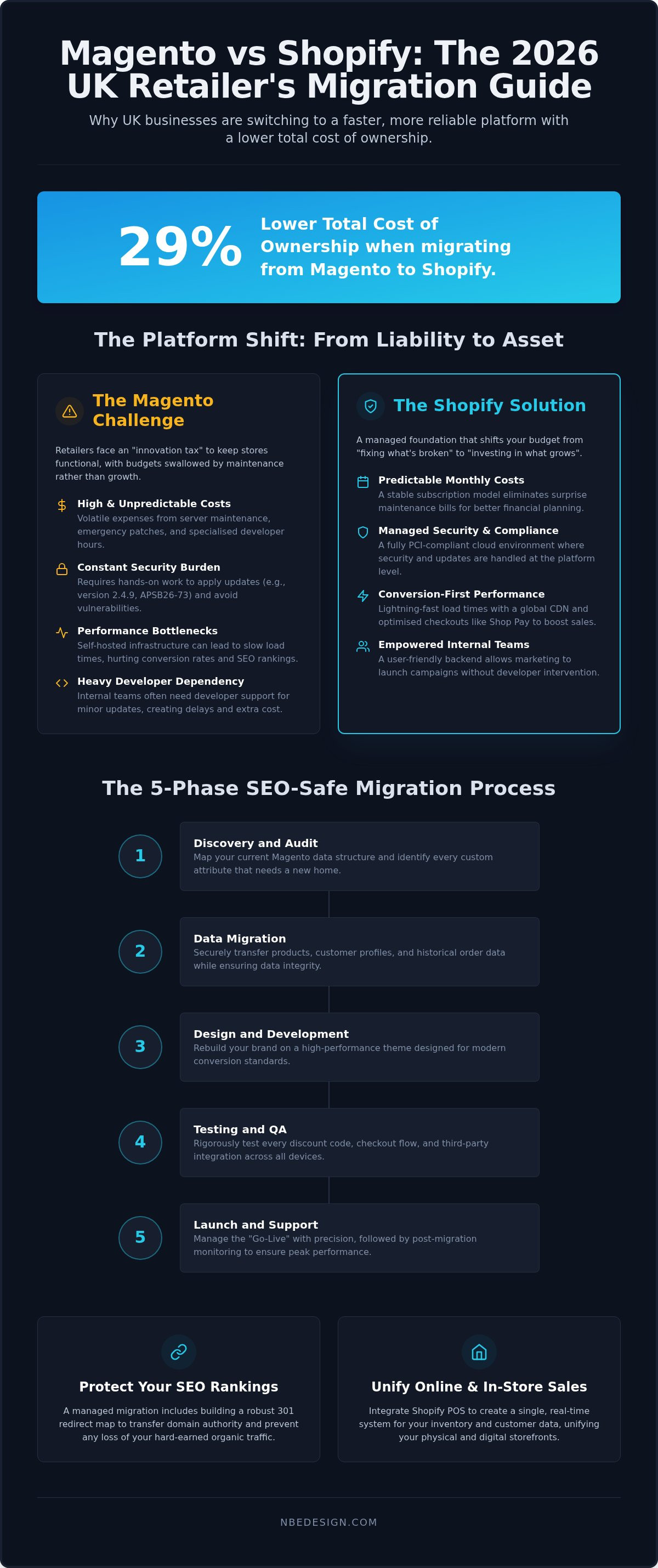
Did you know that switching to Shopify can result in a 29% lower total cost of ownership compared to staying on Magento? For many UK retailers, the burden of managing Magento version 2.4.9, along with the constant pressure of security updates like APSB26-73, has become a significant drain on resources. It's exhausting to feel like your platform is holding you back with slow performance and a heavy dependency on developers for every minor update. You deserve a system that works as hard as you do.
In this expert guide, we'll show you how to migrate from magento to shopify to create a faster, more reliable storefront that reduces monthly operational costs. We'll provide a clear roadmap for a managed, SEO-safe transition that preserves your hard-earned organic rankings and customer history. We'll also explore how to unify your online and in-store sales with Shopify POS, giving your internal team a user-friendly backend that simplifies daily tasks and prepares your business for the next stage of retail growth.
Key Takeaways
- Understand why UK retailers are swapping high Magento maintenance costs and security vulnerabilities for Shopify’s secure, low-maintenance cloud infrastructure.
- Learn how to migrate from magento to shopify through a managed, phased process that prioritises data integrity for your products, customers, and order history.
- Discover the technical steps required to protect your organic search rankings, including how to build a robust 301 redirect map to prevent traffic loss.
- See how integrating Shopify POS can unify your physical and digital storefronts into a single, real-time system for inventory and customer data.
- Find out why working with a certified UK Shopify Expert ensures a low-stress migration tailored specifically to the needs of the British retail market.
Why UK Retailers are Moving from Magento to Shopify in 2026
The decision to migrate from magento to shopify is rarely about one single feature. It's often a response to the "innovation tax" that Magento merchants pay just to keep their websites functional. In 2026, UK retailers are finding that a significant portion of their budget is swallowed by server maintenance, emergency patches, and specialised developer hours. This leaves very little capital for actual growth or marketing. When your platform requires constant attention just to stay online, it becomes a liability rather than an asset.
Magento requires a hands-on approach to infrastructure. With the release of version 2.4.9 and the constant stream of critical security updates, such as APSB26-73, the technical debt is mounting. In contrast, Shopify provides a PCI-compliant cloud environment where security and performance are managed at the platform level. You can see how these architectures differ in this comparison of e-commerce platforms. By moving to a managed service, you trade unpredictable maintenance spikes for a stable, high-performance foundation that scales automatically with your traffic.
Total Cost of Ownership (TCO) Comparison
Total cost of ownership in e-commerce represents the cumulative expense of platform licensing, hosting, development, and security maintenance over the software's lifespan. While Magento Open Source might appear "free" on paper, the hidden costs tell a different story. You have to account for high-spec hosting, SSL certificates, and the hourly rates of developers required to apply manual security patches. These costs are often volatile and difficult to budget for.
Shopify uses a predictable monthly subscription model. This eliminates the anxiety of unexpected "maintenance spikes" that often occur when a Magento site breaks after a version update. For a growing UK business, knowing exactly what your platform costs each month allows for better financial planning. It shifts your spend from "fixing what's broken" to "investing in what grows," such as customer acquisition and brand development.
The Shift to Conversion-First Retail
Modern retail is about speed and friction-free experiences. Shopify’s checkout, particularly Shop Pay, is documented to perform significantly better than Magento’s native checkout flow. It’s built for mobile-first shoppers who expect one-tap payments and lightning-fast load times. Shopify’s global CDN ensures your site is fast for every visitor, regardless of their location, which is critical for maintaining high rankings in search results.
Marketing teams also find Shopify much easier to manage. They can launch landing pages, integrate AI-driven product recommendations, and test new marketing tools without needing a developer to touch the core code. If you want to see how this impacts your bottom line, explore The Ultimate Guide to Conversion Rate Optimisation for more details. Choosing to migrate from magento to shopify isn't just a technical change; it's a strategic move towards a more agile, conversion-focused business model that empowers your team to react to market trends in real time.
The Step-by-Step Magento to Shopify Migration Process
A successful transition isn't just a technical data dump. It's a strategic overhaul. When you migrate from magento to shopify, you're moving from a rigid, self-hosted architecture to a flexible, scalable ecosystem. This requires a methodical approach to ensure no customer records are lost and no SEO value is sacrificed. We break the journey into five distinct phases to maintain total control over the outcome.
- Phase 1: Discovery and Audit – We map your current Magento data structure and identify every custom attribute that needs a new home.
- Phase 2: Data Migration – This is the heavy lifting, where we securely transfer products, customer profiles, and historical order data.
- Phase 3: Design and Development – We don't just copy your old site; we rebuild your brand on a high-performance Shopify theme designed for 2026 conversion standards.
- Phase 4: Testing and QA – Every discount code, checkout flow, and third-party integration is rigorously tested across mobile and desktop.
- Phase 5: Launch and Support – The "Go-Live" moment is managed with precision, followed by post-migration monitoring to ensure everything is performing as expected.
Auditing Your Existing Magento Store
Before moving a single product, you need to conduct a thorough audit. Magento stores often accumulate "technical debt" in the form of unused extensions and legacy data. This is the perfect time to prune your database. Decide which customers are active and which order histories are essential for your reporting. You'll also need to find Shopify app equivalents for your essential Magento extensions. Given the continued UK e-commerce market growth projected through 2026, ensuring your new site structure is lean and logical is vital for staying competitive.
Data Transfer: Products, Customers, and Orders
Transferring complex data sets requires more than just a simple CSV upload. While automated tools can handle basic migrations, complex product variants and custom attributes often need a manual touch to ensure they display correctly on Shopify. Security is our top priority during this stage. While we can migrate customer records, passwords cannot be transferred due to Shopify’s high-level encryption. We help you manage the customer "re-invite" process professionally, ensuring your loyal shoppers feel supported throughout the change. If you're feeling overwhelmed by the technical requirements, our team can help you plan your data transition strategy to ensure a clean start on your new platform.
By following this structured path, you avoid the common pitfalls that lead to downtime or lost revenue. The goal is a seamless "switch-over" where your customers experience nothing but a faster, more intuitive shopping experience on a platform that's built for the future of retail.
Protecting Your SEO and Traffic During the Switch
One of the biggest fears retailers face is the potential for a "migration dip" in search rankings. Some agencies will tell you that losing traffic is an unavoidable part of the process. We disagree. While it's true that Google needs time to crawl your new site, a meticulously planned transition can actually improve your visibility by cleaning up Magento's legacy bloat. When you migrate from magento to shopify, your primary goal is to ensure that search engines can find your new pages without hitting dead ends or losing the authority they've built over time.
The Importance of a 301 Redirect Strategy
A 301 redirect tells search engines that a page has moved permanently. If you fail to map your old Magento URLs to your new Shopify paths, your top-ranking pages will return 404 errors, causing your rankings to plummet and your revenue to stall. 301 redirects act as the essential "insurance policy" of platform migration, ensuring that the link equity you've built over years is transferred safely to your new storefront. We create a comprehensive map that accounts for every product, category, and blog post, leaving no room for broken links.
Shopify uses a more structured URL hierarchy than Magento, typically following a /products/ or /collections/ pattern. This is a perfect opportunity to optimise your slugs for modern search queries. In 2026, where AI-driven search results prioritise logical site architecture and clear context, this shift can give you a significant competitive edge. We ensure your most valuable landing pages maintain their "link juice" while fitting into Shopify’s efficient, search-friendly framework, which helps maintain your position in an increasingly crowded digital marketplace.
Content and Metadata Preservation
SEO isn't just about URLs; it's about the value within the page. We take great care to migrate your meta titles, descriptions, and image alt text. These elements are often overlooked in rushed migrations, yet they are vital for how your site appears in search results. Your blog posts and educational guides are also key assets. We ensure these migrate without losing their formatting or internal linking structures, which are crucial for distributing authority across your entire site.
Updating internal links is a critical final step. All links within your content must point to the new Shopify domain structure rather than old Magento paths. For a deeper look at how we manage these technical details, read our guide on Shopify Migration Services: Your Complete Guide to a Seamless Switch. Once live, we monitor Google Search Console daily to catch any indexing anomalies. This proactive approach allows us to fix minor crawl issues before they impact your bottom line, keeping your retail growth on an upward trajectory without the stress of lost visibility.
Unifying Online and Offline with Shopify POS
Many Magento users find themselves managing what feels like two separate businesses: the online storefront and the physical shop. This fragmentation often leads to inventory discrepancies, siloed customer data, and frustrated staff. When you migrate from magento to shopify, you gain access to a unified ecosystem where your digital and physical storefronts finally speak the same language. Shopify POS isn't just a piece of hardware; it's the bridge that creates a "Single Source of Truth" for your entire retail operation.
Modern UK shoppers now expect a "phygital" experience as standard. Features like Click & Collect, in-store returns for online purchases, and the ability to check local stock levels from a mobile device are no longer optional. Magento often requires complex, expensive third-party integrations to achieve even a basic version of this. By moving to Shopify, these features are native to the platform, allowing you to meet customer expectations without the technical headache.
Real-Time Inventory Management
Imagine a customer buys the last item in your Newcastle storefront. Without a unified system, your online store might still show it as available, leading to a disappointing order cancellation for an online shopper. Shopify’s unified inventory engine prevents this by syncing stock levels in real time across every location. Whether your stock is sitting in a Darlington warehouse or on a shelf in a local boutique, the numbers remain accurate. This level of precision is exactly why many North East retailers are making the switch. if you want to see the hardware in action, we offer Shopify POS demos and onsite visits across the region.
Unified Customer Experience
Retail in 2026 is driven by personalisation. Shoppers expect you to recognise their loyalty whether they're browsing on their phone or walking through your front door. Shopify POS allows you to reward customers with points or tailored discounts regardless of where they choose to spend. It also simplifies data collection. Capturing an email address at the till becomes a natural part of the transaction, feeding directly into your marketing funnels for more effective follow-up campaigns. For a deep dive into these features, check out Shopify POS: The Ultimate Guide.
Bridging the gap between clicks and bricks shouldn't be a technical nightmare. By choosing to migrate from magento to shopify, you're investing in a system that supports your growth across every channel. If you're ready to streamline your operations and provide a better experience for your customers, get in touch with our expert team to discuss your POS integration.
Why Choose a UK Shopify Expert for Your Magento Migration?
Deciding to migrate from magento to shopify is a significant move for any retail business. While global freelancer platforms might offer lower initial costs, they often lack the cultural and regulatory nuances essential for success in the British market. You need a partner who understands UK VAT requirements, local consumer rights, and the specific logistics of domestic shipping providers like Royal Mail or DPD. Working with a specialist in your own time zone ensures that communication is clear, instant, and effective, removing the stress of waiting overnight for a response to a critical question.
We take great pride in our North East identity. Being based in this region allows us to offer a level of personal service that a remote agency simply cannot match. Whether it's an onsite strategy session in Newcastle or a visit to your warehouse in Darlington, having your development team within driving distance builds a foundation of trust. It turns a complex technical transition into a collaborative partnership where we are as invested in your retail growth as you are. We provide a managed, low-stress experience that lets you focus on your customers while we handle the heavy lifting.
Local Expertise, Global Standards
Our team combines deep regional roots with world-class technical capability. As a certified Shopify Expert UK, we've helped retailers across the country shed their Magento technical debt and embrace a more agile platform. Our long history with the Shopify ecosystem allows us to predict and avoid common migration pitfalls, such as data mapping errors or checkout friction, before they can impact your go-live date. You get the reassurance of a local guide backed by the technical power of a global leader.
Start Your Migration Journey Today
The first step toward a more efficient retail business is a simple, professional conversation. When you book a discovery call with NB eCommerce & Design, we won't overwhelm you with technical jargon. We focus on your specific business goals, your current Magento pain points, and your vision for 2026 and beyond. We'll review your data structure and provide a realistic, methodical roadmap for your transition. If you're ready to migrate from magento to shopify with a partner who values craftsmanship and clear communication, get in touch with our Shopify migration experts today to begin your project.
Future-Proof Your Retail Growth
As you prepare to migrate from magento to shopify, remember that this transition is an investment in your brand's agility and long-term stability. By shedding the technical debt of legacy systems and prioritising a unified commerce approach with Shopify POS, you position your business to thrive in the competitive 2026 landscape. Replatforming doesn't have to be a source of anxiety when you have a managed, methodical plan in place.
NB eCommerce & Design brings together the reassurance of a North East England base with the capability of a global Shopify Expert. We specialise in seamless Magento replatforming that protects your SEO and simplifies your operations. Our certified team is ready to guide you through every phase of the journey, from the initial data audit to your successful go-live moment. We take pride in being a trusted partner for retailers who want world-class results with a grounded, supportive approach.
The path to a faster, more reliable storefront starts with a single conversation. Contact our UK Shopify Migration Experts today to discuss your project. We're here to help you build a high-performance foundation for your future retail success.
Frequently Asked Questions
How long does it take to migrate from Magento to Shopify?
A standard migration typically takes between 4 and 12 weeks to complete. The exact timeline depends on the volume of your product data, the complexity of custom integrations, and the depth of your design requirements. We prioritise a methodical approach to ensure that every stage, from the initial data audit to final testing, is managed without rushing, ensuring a stable launch for your retail business.
Will I lose my SEO rankings when moving to Shopify?
You won't lose your SEO rankings if you implement a meticulous 301 redirect strategy. By mapping every legacy Magento URL to its new Shopify equivalent, you preserve the link equity you've built over time. While Google may take a few weeks to crawl the new structure, a professional migration often results in better rankings due to Shopify's superior site speed and logical hierarchy.
Can I migrate my Magento customer passwords to Shopify?
Customer passwords cannot be migrated directly from Magento to Shopify due to the high-level encryption used by both platforms. Instead, we manage a professional account activation email campaign. This invites your existing customers to reset their passwords on the new site, which serves as an excellent opportunity to re-engage your audience and showcase your improved shopping experience and faster checkout.
Is Shopify as customisable as Magento for complex businesses?
Shopify is highly customisable and can meet the needs of even the most complex UK businesses. Through the Online Store 2.0 framework and the vast Shopify App Store, we can build bespoke functionality that rivals any Magento setup. For retailers requiring total creative freedom, Shopify’s headless commerce options provide a flexible frontend while maintaining a robust, secure, and managed backend.
How much does a Magento to Shopify migration cost in the UK?
The cost to migrate from magento to shopify in the UK varies based on the scale of your store and the complexity of your data. Factors such as the number of SKUs, the need for custom app development, and the integration of Shopify POS all influence the final investment. We focus on delivering a lower total cost of ownership by reducing unpredictable maintenance fees and hosting spikes.
Can I keep my current design when moving to Shopify?
You can certainly keep the look and feel of your current brand when moving to Shopify. Our development team can replicate your existing Magento design onto a high-performance Shopify theme, ensuring brand continuity for your loyal customers. However, we often suggest using this transition to refine your UI/UX for 2026 conversion standards, making your new site not just familiar, but more effective at driving sales.
How does Shopify handle multi-currency and international sales compared to Magento?
Shopify handles international sales through Shopify Markets, which is often more streamlined than Magento’s multi-store views. It allows you to manage multiple currencies, languages, and local domains from a single backend. This reduces the administrative burden of running a global business while providing a localised experience for shoppers in different regions, including automated tax calculations and duties that comply with UK and international regulations.
What happens to my Magento extensions after the migration?
Magento extensions are not compatible with Shopify and cannot be transferred. During the discovery phase, we audit your current extensions and identify their equivalents within the Shopify App Store. Because Shopify is a managed platform, many features that required extensions on Magento are now native. This helps to simplify your site architecture, improve overall performance, and reduce the need for constant developer intervention to migrate from magento to shopify successfully.

- Posted in:
- eCommerce Migration
- Magento
- migrate from magento to shopify
- Replatforming
- SEO Migration
- Shopify
- Shopify POS
- UK Retail