Skip to content

Family Business Online: Align Goals While Protecting Family Relationships
-
3067 words · 15 min read

Working out how to get my family business online properly starts with agreeing what the business should achieve and which family values will guide it. Set clear roles for decisions and day-to-day tasks, matching online responsibilities to each person’s skills. Apply the same expectations to family members as to other employees, so business decisions are less likely to become personal disputes.
It’s understandable to want the business to grow online without letting work take over family life. A well-planned online presence depends not only on the store itself, but also on shared priorities, clear ownership of tasks and agreed boundaries around business discussions.
This guide explains how to align your family’s goals before choosing what to build, divide responsibilities fairly and keep business interests separate from personal relationships. You’ll also learn how a Shopify store or a connected online and in-store setup can support those decisions, and when specialist help can make the technical work more manageable.
Key Takeaways
- Agree shared online business goals, define family members’ responsibilities and apply fair standards across the team.
- Plan website costs around the build, ongoing platform needs and the features your business requires, rather than relying on a single headline figure.
- Compare Shopify, Wix, Squarespace and WooCommerce against your products, sales processes and need to connect online and in-store retail.
- Build privacy, cookie and data protection requirements into your website planning, and make essential business and contact details easy to find.
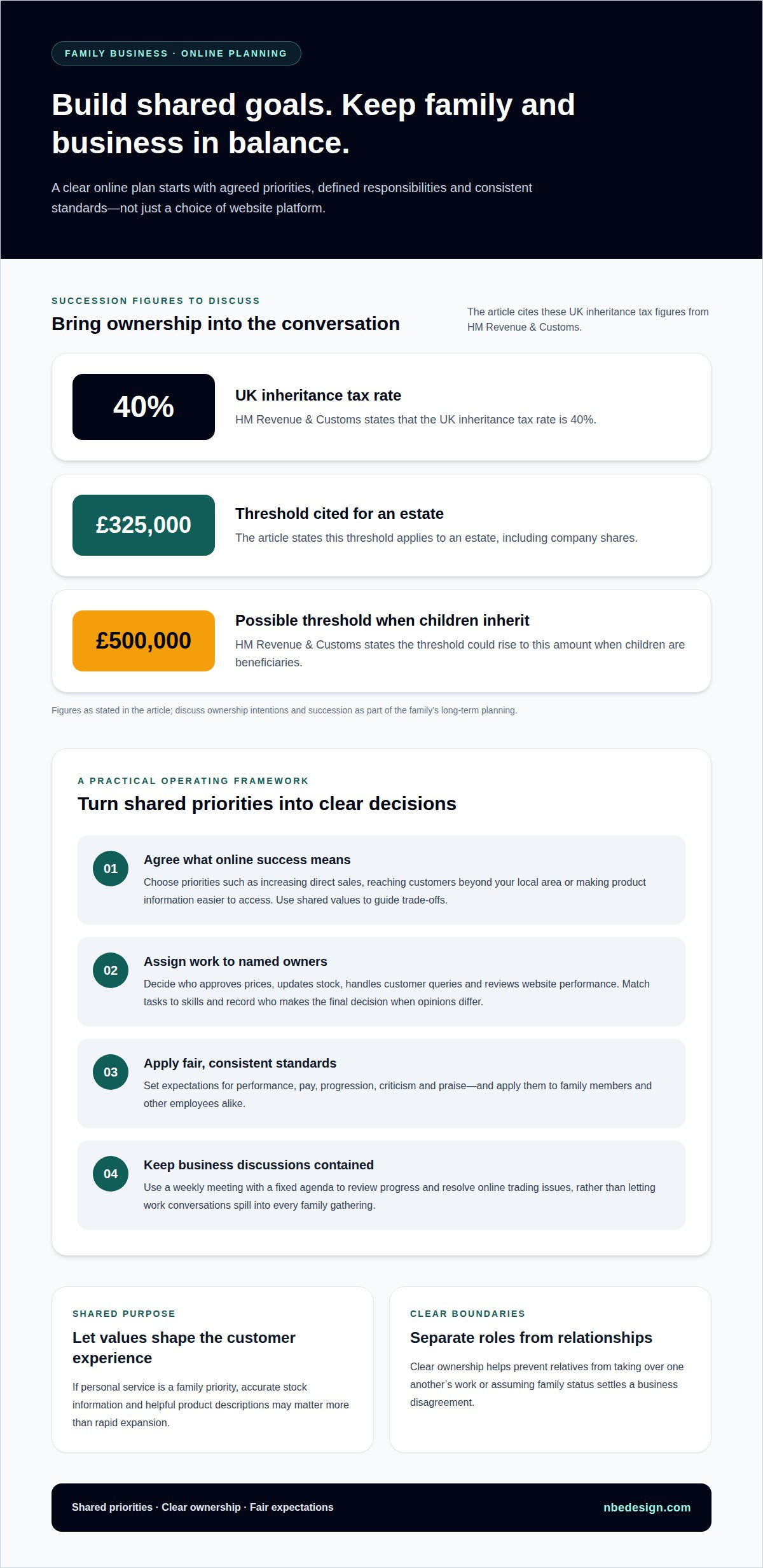
- Factor succession into family business discussions: HM Revenue & Customs states that the UK inheritance tax rate is 40%.
1. Agreeing shared business goals and values
Before choosing a platform or planning a launch, agree what the online business needs to achieve. In a family meeting, write down priorities such as increasing direct sales, reaching customers beyond your local area or making product information easier to access. Then choose a shared purpose to guide trade-offs. For example, a family that values personal service might prioritise accurate stock information and helpful product descriptions over rapid expansion.
Turn those priorities into practical responsibilities. Decide who approves product prices, updates stock, handles customer queries and reviews website performance. Match each task to the person’s skills, and record who makes the final decision if opinions differ. Use a weekly meeting with a fixed agenda to review progress and resolve online trading issues, rather than letting work conversations spill into every family gathering.
Set the same expectations for relatives and non-family employees. Agree how performance, pay, progression, criticism and praise will be handled, then apply those standards consistently. A family member who manages online orders should meet the same fulfilment expectations as colleagues. Clear roles also help prevent one relative from taking over another’s work or assuming that family status settles a business disagreement.
Include ownership and succession in discussions about long-term goals. HM Revenue & Customs states that the UK inheritance tax rate is 40%. HM Revenue & Customs gives £325,000 as the UK inheritance tax threshold for an estate, including company shares. HM Revenue & Customs states that the threshold could rise to £500,000 when children are beneficiaries. These figures make it useful to discuss ownership intentions alongside the practical work of running an online business.
How do you make a business website accessible, mobile-friendly and easy to find on Google? Use readable text, clear navigation, descriptive image text and buttons that work on touchscreens. Organise pages around customer needs, write specific product information and use relevant search terms naturally in page titles and content.
What are the best ways to market a small UK business online, including local SEO and social media? Keep your Google Business Profile accurate, use consistent business details and publish useful updates on social channels your customers use. Ask satisfied customers for honest reviews, and track which posts or pages lead to enquiries or sales.
How can a UK business protect its website and customer data from scams and cyberattacks? Use unique passwords, enable multi-factor authentication where available and restrict account access to people who need it. Train staff to spot suspicious messages, keep software updated and make regular backups of website and order data.
What are the risks of selling online, including VAT, delivery, returns and consumer rights? Plan how you’ll handle VAT records, delivery delays, damaged parcels, returns and customer complaints before taking orders. Set clear delivery and returns information, assign responsibility for resolving issues, and make sure your family understands the costs and workload involved.
3. How much does it cost to build and maintain a small business website in the UK?
There isn’t one reliable price for every UK small business website. A simple brochure site has different requirements from an online shop with product catalogues, stock control and checkout. Start by listing what the family business needs its website to do, then separate launch work from ongoing costs. If you’re working out how to get your family business online properly, this scope gives relatives a shared basis for comparing proposals and setting a realistic budget.
A website’s price depends on its requirements and is provided after a quote request. Key cost factors include the number of pages, design requirements, product data, payment and delivery settings, integrations, content preparation and migration of existing information. A shop with varied products and complex stock arrangements takes different planning from a small site displaying services and contact details. Agreeing the scope first helps avoid comparing proposals that cover different work.
Decide which building route fits your team’s time and technical confidence. A website builder may suit a business with a straightforward brief and someone available to manage the setup. A professionally designed and developed site may be a better fit when the family needs a distinctive customer journey, connected systems or tailored retail workflows. Each route has trade-offs: doing more in-house takes staff time, while specialist work can shape the project around agreed requirements.
Make a written cost plan before work begins. Separate the initial build from regular platform or hosting charges, domain renewal, payment processing, paid apps, content updates and technical support. Not every website needs every add-on. For example, a shop that sells through a physical counter may need stock synchronisation, while a service business may not need product-management tools. Assign an owner to each recurring cost and review whether it still supports a business goal.
Maintenance is a business responsibility, not just a technical line in a budget. Decide who will review product details, update opening hours, check contact forms and remove outdated offers. For an online shop, include time to check product availability, delivery information and checkout settings. A family member responsible for site updates should have access to the relevant accounts and a clear process for approving changes.
Before approving a proposal, ask for its scope in writing. It should explain the pages and functions included, what the business must supply, how changes are handled and which ongoing charges sit outside the build. Compare like with like, then agree who approves extra work. To get a family business online properly without leaving one relative responsible for every decision, assign project ownership and approval roles before work starts. If you’re defining the project scope for a family business website, you can discuss your website requirements and the outcomes you need.
4. Should a family business use Shopify, Wix, Squarespace or WooCommerce?
Choose a platform based on how your family sells, who will manage the website and which systems need to connect. Shopify is built for selling online, while Wix and Squarespace combine website building with commerce features. WooCommerce adds shop functionality to a WordPress website. Each can suit a different business, so compare the work involved as well as the design.
For a retailer managing products, orders and stock, Shopify offers a commerce-focused environment. Consider whether the team needs to coordinate online sales with a physical shop, maintain product information in one place or manage orders through a shared process. Map these requirements before selecting themes or adding features. A platform should support the way your family intends to run the operation, not simply reflect one relative’s design preference.
Wix or Squarespace may suit a family business whose website mainly introduces its services, shares opening details and generates enquiries. Their visual editing tools can help a non-specialist update pages. If the business also sells products, compare how each platform handles the catalogue, checkout and routine shop administration. The person responsible for updates should be comfortable completing these tasks alongside other family responsibilities.
WooCommerce can work for a business already using WordPress or wanting to build around that content-management system. The family should plan who manages hosting, updates, extensions and compatibility between components. More flexibility can mean more decisions to manage. Agree who owns those tasks before launch, especially if only one family member currently understands the website setup.
Use a practical comparison rather than choosing by familiarity. Ask each family member involved in the project to rank the business needs, then test the options against the same criteria:
- Sales: Does the platform support your products, checkout process and order workflow?
- Daily ownership: Can the person assigned to updates manage products, pages and customer enquiries?
- Retail operations: Do online orders need to connect with in-store stock or point-of-sale processes?
- Future changes: Can the setup adapt if the business adds products, channels or locations?
- Control: Who holds account access, approves changes and manages essential website data?
Run through a typical order before committing. For example, follow a customer journey from product discovery to checkout, then decide who handles the order and updates stock. This reveals gaps that a design preview won’t show. A written comparison can also prevent disagreement later, because the family can assess platforms against agreed needs instead of personal preferences.
If you’re clarifying the requirements before selecting a platform, you can discuss your website project with the team supporting your decision.
4. What UK legal requirements apply to business websites, including privacy policies, cookies and GDPR?
Plan privacy and cookie information before publishing a UK business website. The right approach depends on what the site collects and how it uses that information. A shop taking orders, for example, handles different details from a site that only provides a telephone number. Map each form, checkout field and tracking tool, then record its purpose and who can access the information.
A privacy notice should explain the business’s data practices in clear language. Describe what information customers provide, such as names, delivery addresses or enquiry details. Explain why the business uses it, how it is handled and how customers can raise a privacy question. Keep the notice aligned with the live website. If the family later adds an email sign-up form, update the explanation and the process behind it.
Cookies need deliberate planning, especially if the site uses analytics or advertising tools. Make an inventory of cookies and similar technologies, including which website feature uses each one and what it does. Distinguish essential site functions from optional tracking in the site’s design. Present choices clearly, avoid wording that pressures visitors and make it straightforward to change a choice later. A banner alone doesn’t explain the wider data practices.
Use GDPR as a practical framework for reviewing the customer journey. For each data field, ask whether it serves a defined purpose. For example, don’t request a telephone number on an enquiry form if email is sufficient to handle the enquiry. Set an internal retention process, restrict access to people who need it and keep records of the systems or suppliers that handle customer information.
Give website security a named owner. That person should manage account access, review who can export customer records and remove access when someone’s role changes. Use strong, unique passwords and multi-factor authentication where available. Create a clear response plan for a suspected breach, including who assesses the incident and who communicates with affected customers. The family business should also know which supplier to contact about a compromised website account.
Before launch, walk through the site as a customer. Submit an enquiry, create an account if offered, place a test order and review the cookie settings. Confirm that the privacy notice reflects each step and that the business can handle a request about personal information. Assign responsibility for future updates, so a new app, analytics tool or form doesn’t quietly change the website’s data practices. For complex processing, seek advice from a suitably qualified UK privacy professional.
5. What information must a UK business show on its website, such as company details and contact information
Make it easy for visitors to identify the business and understand who they’re dealing with. The details to display depend on the business structure and what the website does. A family retailer taking online orders has different customer interactions from a business site that only describes services. Treat the website as a clear source of business information, not simply a shop window.
Start with the business’s full trading name and a reliable way to get in touch. Add a monitored email address, a telephone number if customers can call, and a postal address appropriate for business correspondence. If the business operates from a shop, show its location and opening hours. Keep these details consistent across the website, order confirmations and customer service messages.
For a limited company, organise its identity details in an easy-to-find place, such as the footer or contact page. Include its registered company name, registration number and registered office address. Make clear if the trading name differs from the registered name. Visitors should be able to distinguish the company they’re buying from a family brand or shop name.
Online shops should explain the transaction before a customer commits. Show product descriptions, prices, delivery options and any relevant restrictions beside the products or during checkout. Set out how customers can contact the business about an order, and make returns information straightforward to find. For example, someone buying a stocked item should be able to understand the delivery arrangements before placing an order.
Keep policies aligned with the way the business actually operates. A returns page should describe the process the team follows, including how customers start a return and where they can find help. A privacy notice should reflect the information collected through order forms, account registration and enquiries. If the family changes its delivery process or adds a customer form, review the relevant pages and messages.
Use a simple pre-launch review. Ask someone outside the family to find the business name, contact details, delivery information and returns process. Then check every link on a phone and desktop, and compare the pages with the checkout and order emails. Assign one person to keep business details current when opening hours, contact routes or trading information change.
These steps improve clarity, but they aren’t a substitute for assessing requirements specific to the company and its sales. If your family is planning a Shopify store and needs help shaping its business information and customer journey, discuss your Shopify website project.
A UK limited company is a separate legal entity, independent of its owners; shareholders’ liability for company debts is limited to what they have paid or agreed to pay for shares. UK law does not require a private limited company to have a company secretary.
In the UK, a limited company is generally considered family-run when the owner or family members hold at least 25% of its voting rights. The article states that Business Relief can provide up to 100% tax relief on qualifying shares in a private limited company. Gary Vaynerchuk says he grew his family’s liquor-store business into a company with 60M in revenue.
NB eCommerce & Design: Shopify Store Design & Development
NB eCommerce & Design provides Shopify Store Design & Development for family businesses ready to turn agreed goals into a clear online retail experience. We can shape the store around your products, customer journey and day-to-day responsibilities, giving the family a practical foundation for managing online sales.
If you already sell online, Shopify Migration Services can support a move to Shopify. For retailers combining an online shop with a physical counter, Shopify POS Integration can connect the two parts of the operation. These options are relevant when your next step involves building a store, moving platforms or bringing online and in-store retail together.
To discuss your family business’s Shopify project, contact NB eCommerce & Design.
Make your next online move a shared decision
A family business doesn’t need to solve every digital challenge at once. Choose a practical next step, agree who will lead it and decide how the family will judge whether it’s working. A representative customer journey can help: consider how someone discovers a product, gets their questions answered and completes an order. Use that experience to identify what needs attention first.
If you’re deciding how to get my family business online properly, keep the decision grounded in your business priorities and how your family wants to work together. A new Shopify store, a move to Shopify or connecting online and in-store sales each calls for a different project focus.
NB eCommerce & Design can help with Shopify Store Design & Development, Shopify Migration Services and Shopify POS Integration. Discuss your Shopify plans with NB eCommerce & Design and take the next step with a clearer direction.
Frequently Asked Questions
What are the steps to take a UK family business online?
Take a UK family business online by turning agreed priorities into a manageable launch plan. Choose the first products or services to feature, gather approved descriptions and photographs, and decide whether to use a new or existing domain. Select a suitable platform, prepare the site content, then review the full customer journey before launch. Afterward, record enquiries and orders so the family can decide what to improve next.
How can a UK family business set up online payments and handle refunds securely?
Plan payment settings and processing costs as part of the website scope, and restrict account access to people who need it. Set clear returns information and assign someone to handle refunds and customer complaints. Use unique passwords and multi-factor authentication where available.

- Posted in:
- business planning
- e-commerce
- family business
- family relationships
- how to get my family business online properly
- online retail
- Shopify
- succession planning
- website platforms