Skip to content

Ecommerce consultant in Middlesbrough: fees and project scope
-
2973 words · 14 min read

The cost of an ecommerce consultant in Middlesbrough depends on the project, not simply your location. A focused store update, a new Shopify build and a migration involve different work. NB eCommerce & Design provides a quote based on the project requirements.
It’s reasonable to want a clear view of the work before committing, especially when your store needs to handle stock, orders or in-store sales. Start by identifying the challenge you want to solve. The right support might be a targeted improvement, a new store or a wider project connecting online and physical retail.
This guide explains the main consultancy options for B2B and B2C businesses, what can shape project scope and fees, and the integrations to consider. You’ll also see where store design, migration and point-of-sale integration fit, so you can identify the next step that makes sense for your business.
Key Takeaways
- Project fees depend on the scope of work, including planning, implementation and ongoing optimisation. A clearly defined brief helps establish what the project needs to cover.
- Assess a consultant’s experience by looking at how their approach aligns with your business goals and the work your store requires.
- B2B and B2C businesses have different sales and order-management needs, so integrations should support the way each business operates.
- Platform expertise matters: consider how a platform’s capabilities fit your current setup, future plans and required integrations.
- For a new store, a migration or joined-up online and in-store selling, identify the specific outcome you need before deciding on the project scope.
Consultation, planning, implementation and optimisation
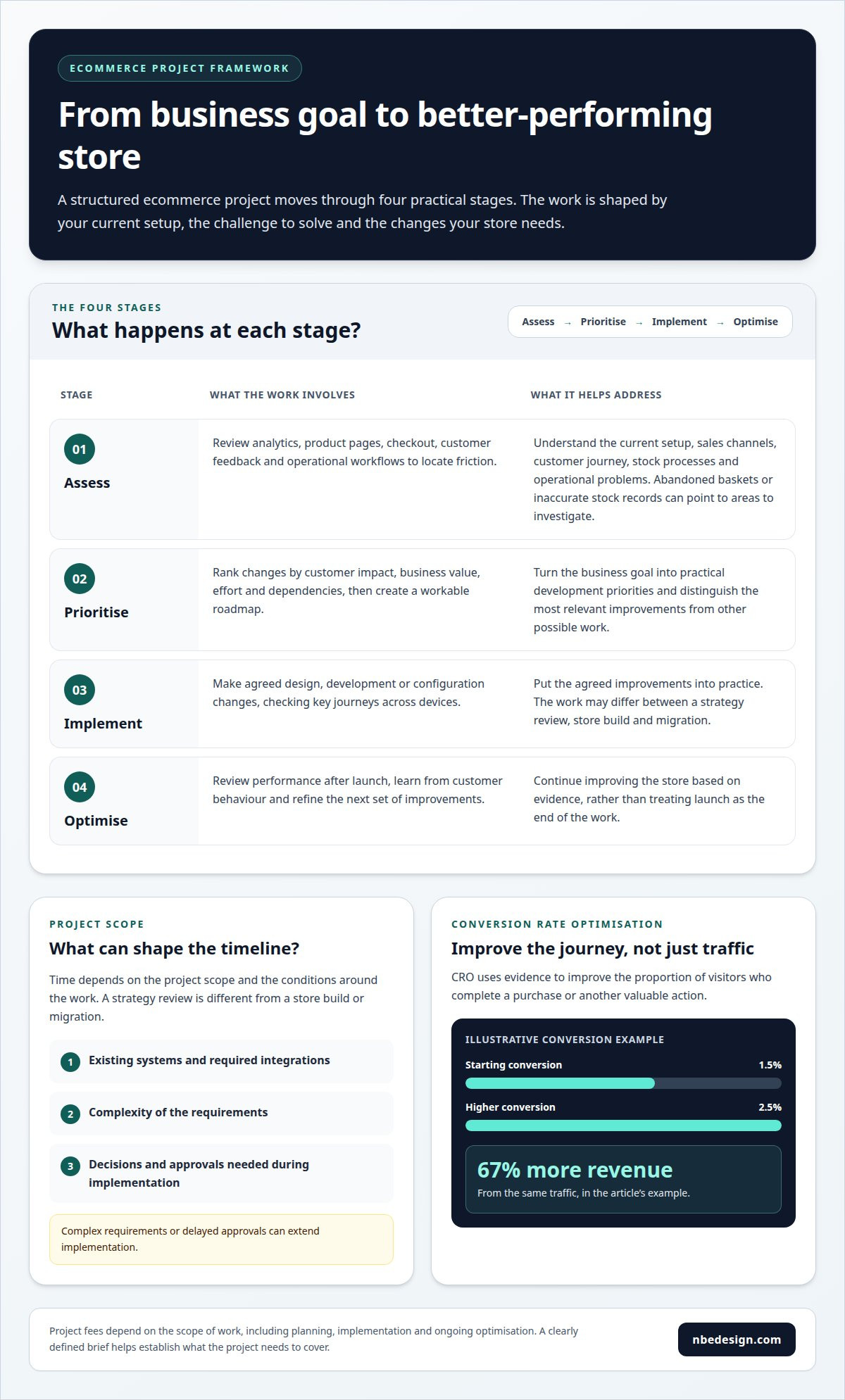
A useful ecommerce consultation turns a business goal into practical development priorities. It starts with your current setup, including sales channels, the customer journey, stock processes and operational problems. From there, the work can identify improvements and set out a roadmap. For example, a retailer with abandoned baskets might need clearer delivery information, while inaccurate stock records could point to a need for better inventory processes.
How long does an ecommerce strategy or website project take? It depends on the scope, existing systems, integrations and decisions required. A strategy review is different from a store build or migration, and complex requirements or delayed approvals can extend implementation.
A structured project typically moves through four practical steps:
- Assess: Review analytics, product pages, checkout, customer feedback and operational workflows to locate friction.
- Prioritise: Rank changes by customer impact, business value, effort and dependencies, then create a workable roadmap.
- Implement: Make agreed design, development or configuration changes, checking that key journeys work across devices.
- Optimise: Review performance after launch, learn from customer behaviour and refine the next set of improvements.
Conversion rate optimisation (CRO) uses evidence to improve the proportion of visitors who complete a purchase or another valuable action. As an illustration, increasing conversion from 1.5% to 2.5% adds 67% more revenue from the same traffic. That example shows why improving an existing funnel can deserve attention alongside acquiring more visitors. A £10k Meta spend, for instance, may be less valuable than fixing a checkout barrier, depending on the store’s circumstances.
Merchandising and user experience (UX) shape how easily shoppers find and choose products. A review can cover category structure, search, filters, product descriptions, imagery and calls to action. For example, placing delivery details near product choices can answer a common question sooner. On mobile, simpler navigation and fewer unnecessary checkout steps can make the path to purchase clearer.
Can local consultants help with SEO, paid advertising and conversion optimisation? Services differ, so clarify whether your project needs recommendations, implementation or ongoing analysis. SEO supports discoverability, paid advertising brings visitors through campaigns, and conversion rate optimisation (CRO) improves the experience after they arrive. These activities are related, but they require different expertise and should be scoped accordingly.
Consultant experience and client work
The most relevant experience is experience that matches your platform, trading model and business challenge. A consultant who has managed migrations may understand product data transfers and redirects, while another may specialise in customer journeys or merchandising. Look for clear evidence of the skills your project needs, rather than relying on a long service list.
Case studies can reveal how a consultant approaches real work. One reported project gained more than 14,000 Google rankings within 12 months. Another analysed 76,000 unique user journeys to identify patterns linked with conversions. These figures are useful context, but they don’t explain the work by themselves. Read for the starting problem, actions taken, timeframe and measured outcome.
Client testimonials can offer insight into communication, problem-solving and collaboration. A case study should explain the project and its outcome. For example, a testimonial about a smooth migration is more useful alongside details about the data, systems or customer journeys involved. Look for specific observations, not just broad praise.
Some UK consulting-firm rankings combine survey reviews from clients and consultants with a capabilities assessment, giving each equal weighting. Survey feedback reflects reported working experiences; a capabilities review considers expertise and service strengths. Rankings can provide context, but they cannot show whether a consultant’s skills and approach suit your project.
What should you ask before hiring an ecommerce consultant? Clarify who will deliver the work, what the project includes, how progress will be measured and what your team needs to provide. Ask for a relevant example and how its approach relates to your goals, platform and operational constraints.
- Check fit: Match past work to your platform, project type and business model.
- Read evidence: Compare the case study’s starting point, actions and outcomes.
- Review feedback: Look for concrete comments about communication and delivery.
- Clarify scope: Agree deliverables, responsibilities, measures and decision points.
For a store design or development project, a conversation about your project requirements can help clarify the skills and scope involved.
Testimonials can add detail about a consultant’s experience and working relationships. One client testimonial states that Adam Pritchard had over 15 years of experience across eCommerce design, development and ongoing analysis; its writer had known him for over 8 years. James Gurd has 20+ years of ecommerce experience, while ecommerce consultant Ian Rhodes says he has 27 years of experience in ecommerce.
A specific account of collaboration can help clarify the work involved: Jonathan Cummins worked with James for over 18 months, primarily on building and optimising a remarketing strategy. As of May 2026, the global survey database spans 5,000 client reviews, offering a broader pool of reported client experiences to consider alongside project details.
Ecommerce consultancy for B2B and B2C organisations
B2B and B2C ecommerce share a digital storefront, but serve different buying processes. A B2C customer may choose one product, pay immediately and expect clear delivery updates. A B2B buyer may need repeat ordering, account-specific terms or approval before purchase. Consultancy starts by mapping those journeys, then identifying which platform functions and operational changes support each one.
For B2C retail, the review often follows a shopper from product discovery through checkout. For example, a customer might browse a category, compare product details, select delivery and pay. Each step can expose friction: unclear stock, confusing delivery choices or missing product information. Optimisation should prioritise the point that most disrupts the actual buying journey, rather than adding features without a clear purpose.
B2B workflows need a different operational lens. A consultancy can analyse existing order systems and consider automation for order management and deliveries. For example, a buyer placing a repeat order may need a straightforward way to find familiar products, while staff need accurate order details for fulfilment. Mapping how orders move from submission to dispatch helps reveal hand-offs, duplicated entry and delays between teams.
When a business serves both online and in-store customers, decisions need to account for each channel. A single platform may support shared processes, while customer journeys, product visibility or ordering rules may need different handling. A useful roadmap connects those choices to daily tasks such as product updates, stock control, customer service and delivery coordination.
Consultancy can also clarify how systems should connect. Order management, stock records and delivery processes need consistent information to support fulfilment. The right integration depends on your existing systems, the data they exchange and who acts on it. For example, order-status changes should be clear to the people handling packing and customer updates.
- Map each journey: Record how a B2C shopper purchases and how a B2B buyer places or repeats an order.
- Trace the order: Follow information from checkout through management, fulfilment and delivery.
- Separate shared and distinct needs: Decide which processes work across both audiences and which require different handling.
- Prioritise by impact: Link each proposed change to a specific customer, operational or growth need.
Helping both models grow means joining customer experience with workable operations. A B2C checkout improvement won’t resolve a B2B order-handling bottleneck, and automating fulfilment won’t clarify a confusing product page. Consultants assess those issues separately, then coordinate decisions into a practical programme. That gives teams a clearer basis for choosing what to implement first and how to assess its effect.
Which ecommerce platforms do local consultants focus on?
An ecommerce consultant in Middlesbrough may specialise in a particular platform or project type. NB eCommerce & Design focuses on Shopify store design and development, migrations to Shopify and Shopify POS integration. Match that expertise to your current store, sales model and growth plans before deciding on a project.
Shopify is one platform businesses may consider for online retail. Before recommending any platform, a consultant should assess how you sell, what your team needs to manage and which systems must connect. For example, a retailer with a physical shop may need online and in-store sales to work together. A B2B business may prioritise how orders and customer accounts fit its existing operations.
Choosing a platform means considering the whole setup: product information, stock processes, order handling, customer experience and future development. A platform that suits a small catalogue may not fit a business with complex workflows. Moving platforms also involves work on data, content, design and integrations, all of which affect the project scope.
A practical assessment can follow these steps:
- Map the current setup: Record the platform, key systems, sales channels and processes used by staff.
- Define business needs: Separate essential requirements from features that would be useful later.
- Review integration needs: Identify where product, order, stock or customer information needs to move.
- Plan the transition: Set out design, development, data and testing tasks before implementation begins.
Ask how the consultant’s platform expertise relates to your situation. A portfolio can show store design and development, but the discussion should also cover operational needs. A retailer opening a new online channel faces different decisions from a business replacing its existing platform. The roadmap should explain what happens first and how each step supports the intended outcome.
Platform choice also affects ongoing improvements. Navigation, product presentation and checkout depend on how the platform is configured and how customers use it. A consultant familiar with your chosen system can connect design decisions with everyday retail needs. The aim is not to choose the same platform as every other business, but to assess the fit before development or migration.
For a Middlesbrough business, local access can make project conversations easier, but location alone does not establish technical suitability. Compare the consultant’s platform experience with your requirements, such as store design, migration planning or connecting online and in-store operations. A clear scope, responsibilities and decision-making process help you assess the proposed approach.
Do Middlesbrough ecommerce consultants work with startups and small businesses?
Some consultants work with startups and smaller retailers, while others focus on established brands. The right fit depends on the project, available resources and business stage. A startup preparing its first online shop needs different support from a retailer improving an established store. Define the immediate problem before choosing specialist help.
Consultancy can be useful before launch, when founders need to turn product and operational decisions into a workable ecommerce plan. A consultant can help assess platform requirements, customer journeys, product information and order fulfilment. A small retailer moving from in-person sales online, for example, may need to organise its catalogue and stock processes before adding sales channels.
Support can focus on a specific task rather than a broad transformation. A small business might need an assessment of its current store, a design refresh or guidance on a migration. A defined scope keeps attention on the immediate issue, while a roadmap separates essential launch requirements from later improvements. This is especially useful when time and internal capacity are limited.
Consultant specialisms vary, and not every firm targets early-stage businesses. One stated North East focus is direct-to-consumer and retail brands generating £500k-£20M online. That gives a useful example of how a consultancy may define its ideal client, but it isn’t a universal threshold for ecommerce advice. Startups and smaller firms should look for a project approach that matches their current stage and goals.
Before work begins, clarify the decisions that affect the project. A startup might need to choose which products to launch first, who will maintain product details and how orders will be handled. A small retailer may already have those processes but need to identify where its online store creates friction. In both cases, realistic priorities make the project easier to plan.
- Set the goal: Identify the outcome, such as launching online or improving a specific customer journey.
- Describe the operation: Explain how products, stock, orders and customer enquiries are handled today.
- Define responsibilities: Establish who supplies content, makes decisions and manages the store after delivery.
- Agree priorities: Separate launch-critical work from improvements that can follow later.
For a startup, the right first step may be planning a focused project rather than building every possible feature. For a growing retailer, it may be addressing an operational or customer-experience issue before expanding. Discuss your ecommerce project requirements to identify a suitable starting point.
NB eCommerce & Design
NB eCommerce & Design helps retailers turn ecommerce priorities into practical Shopify projects. For a new or improved online store, Shopify Store Design & Development shapes the storefront and customer experience. Shopify Migration Services support the move from another platform, while Shopify POS Integration connects online and in-store operations.
The right starting point depends on your current store, systems and goals. A focused discussion can help define the project scope and identify which of these services fits your needs. If you’re ready to discuss your ecommerce project, contact NB eCommerce & Design.
Set your next ecommerce project in motion
Choosing an ecommerce consultant in Middlesbrough is an opportunity to turn business priorities into a practical project, rather than tackling every store challenge at once. Start by identifying the change that would make the biggest difference to customers or daily operations. A focused conversation can clarify the work involved and how it fits your plans.
NB eCommerce & Design provides Shopify Store Design & Development, Shopify Migration Services and Shopify POS Integration. These services support businesses launching a Shopify store, moving an existing store or connecting online and in-store selling. The right project depends on what you want your ecommerce setup to achieve.
You don’t need to have every technical decision settled before starting. A clear outline of your current setup, priorities and challenges is enough to begin a useful discussion. From there, you can define a project scope that reflects your business and gives your team a considered way forward.
Ready to discuss your next step? Contact NB eCommerce & Design to talk through your ecommerce project and move ahead with confidence.
Frequently Asked Questions
How much will this cost?
The project cost is provided after a quote request. A focused store update differs from a new build or migration because the work, systems and responsibilities differ. Scope, the existing platform, data requirements, integrations and design needs all affect the estimate. Defining the intended outcome and deliverables gives the quote a clear basis.
What is eCommerce consultancy?
Ecommerce consultancy helps a business make informed decisions about online selling. A consultant can assess how a store, platform and connected processes support the business, then recommend practical changes. For example, a retailer preparing to sell online may need to plan store structure, product information and order handling. The work can focus on strategy, implementation or guidance for a specific project.
Which ecommerce consultants serve Middlesbrough and Teesside?
An ecommerce consultant in Middlesbrough can help when their expertise matches the project. NB eCommerce & Design focuses on Shopify store design and development, Shopify migrations and Shopify POS integration. These services suit retailers planning a new Shopify storefront, moving an existing store or connecting online and physical retail operations.
What ecommerce services do Middlesbrough consultants offer?
Services vary by consultant and specialism. For example, an ecommerce consultant in Middlesbrough may focus on a particular platform or project type. NB eCommerce & Design offers Shopify Store Design & Development, Shopify Migration Services and Shopify POS Integration. A retailer planning a new Shopify storefront, changing platforms or connecting online and in-store sales can consider which area fits its project.
How are ecommerce consultancy fees determined?
There isn’t one fee for every project. NB eCommerce & Design provides an estimate after a quote request, based on the agreed deliverables, technical complexity, existing systems and any migration or integration work. A defined scope distinguishes essential tasks from later improvements and makes clear what the proposed work covers.
How can I compare ecommerce consultants in Middlesbrough by reviews and results?
Compare evidence with the work your business needs. Look for reviews with specific details about communication, decisions and delivery, then consider project examples that explain the original challenge and outcome. Results are most useful when the context is clear and relevant to your situation. Also assess whether the consultant’s platform expertise and project approach match your store and operational needs.

- Posted in:
- B2B ecommerce
- ecommerce consultant middlesbrough
- ecommerce consulting
- ecommerce migration
- ecommerce project costs
- Middlesbrough
- POS integration
- Shopify