Skip to content

Can my ecommerce idea sell, and how can I reduce the risk?
-
3175 words · 15 min read

An ecommerce idea doesn’t need certainty to earn a test. The fear that my ecommerce project will fail is understandable, but it doesn’t have to decide what happens next. You can look for evidence that customers will buy before committing more time and money.
It’s natural to worry about weak sales, cash running short or a supplier letting you down. The useful question isn’t how to remove every risk, but which uncertainty to investigate first and what a small test can teach you.
This article explains how to test demand, assess cash-flow and supply risks, and prioritise the questions behind your concerns. You’ll also learn how to set manageable goals and use what you discover to decide whether to refine your offer, take the next step or pause. No practical approach can guarantee success, but it can help you make a clearer decision with less guesswork.
Key Takeaways
- Use small, low-commitment tests to learn whether customers are interested before making a larger investment.
- Turn worry into a practical experiment: set a clear goal, track what happens and use the result to decide what to change.
- Map out cash-flow scenarios and consider how a supply disruption could affect stock and sales.
- List your biggest unanswered questions, then prioritise them by how much they could affect the business.
- Recognise common causes of ecommerce setbacks so you can address weak points before they grow.
1. What causes fear of failure?
Fear often grows when an ecommerce idea feels like one large, irreversible decision. You may imagine ordering stock, building a shop and receiving no orders. That picture combines several risks before you’ve tested any of them. If you fear your ecommerce project will fail, break the decision into smaller steps. First, describe the product and intended customer; then ask potential buyers what they would need before purchasing. A specific action gives you evidence to consider instead of another reason to delay.
Perfectionism can make the first step feel harder than it is. You might spend weeks refining product descriptions or choosing colours before finding out whether anyone wants the product. Set a small, realistic goal instead, such as drafting a product page or sharing a clear offer with a small group of likely customers. Treat the result as information, not a verdict on your ability. A launch that attracts little interest can still show what needs changing, such as the value proposition, product explanation or intended audience.
At work, fear of failure can lead to avoiding a decision, delaying a test or presenting an idea only when it seems flawless. Choose one contained experiment with a clear question: will customers understand this offer, or will they ask for a different option? Write down what you expect to happen, what you will observe and what result would prompt a change. The 5-second rule can help interrupt overthinking: when you notice yourself postponing a manageable action, count down from five and begin the first practical step.
Reframing failure means examining the gap between what you expected and what happened. After a product launch, record what worked, what didn’t and what you would repeat or change. If visitors ask questions but don’t order, for example, the offer may need clearer information. If they show little interest, revisit who the product is for and how you introduce it. This distinguishes a poor result from failing to experiment or learn. Each test should leave you with a decision, not just a feeling.
Past setbacks can also guide your next attempt. Look back at a previous project or decision and identify the assumption that proved wrong, the warning sign you missed and what you would do earlier now. Write a short record you can consult before your next test. Small actions build confidence through practice, while realistic goals keep the work manageable. The aim isn’t to remove every risk before acting; it’s to learn enough to choose your next step carefully.
Seeking advice while testing ideas yourself
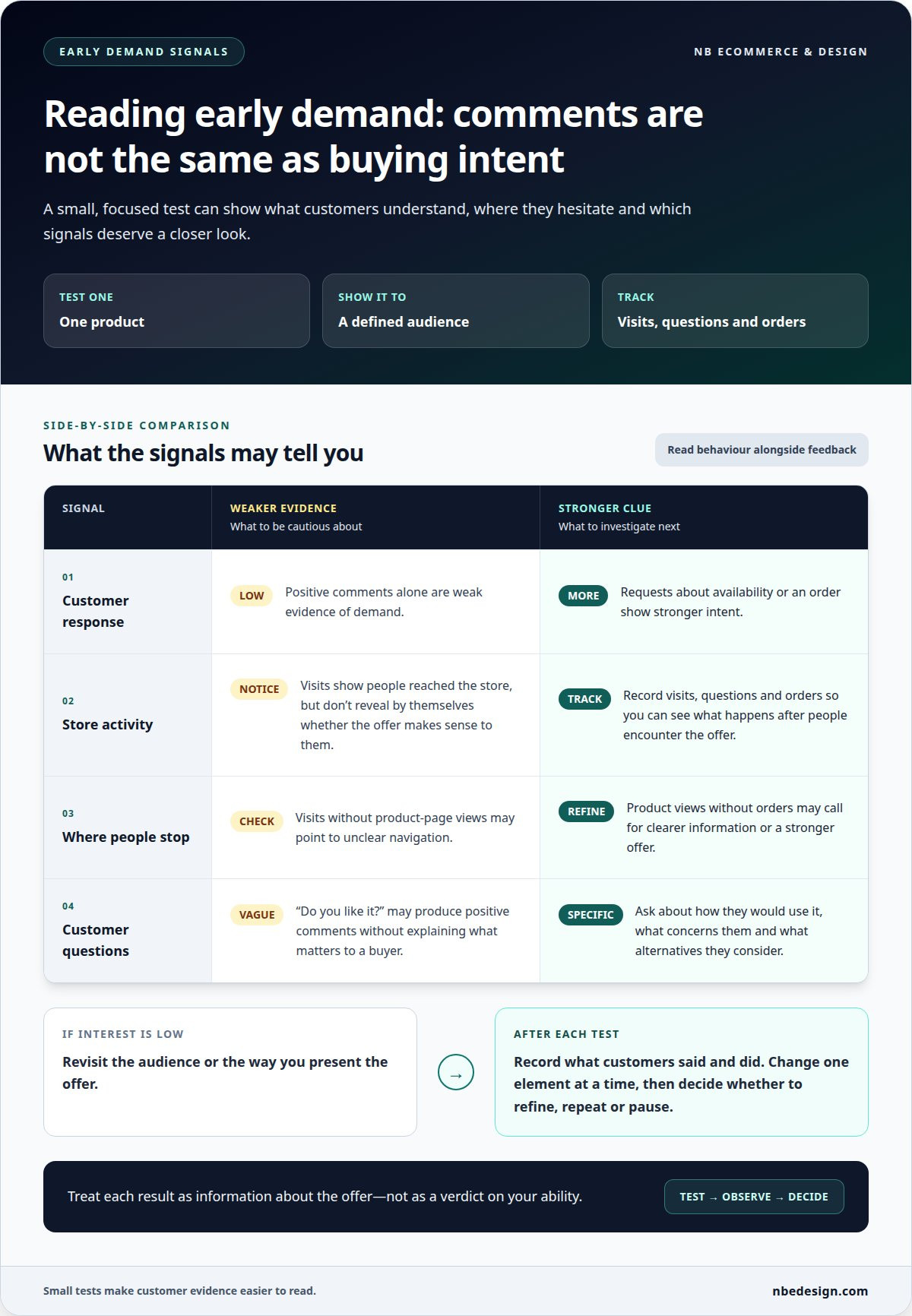
To validate product demand, show likely customers a clear offer and ask what would make them buy. A sample, prototype or simple product page can reveal whether people understand the product and want to take the next step. Ask specific questions about use, concerns and alternatives, rather than “Do you like it?” Positive comments alone are weak evidence; requests for availability or an order show stronger intent.
To test a store on a small budget, keep the experiment focused. Present one product to a defined audience, offer a simple way to express interest, and track visits, questions and orders. Avoid investing in a large range before you know which offer attracts attention. Testing before leaving your day job can also reduce pressure on early results and give you room to adjust.
Choose someone you trust who can listen without taking over the decision. Explain the situation, the customer you hope to serve and the evidence you’ve collected. Ask them to challenge one assumption, such as whether the product solves a real problem or the offer is clear. A practical conversation should leave you with a question to test, not someone else’s business plan.
If your store isn’t getting sales, first locate where potential buyers stop. For example, visits without product-page views may point to unclear navigation, while product views without orders may call for clearer information or a stronger offer. Ask a few potential customers to describe what they expected and what confused them. Then change one element at a time, so the next test helps identify what matters.
Feedback is useful when it leads to a decision. Record what customers said, what behaviour you observed and what you’ll change or repeat. If people like the product but hesitate over delivery details, clarify them before testing again. If interest remains low, revisit the audience or proposition rather than treating rejection as a personal judgement. No single method suits every idea, so use advice to sharpen your experiment, not replace it.
Feeling afraid of a poor result is understandable, but a limited test makes the decision more manageable. Share the offer with a trusted person, gather customer responses, then decide whether to refine, repeat or pause. If the evidence supports building a storefront, you can talk through your Shopify store design project as the next practical step.
3. Building cash reserves and alternative supply options
A cash-flow plan helps you see how long the business can operate under different sales conditions. Record expected income alongside costs for stock, packaging, postage, the platform and other operations. Then compare a stronger-sales scenario with a slower one. If orders arrive later than expected, for example, note which bills still fall due and when available cash could become tight.
A forecast can make potential cash problems visible early enough to act. Update it when an assumption changes, such as a supplier raising a price or a customer paying later. Separate confirmed orders from hoped-for sales, so the plan doesn’t treat interest as money received. This gives you a clearer view of what you can commit to and when you may need to delay a purchase or reduce spending.
Set a reserve by working backwards from the costs the business must meet during a disruption. List essential outgoings, then consider how long sales could take to recover if stock were delayed. The right reserve depends on your costs, payment timings and stock model, so an arbitrary target can mislead. A retailer holding costly stock, for example, may need a different cash buffer from one producing items only after orders arrive.
Supplier risk needs its own plan. Identify products or components that rely on one source, then record what would happen if that supplier couldn’t deliver. A second source may offer an alternative, while a substitute product or smaller initial order could limit the impact. Before relying on a backup, compare practical details such as product consistency, minimum order requirements and delivery arrangements.
Think through the entire route from supplier to customer. A late component can postpone production; a missed delivery can leave a product unavailable during a busy sales period. For each key product, note the supplier, expected replenishment process and possible substitute. If a backup source can’t provide the same item, decide whether customers might accept a different specification or would prefer a clear update and a later order.
Cash reserves and alternative suppliers support each other. A sudden replacement order may require funds before the original stock sells, so include that possibility in your forecast. For example, model the cost of replacing delayed stock while sales are slower than planned. This helps you decide whether to hold more cash, reduce reliance on one product or wait before expanding the range.
Review the plan whenever something significant changes, such as a new supplier, product or sales channel. Write down a trigger for action, such as pausing a stock order when projected cash falls below essential upcoming costs. That turns a vague sense of risk into a decision you can make in advance. A clear reserve plan and a workable supply alternative can build confidence without assuming every forecast will go to plan.
Listing and prioritising business uncertainties
Unanswered questions can feel like one large threat until you write them down. Divide a page into customer demand, stock, cash, fulfilment, website and compliance. Under each heading, record one specific uncertainty. “Will customers understand the product size?” is more useful than “Will the shop fail?” Specific wording points towards an action or decision.
Next, rank each question by its potential impact and how soon you can investigate it. A product’s suitability for customers may matter more than a packaging preference. Mark each uncertainty as high, medium or low impact, then note what evidence you need. A short customer conversation could test product clarity; a supplier discussion could clarify replenishment. Prioritise questions that could change your next commitment.
For each priority, write down what could happen, what would indicate it and what you would do. If visitors view a product but don’t add it to their basket, for instance, review the description and delivery information before ordering more stock. Keep negative possibilities realistic: a delay may mean lost sales, not necessarily the end of the business. Revisit the list after a day or two, when fresh questions may surface.
UK ecommerce legal and tax considerations depend on your business structure and products. Map relevant areas, including business registration, tax, customer information, privacy and product-specific obligations. Identify which apply to your situation before trading.
Paid adverts can bring visits without sales, while spending continues as you learn. Before running a campaign, define the product and audience, set a spending limit you can afford, and decide what evidence would justify continuing. Track whether visitors view products and complete orders, rather than judging success by clicks alone. If a campaign attracts traffic but no purchases, review the offer and customer journey before increasing spend.
Use evidence and decision points set in advance to choose whether to pivot, pause or close. Pivot when customer feedback points towards a clearer audience, product or offer. Pause when a key uncertainty remains unresolved, cash is under pressure or a supplier issue blocks fulfilment. Consider closing when repeated tests show weak demand and the remaining costs or commitments outweigh a credible route forward. Write down your reason before making the change, so fear alone doesn’t set the direction.
Keep the list active as the business changes. A new product, supplier or sales channel can create fresh unknowns, while customer questions may resolve older ones. Review each item against evidence, not how scared you feel that day. This turns uncertainty into practical decisions and helps you focus on the next risk that matters most.
5. What are the most common reasons ecommerce businesses fail?
There isn’t one cause behind every ecommerce setback. Problems often develop when several weak points reinforce each other. A product with unclear demand may come with high operating costs, while a confusing shop makes each sale harder to win. Look for connections between symptoms, not just the most visible problem. Low repeat orders, for example, could reflect product fit, the delivery experience or expectations set before purchase.
A weak customer proposition makes it difficult for shoppers to understand why they should buy. If a product page lists features but doesn’t explain who the product helps, visitors may leave without seeing its value. Compare the promise in your product description with the questions customers ask before buying. If they repeatedly misunderstand the same detail, improve the explanation and see whether their response changes.
Poor margins can make sales look healthier than the business really is. A retailer might count revenue but overlook product costs, packaging, payment charges, postage, returns and other running expenses. Review the full cost of fulfilling a typical order, then compare it with the amount left from that sale. If little remains, more orders could increase the workload without improving the business’s financial position.
Friction in the buying journey can stop interested visitors from becoming customers. Unclear delivery details, missing product information or a difficult checkout can create hesitation. Walk through a purchase from a customer’s perspective and note where a decision becomes harder. Separate a technical issue, such as a broken link, from a communication issue, such as an unclear returns explanation. Each needs a different fix.
Operational weaknesses can damage trust even when the product attracts interest. Inaccurate stock records may lead a retailer to accept orders for unavailable items. Unclear dispatch processes can result in inconsistent customer updates. Map the steps from order receipt to delivery, then identify where information or responsibility gets lost. A simple process for updating stock and communicating delays can prevent avoidable confusion.
Another risk is changing too many things at once. If you alter the product, audience, prices and website together, you won’t know which change affected customer behaviour. Choose the most plausible cause, make a focused adjustment and review the response. Keep a record of the decision and what followed, so the next change builds on evidence rather than guesswork. If your review points to storefront structure or the buying journey, talk through your ecommerce project.
NB eCommerce & Design
NB eCommerce & Design helps retailers turn a tested ecommerce idea into a practical Shopify setup. If your next uncertainty is how to build a clear, easy-to-use storefront, Shopify Store Design & Development can support that step. For an existing business moving to Shopify, Shopify Migration Services help with the platform transition. Retailers connecting online and in-store operations can also consider Shopify POS Integration.
These services address your store’s design, platform and sales-channel setup. They don’t replace customer research or a cash-flow plan, but can help when you’re ready to put your next business decision into practice.
Contact NB eCommerce & Design to discuss your ecommerce project.
Take your next step with greater clarity
Choose one decision that would move your ecommerce idea forward, then decide what support would make that step easier. The fear that my ecommerce project will fail can make every choice feel final, but your next move can be specific: shape the storefront, move an existing shop or connect online and in-store operations. A clear technical foundation gives you a practical place to apply what you’ve learned about your customers and business.
NB eCommerce & Design provides Shopify Store Design & Development, Shopify Migration Services and Shopify POS Integration. These options support different stages of a retailer’s setup, from creating a new Shopify store to switching platforms or linking sales channels. Consider which task is now standing between your business and its next considered step.
You don’t need to resolve every uncertainty before moving forward. Focus on the decision in front of you and choose support that fits the work you’re ready to undertake.
Discuss your next step with NB eCommerce & Design and keep building with purpose.
Frequently Asked Questions
Can I sell?
You can sell if customers understand your offer, can buy through a workable process and receive what they expect. Before committing to a broad range, consider whether one clearly described product solves a specific customer problem. A retailer selling reusable lunch containers, for example, could test whether shoppers value portability, leak resistance or easy cleaning most. Their responses can help shape the offer and identify who is most likely to buy.
How long will the money last?
Estimate your cash runway by comparing available business cash with forecast net outgoings. Include regular expenses, stock purchases, payment timing, tax set-asides, refunds and money you need to draw from the business. Then model a slower-sales period and note when cash could become tight. A forecast is more useful when you update it after changes, such as a supplier invoice arriving earlier or a planned order being delayed.
What causes fear of failure?
Fear of failure can grow when an outcome feels personal, costly or difficult to reverse. A new retailer might worry that poor sales will prove the idea was misguided, even though the result could reflect the product description or audience instead. Unclear expectations can intensify that worry. Name the feared outcome, identify what could make it happen, and distinguish evidence from assumptions before deciding what to do.
What is atychiphobia?
Atychiphobia is an intense fear of failure that can interfere with everyday activities and decisions. It is different from ordinary concern about a business risk: the fear may make routine tasks, such as sharing an offer or making a decision, feel overwhelming. A healthcare professional considers the symptoms, how long they have been present and their effect on daily life when assessing the concern. There isn’t a diagnostic test for fear of failure.
Will I lose the house if it all goes wrong?
A failed ecommerce business doesn’t, by itself, determine whether your home is at risk. Relevant factors include your business structure, borrowing agreements, any personal guarantee and whether property secures a debt. Before taking finance or signing an agreement, understand which assets and people are legally responsible for repayment. If you already have a commitment you’re worried about, review its terms with a UK solicitor or accountant.
Will they buy?
Positive comments alone can’t tell you; look for behaviour that shows customers are willing to take the next step. Ask likely buyers to choose between specific options, join a waiting list or place an order you can fulfil. Note who responds and what concerns they raise. If people praise the idea but avoid committing, investigate whether the offer, timing or product details are holding them back.
How can I assess whether my ecommerce project has product-market fit?
Look for evidence that a defined group repeatedly chooses your product because it meets a real need. Consider whether customers return, recommend it, understand its value without extensive explanation and continue buying when an introductory offer ends. Review returns and complaints alongside sales, since repeat orders alone can hide problems. Product-market fit is stronger when customer behaviour and feedback point towards the same audience and benefit.

- Posted in:
- business ideas
- business risk
- cash-flow planning
- demand testing
- ecommerce
- fear of my ecommerce project failing
- market research
- supplier management