Skip to content

Retail Website Design in Sunderland for Mobile-Ready Stores
-
2990 words · 14 min read
Do you need a Sunderland-based agency for a mobile-ready shop? Not necessarily. Retail website design in Sunderland can be delivered remotely, as long as the team understands your retail needs and builds a store that works smoothly on phones, tablets and larger screens.
It’s reasonable to value local knowledge, especially when your online shop needs to work alongside a physical store, stock control or in-store sales. But location alone doesn’t determine whether a website is easy to use on a small screen. Clear navigation, readable product details and a straightforward checkout matter wherever your design team is based.
This guide explains what to look for in a mobile-ready retail website, how design can support your business, and which project details shape the work. You’ll also learn when a local agency may be useful and when a specialist team elsewhere in the North East could suit your needs. The aim is to help you choose a practical approach with confidence, keeping in view the customers who browse and buy on different devices.
Key Takeaways
- Choose a design team for its understanding of retail needs and mobile shopping, not location alone.
- Plan your site around clear navigation, useful product information and a simple path to purchase.
- Assess project scope and content needs early, as these shape the design process and overall cost.
- Responsive design should make your store easy to browse across phones, tablets and larger screens.
- Look for ecommerce experience that fits how your online and in-store retail operations work together.
Website design and development for Sunderland businesses
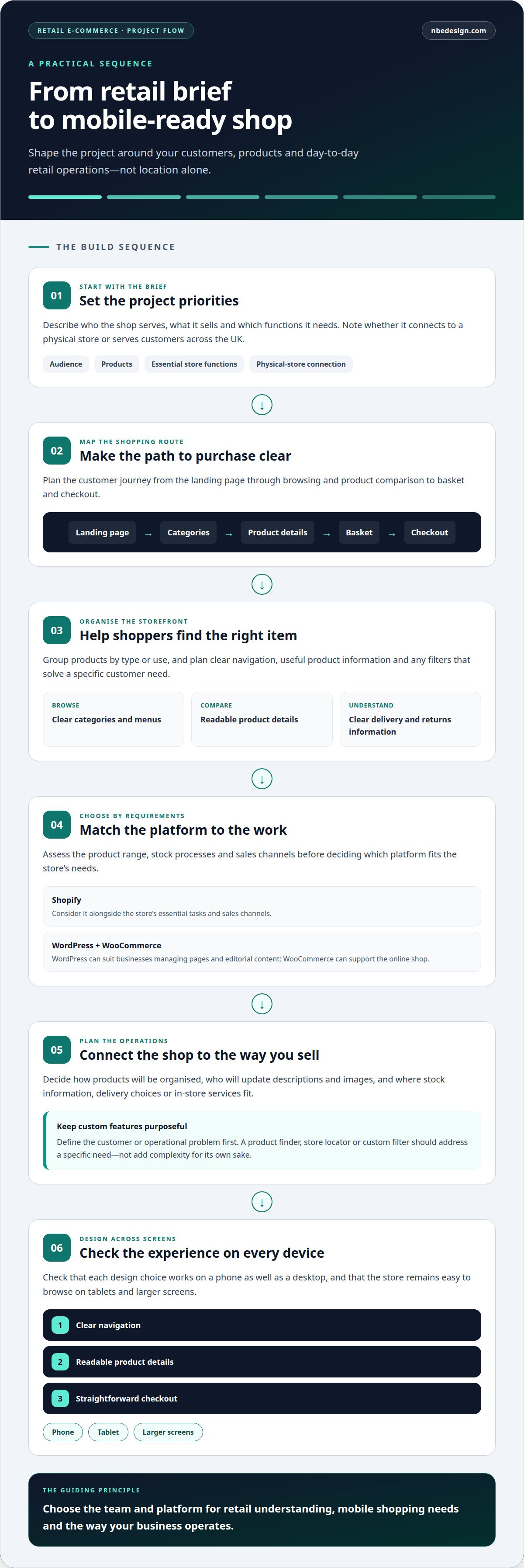
A Sunderland retailer needs a website shaped around its products, customers and daily operations. Strong design and development bring the storefront, product information and checkout together in one clear shopping journey.
Sunderland, Darlington, Newcastle and UK Website Projects
A website project from NB eCommerce & Design can serve a business in Sunderland, Darlington, Newcastle or customers across the UK. The design should reflect where people shop, how products are presented and whether the business also has a physical store. For example, a local gift shop may need clear collection details, while a retailer selling nationally needs product pages that make sense to customers unfamiliar with its premises. Agreeing on the audience and priorities early gives the project a practical direction.
E-commerce Website Development
E-commerce development covers more than visual design. It shapes how shoppers browse categories, compare product details, add items to a basket and complete checkout. Before development begins, map the journey from landing page to purchase, then identify where stock information, delivery choices or in-store services fit. For example, grouping products by use or type can help visitors find the right item without navigating an unclear menu.
When comparing the best ecommerce platform for retailers across Sunderland, Darlington and Newcastle, weigh Shopify and WordPress with WooCommerce against your product range, stock processes and sales channels. The right choice depends on what the store needs to do, not just the platform’s name. List essential tasks first, such as managing product information or supporting online and in-store sales, then assess which platform suits those needs.
WordPress website development can suit businesses that want to manage pages and editorial content in WordPress. Adding WooCommerce can support an online shop, but the combined setup still needs careful planning. Decide how products will be organised, who will update descriptions and images, and how the checkout should fit the brand. This makes it easier to judge whether a content-led WordPress site meets the retailer’s ecommerce needs.
Custom design should solve specific customer or operational problems, rather than add complexity for its own sake. A retailer might need a distinctive product-filter layout or clearer links between collections. Define those needs before development, then check that each design choice works on a phone as well as a desktop. This keeps the visual direction connected to a real shopping task.
Brand assets also influence how consistently a business appears across its website and other customer-facing materials. A defined colour palette, logo and type style can guide page layouts and product imagery; the business graphic design page relates to this visual side of the project.
For retail website design in Sunderland, Darlington and Newcastle, start with a short project brief with NB eCommerce & Design: describe your audience, products, essential store functions and any connection to a physical shop. These decisions help guide design and development, whether your business serves local shoppers in the North East or customers across the UK.
How consistently a retailer can present itself across product pages and other customer touchpoints relies on expert execution. Michael Chapman-Johns has almost two decades of experience in business. Michael Chapman-Johns graduated from Durham University Business School with a degree in Business Administration in 2023, bringing business education alongside practical experience to project planning.
Small business and retail website design in Sunderland
A small retailer’s website should support how the business sells, not just display its products. Start with the essentials: the customer journey, store information, product content and features that help shoppers make decisions. A tailored design can then reflect the business’s identity while keeping core tasks easy to complete.
For a UK retail ecommerce site, review consumer information, privacy and data handling, and payment processing. Map each area to relevant parts of the store, such as product pages, checkout, customer accounts and marketing sign-ups. Clear product, delivery and returns information also helps customers understand what they’re buying before they order.
Local SEO doesn’t require a special website format for Sunderland. Keep the business’s name, address, contact details and opening hours consistent across its website and Google Business Profile. Add useful local information, such as collection options or directions to the shop, where relevant. A dedicated location page should answer real customer questions, rather than repeat the same keywords in every paragraph.
Custom web apps and business features are worth considering when they solve a specific operational problem. For example, a retailer might need a product finder for a varied catalogue or a store locator for several branches. Define the task first, then decide whether a bespoke feature is necessary or a standard ecommerce function can handle it. This can prevent unnecessary complexity.
Small-business website pricing depends on scope, content, design requirements and the features needed. A straightforward shop with a focused catalogue has different demands from a store requiring custom functions, extensive product information or links to existing business systems. Set priorities before design begins, separating essential launch features from improvements that can come later. This clarifies the project scope and what the budget covers.
Most small-business websites for Sunderland clients take 3-6 weeks from kick-off to launch. The schedule is shaped by the project’s design and development work, the amount of content and how promptly decisions and materials are provided. Agreeing the page structure, product information and key features early helps keep the work moving through each stage.
Use the first planning conversation to outline your products, customers, store operations and must-have website features. A clear brief makes it easier to shape the design around your business and build a constructive working relationship. If you’re considering a new retail website, discuss your project requirements.
Before work starts, confirm which pages, content and core functions are included, and clarify how changes to the agreed scope will be handled. The remaining half of the website price is due before launch, so include that payment point in the project plan. Agreeing on deliverables, approvals and launch readiness gives everyone a shared understanding of what the price covers and what needs to be in place before the site goes live.
Web design agencies listed for Sunderland
An agency listing can help you build a shortlist, but it doesn’t show whether a team understands retail. Compare each design agency’s ecommerce experience, working process and examples with your store’s needs.
Choosing a Retail Website Designer
Start with your project vision: the products you sell, the customers you serve and the tasks your website must support. Ask how the designer will turn those priorities into page layouts, product information and a working checkout. For example, a clothing retailer may need size details to be easy to find, while a gift shop may prioritise clear product categories.
Then assess the proposed design and development process. Look for clear stages covering discovery, design, development, review and launch. Ask who provides product copy and photography, how feedback is handled, and who can update the site afterwards. Specific answers show how the agency will manage decisions and fit the work around your business.
Agency Examples and Portfolios
Portfolio examples help you judge whether an agency can make a retailer’s products easy to understand and browse. Look beyond attractive homepages: inspect product pages, category navigation and checkout journeys. A furniture store, for example, may need detailed dimensions and material information, while a small accessories shop may need a compact, easy-to-scan catalogue.
Review each example on a phone and a larger screen. Notice whether menus remain usable, text is readable and product images retain useful detail. A portfolio should also explain the agency’s role, such as whether it handled strategy, design, development or an update to an existing store. That context makes comparisons more useful.
Agency directories can provide names and service descriptions, but a listing alone doesn’t demonstrate retail expertise. Use it as a starting point, then compare the agency’s own project examples and explanations. Check whether its work includes online shops, rather than only brochure websites, and whether the featured projects resemble your catalogue or customer journey.
Before choosing, compare shortlisted agencies using the same project brief. Include your product range, essential functions, brand assets and any connection to a physical shop. Then assess each response for clarity: does it explain the proposed scope, who makes decisions and how requested changes are handled? A consistent brief makes differences between approaches easier to spot.
Finally, consider the working relationship. A useful design discussion should connect your vision to practical choices, such as category structure, product presentation and future updates. Choose the team whose approach makes the next steps clear, not simply the one with the most polished pitch.
Responsive design
Responsive design lets one retail website adapt to different screen sizes, rather than forcing customers to use a desktop layout on a phone. For a Sunderland shop, shoppers should be able to browse products, read key details and reach checkout on their available device. The layout should respond to the content, keeping important actions visible without crowding small screens.
Start by testing the most important customer tasks at different screen sizes. On a phone, check whether a shopper can open the menu, choose a product option and add an item to the basket. On a tablet, check that product images and descriptions remain balanced. On a desktop, confirm that the layout uses space effectively without stretching text into hard-to-read lines.
Product pages need particular care. A clothing retailer should make size and colour choices easy to select, while a homeware shop should keep dimensions and material details readable. Buttons need enough room for accurate taps, and product images should remain clear when the layout narrows. A tailored page prioritises the information customers need before buying, rather than simply shrinking every desktop element.
Navigation also changes across screens. A wide desktop menu may become a compact mobile menu, but shoppers should still find categories without guessing. Group related products under familiar labels, keep search accessible and provide a clear route back to the basket. Test a complete journey, from category page through product selection to checkout, on touchscreens and computers.
Responsive ecommerce design must account for the features connected to the shop. For example, a stock message or delivery option should remain readable when product details stack vertically. Integrations with stock or payment systems also need to work within the mobile journey, so shoppers can understand availability and complete an order. Review these screens with real product examples, including items with different options or availability.
Images and content affect how each page looks. Use consistent product photography, concise headings and descriptive details, then check that they remain useful in a narrow column. A long product description may need clear subheadings, while a product gallery should keep its controls easy to use. These choices help preserve the store’s identity across screen sizes.
Before launch, test key templates on actual phones, tablets and desktop screens. Check menus, filters, forms, product options, basket updates and checkout messages. Note any point where text clips, controls overlap or a customer loses their place. Fixing these issues before launch helps deliver a more consistent shopping experience across devices.
Sunderland web designers specialising in ecommerce and retail
A retail specialist considers how the website supports browsing, product decisions and completed orders. For a Sunderland shop, that means connecting the online catalogue with how the business presents and sells its products.
Look for experience with retail tasks, not just attractive page layouts. A designer should understand product categories, variants, stock messages and checkout content. For example, a retailer selling products in several colours needs clear options on each product page. The project plan should also explain how product information is organised and how the store owner can maintain it.
Platform knowledge matters because the chosen system shapes everyday store management. Shopify, for example, is designed for online commerce, while other platforms may suit businesses with different content or technical needs. A specialist should connect platform decisions to the retailer’s requirements, such as catalogue structure, payment setup and future updates. Features should support real work, not add complexity.
Retail design also needs to account for the business beyond its website. A shop with physical premises may want online product information to match what customers see in store. If staff manage stock or orders through existing processes, those workflows should inform the design. Map a typical sale from product discovery to fulfilment, then identify where the website needs to support staff and customers.
Ask how a designer handles product-page content and visual consistency. A bookshop might organise products by author and subject, while a food retailer may need clear product descriptions and collection details. These examples show why reusable page templates matter: they create consistency while allowing room for useful information specific to each product category.
Support after launch is another practical consideration. Establish who can make routine updates, such as changing a product description, adding a collection or updating store information. A clear handover should explain the relevant editing steps and where key settings are located. This helps the business manage everyday changes without treating each small update as a new design project.
For a retailer planning a new Shopify store, the design should connect customer-facing pages with the catalogue and the way the business operates. A focused project brief can set out products, sales channels, essential features and brand direction. Discuss your retail ecommerce project to explore the design and development needed for your store.
NB eCommerce & Design
NB eCommerce & Design helps retailers plan mobile-ready Shopify stores around their products, customers and day-to-day operations. If you’re starting an online shop, developing an existing store or connecting online and in-store sales, its design and development work can support those needs. Shopify Migration Services can help businesses moving their ecommerce operation to Shopify, while Shopify POS Integration connects with retailers looking to bring sales channels together. The right next step depends on your current setup and what customers need to do on different devices. A clear discussion of your products, store processes and project priorities can help shape a practical direction. To discuss your retail website plans, contact NB eCommerce & Design.
Set your store up for its next stage
A useful next step is to decide what your online store should make easier for customers and staff. Perhaps you’re planning a new Shopify store, moving an existing one to Shopify, or connecting online sales with in-store operations. Those priorities can guide the project scope and keep design decisions tied to how your business works.
Retail website design in Sunderland should support the direction your business is taking, not just its current catalogue. Consider which changes matter now and which can wait. A clear starting point makes it easier to discuss the right approach with a design team and plan a store that can develop alongside your retail operation.
NB eCommerce & Design offers Shopify Store Design & Development, Shopify Migration Services and Shopify POS Integration. If you’re ready to discuss what your store needs next, contact NB eCommerce & Design. A considered first conversation can help you move forward with a clear sense of direction.
Frequently Asked Questions
Which services are available near me?
Retailers can get help with Shopify store design and development, migrations to Shopify, and Shopify POS integration. These services suit different situations: a new shop may need a storefront built, while an established retailer may be moving an existing online store. A business with physical and online sales may need its point-of-sale system connected. Shopify POS synchronises inventory and customer profiles between in-store and online systems.
Which services do you offer locally?
NB eCommerce & Design is based in the North East of the UK and works with retailers across the UK. Sunderland businesses can discuss Shopify store projects, platform migrations and point-of-sale integration. For a retailer with a shop and an online store, the work can address how sales and inventory operate across both channels. The focus is on Shopify-based ecommerce, rather than general web design or marketing services.
How much does retail website design cost in Sunderland?
The cost depends on the individual project and is provided after a quote request. Key factors include whether the work involves a new Shopify store or a migration, the design and development scope, the product catalogue, and any Shopify POS integration. A migration also involves transferring store data and supporting the move through launch. Defining the required work helps establish a suitable project scope.

- Posted in:
- ecommerce
- mobile-ready websites
- online shops
- responsive design
- retail website design
- retail website design sunderland
- Sunderland businesses
- web design