Skip to content

Ways to protect your budget when hiring a web developer
-
2983 words · 14 min read

A low quote isn’t a safe choice unless you know exactly what it covers. To understand how to avoid being ripped off by a developer, compare at least three written quotes, agree a clear scope and total price before work begins, and link payments to defined project milestones rather than paying everything upfront. Put responsibilities, dates and cancellation terms in writing, too.
It’s sensible to be cautious: a website project can involve several stages, and vague promises make it difficult to tell whether the work is on track. A clear agreement gives you a practical way to compare proposals, understand what you’re paying for and raise questions before committing. This guide explains how to assess quotes, review a developer’s work and reputation, and set budgets and payment terms that keep the project accountable. You’ll have a straightforward framework for making a confident hiring decision and protecting your business throughout the work.
Key Takeaways
- Compare at least three written quotes against the same project scope, so you can see what each proposal includes and where costs differ.
- Agree a written contract before paying, with responsibilities, deliverables, dates, price and cancellation terms clearly set out.
- Look beyond star ratings: review relevant project examples and references to assess whether the developer’s experience matches your needs.
- Use your judgement during discussions. Clear answers and realistic expectations help you decide whether you can work together confidently.
- Set out payment stages in advance and connect each payment to a defined milestone, rather than paying the full project cost upfront.
1. Getting competing quotes and a detailed contract
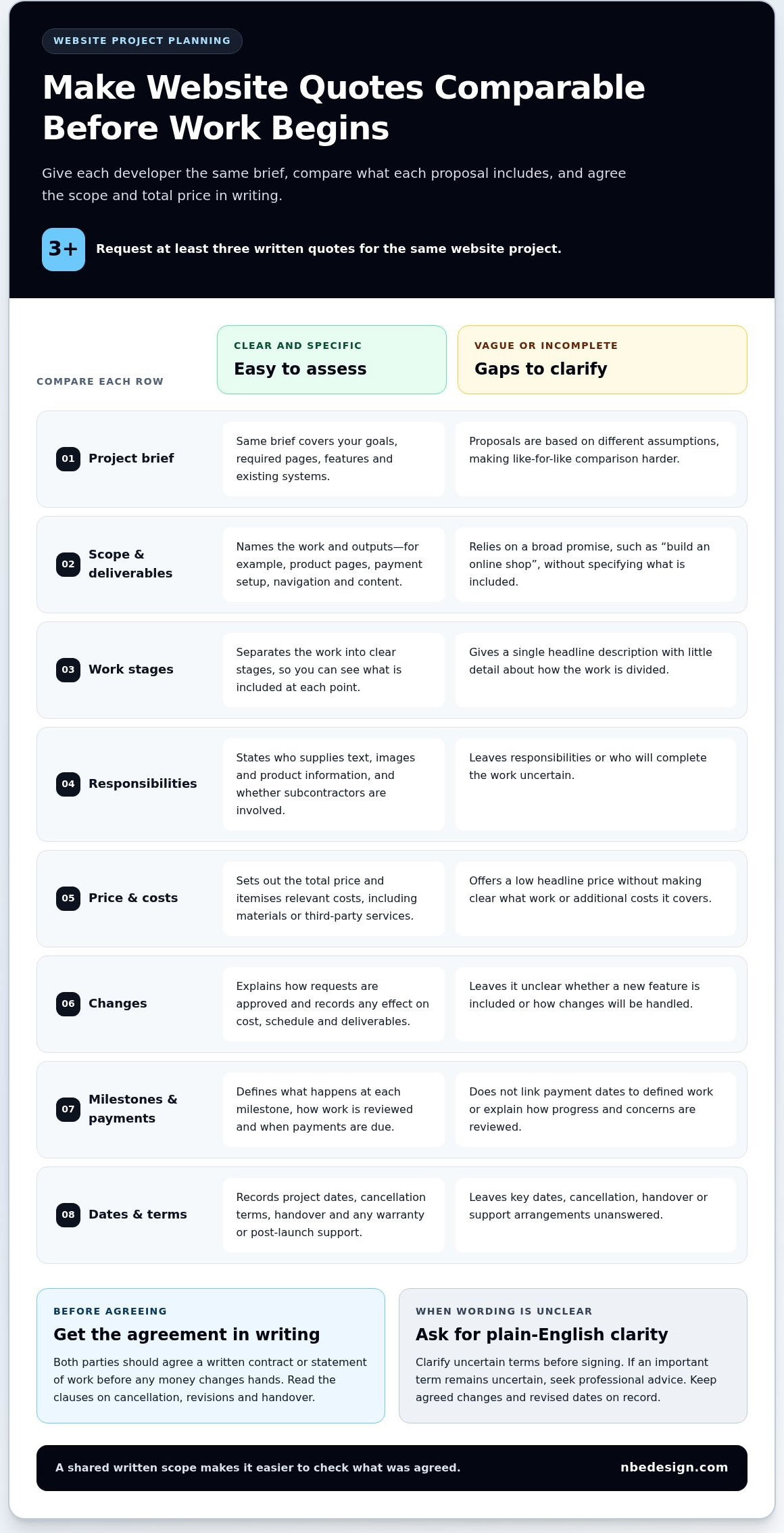
Request at least three written quotes for the same website project. Give each developer one brief covering your goals, required pages, features and existing systems. That makes it easier to compare like with like, rather than weighing a low headline price against a proposal that includes more work. Ask each quote to separate the work into clear stages, so you can see what is included at each point.
Look for specific deliverables, not broad promises such as “build an online shop”. For example, the scope could name the product pages, payment setup, navigation and content you expect. It should also explain who supplies text, images and product information, and how requested changes will be handled. If a feature or responsibility is unclear, ask for it to be explained in writing before you agree. Clear answers now reduce room for disagreement later.
A useful contract sets out the agreed work and total price, alongside each party’s responsibilities and the project dates. It should explain how progress will be reviewed, when payments are due and what happens if a milestone is delayed. Ask for costs to be itemised where relevant, including any materials or third-party services in the proposal. The contract should also describe warranty or post-launch support terms and say whether subcontractors will complete any work.
Agree how changes will be approved before work starts. If a new request affects the scope, record its impact on the cost, schedule and existing deliverables before authorising it. For example, adding a product filter should be written into the agreed scope, rather than assumed to be part of an earlier description. This gives both sides a clear record and makes it harder for either party to dispute what was promised.
Set out what happens at each milestone, including how you’ll review the work and raise concerns. The agreement can state that either party may cancel when a milestone is complete, with the work delivered and payment due at that stage recorded clearly. If a developer later appears to be reneging on agreed work, compare the missed deliverable with the signed scope and raise the gap in writing. Keep the response, revised dates and any agreed changes together.
Before any money changes hands, make sure both parties have agreed to a written contract or statement of work. Read every clause, including cancellation, revisions and handover, and ask for plain-English clarification wherever wording is unclear. If an important term remains uncertain, seek professional advice before signing. A detailed agreement won’t prevent every disagreement, but it gives you a shared reference for checking what was agreed and addressing problems promptly.
2. Researching builders and checking consumer reviews
Don’t rely on a polished homepage or a handful of five-star reviews. Look for evidence that the developer has completed websites similar in size and scope to yours. If you need an online shop with a large product catalogue, for example, a portfolio of simple brochure sites may not show relevant experience. Review live examples for navigation, product information and mobile usability, then note questions about how each site meets your needs.
Read consumer reviews for detail, not just the overall rating. Specific comments about communication, missed deadlines, changes and after-launch support can reveal how a developer manages the work. Look for recurring themes across different reviews, and consider how recent and relevant each account is. A testimonial on the developer’s own website can help you identify clients to ask about, but it shouldn’t be your only evidence.
Ask for references from previous clients whose projects resemble yours. Ask what the developer delivered, whether the agreed scope changed, how progress was communicated and how issues were handled. If you’re speaking with a retailer, ask how the site supports everyday tasks such as updating products or managing orders. Direct, project-specific answers tell you more than a general recommendation.
Check the proposed timeline against the work involved. A website project may take around six weeks, but the schedule depends on scope, content readiness, integrations and how quickly decisions are made. Ask for dates or stages covering design, development, testing and launch. If a developer promises a rapid launch, ask which tasks are included and what would need to be ready from your side. A timeline with named stages is easier to assess than a single launch date.
For a UK company, Companies House filings can help you understand its financial position. Review its annual accounts alongside its trading history, and consider whether the information fits the scale of the project you’re planning. This isn’t a substitute for checking work quality, but it can add context when deciding how much risk to take on. Keep your judgement proportionate: a company record alone doesn’t show how well a developer will deliver your website.
Licensing checks depend on the type of work. Where a licence is required, verify the status with the relevant licensing agency; don’t assume a web development project has the same requirements as regulated building work. Then compare evidence: relevant examples, client references, review patterns and a clear project plan. If a Shopify project is on your roadmap, you can discuss your project requirements and what you need to assess before moving ahead.
3. Trusting your judgement when choosing a builder
Your judgement matters most when it’s based on what you can observe. After reviewing a proposal, notice whether the developer listens to your business goals and answers questions directly. For example, if you explain that customers struggle to find products, a useful discussion should explore navigation and product categories. A quick promise to “make it look better” doesn’t show how the problem will be addressed. Treat your impressions as evidence to weigh, not as a substitute for checking the project details.
Pay attention to how clearly technical decisions are explained. You don’t need to know how every feature is built, but you should understand what it does for your customers and staff. If a developer recommends a particular integration, ask what business task it supports and how it affects the site. A clear answer connects the technical choice to a practical outcome, such as keeping stock information consistent across sales channels. Jargon without an explanation makes it harder to assess whether a recommendation fits your needs.
Notice how the developer responds when you raise a concern. If you question a proposed feature, a constructive response should explain its purpose, alternatives and trade-offs. For instance, you might ask whether a custom design element is essential for launch or could be added later. A reasoned answer helps you prioritise work. A response that dismisses the question or pressures you to decide immediately gives you a reason to pause and seek clarification before proceeding.
Use a simple decision record to separate facts from instinct. After each conversation, write down what was explained, which questions remain open and how the discussion felt. Compare those notes with the written proposal and your priorities. If one developer explains content responsibilities clearly while another leaves them vague, record that difference. This turns a general feeling of confidence or concern into specific points you can revisit, discuss and compare fairly.
Trust is built through consistency. Check whether the same deliverables, dates and responsibilities appear in conversations, emails and the proposal. If a verbal promise changes in writing, ask for the difference to be resolved before agreeing. For example, if a launch discussion includes staff training but the scope only describes website development, clarify whether training is part of the agreed work. Keeping those decisions together is one practical way to avoid being ripped off by a developer.
Take time to decide, especially if you feel rushed. A professional conversation should leave room to review the details and consider how the proposed approach fits your business. Write down your non-negotiables, such as a smooth checkout or straightforward product updates, then assess each proposal against them. If you’re considering how to avoid being ripped off by a developer, look for clear explanations that align with your priorities. Your judgement is strongest when it reflects evidence, priorities and the quality of communication.
4. Agreeing on project budgets and payment terms
Should you use a solicitor, surveyor or independent project manager when appointing a developer? For a website project, a solicitor can help review contract terms, while an independent project manager can oversee scope, milestones and communication. A surveyor’s expertise usually concerns property, rather than website delivery.
Before work begins, set a total budget and decide what it must cover. Separate essential launch requirements from optional improvements, such as adding extra product filters later. Ask the developer to show how the proposed work fits your priorities, and identify any costs that depend on third-party tools or services. Record what is included, what would count as a change, and how that change would affect the budget.
Agree payment dates and conditions in writing. Avoid paying the entire project cost upfront; instead, connect payments to completed, reviewable milestones. For example, payment stages might follow approval of the design, completion of the working site and final handover. A suggested approach is to allocate 10% of the payment to each project milestone. Treat the percentage as a planning method, then make sure the agreed stages and amounts are clear in your own contract.
Define what “complete” means at every stage. A design milestone could require approved page layouts, while a development milestone could require the agreed features to work in a test environment. Include time for you to review each deliverable and raise specific issues before the next payment falls due. This helps prevent a dispute where the developer considers a stage finished, but you expected different work.
Keep a record of payments, approvals and changes. If a requested feature affects the original scope, ask for its revised cost and schedule in writing before authorising it. For instance, adding a new checkout requirement should not remain a verbal promise alongside the original budget. Compare each invoice with the agreed milestone, and query any item that doesn’t match the documented work.
Don’t treat a deposit as proof that the project is protected. The payment schedule should explain what work it covers, what happens if a milestone is incomplete, and how either party can end the agreement at a milestone boundary. Keep enough project documentation to track decisions, deliverables and amounts paid. With a solicitor reviewing complex contract terms or a project manager coordinating a demanding build, you can make responsibilities and payment triggers easier to follow.
Be cautious if a contractor asks for 30-50% of the project price up front; this may be a scam tactic. A prospective client told the author that she paid a first web designer a $1,000 deposit and received no work. She then paid a second web designer a $1,000 deposit, but the designer left after producing a mock-up. These examples show why a deposit should be tied to clearly defined work and why you should check a contractor’s terms before sending money.
For a US homeowner, the page advises not prepaying more than $1,000 or 10% of the job total, whichever is less. Whatever the project, keep the initial payment limited, document what it covers, and make later payments conditional on reviewable work. If a contractor resists clear milestones or demands a large upfront payment, pause and consider whether the arrangement is safe.
5. Evaluating a developer’s reach, reputation, results and referrals
Assess a developer through four connected angles: reach, reputation, results and referrals. Reach means looking at the kinds of clients and projects they serve, not assuming that distance proves quality. For a UK retailer, ask whether their experience includes businesses with similar customers, sales channels or operational needs. A developer working remotely may suit your project, but the important question is whether their approach fits your business and communication preferences.
Look at results in context. A portfolio can show finished websites, but ask what the developer contributed and what the business needed. For example, a retailer may have wanted easier product discovery, while another needed online and in-store operations to work together. Compare the stated goal with the visible site, and note whether the example demonstrates work relevant to your priorities. This helps distinguish a strong visual showcase from evidence of a suitable project fit.
Reputation should reflect patterns, not one glowing testimonial or critical review. Look across review platforms and published client comments for recurring details about delivery, communication and problem-solving. A reviewer who explains how an issue was handled gives you more to assess than a brief rating alone. Consider whether the feedback relates to work like yours, and whether the developer’s response to criticism is measured and specific.
Referrals add useful perspective. Ask to speak with a previous client whose project resembles yours, then ask about the finished work, the working relationship and any unexpected challenges. For example, a retailer can ask whether the site was manageable after launch and whether agreed outcomes matched the delivered work. Treat the conversation as one piece of evidence, alongside portfolio examples and reviews, rather than a guarantee of your own experience.
For a larger or business-critical website, examine completed projects closely before deciding. Open the live sites, follow key customer journeys and check how important features work. A shop’s product pages, filters and checkout provide more insight than a screenshot. Where a portfolio example has changed since launch, ask what the developer originally delivered. The aim is to understand the quality and relevance of the work, not simply its appearance.
Bring your findings together in a short comparison. Record which examples match your needs, what clients say about working with the developer, and what referrals reveal about delivery. If you’re planning a website project and want to discuss what success should look like, talk through your website requirements.
The same evidence-led approach applies when reviewing bids: homeowners are advised to visit a contractor’s completed projects while reviewing bids, especially for a large job. For a developer, inspecting live work and asking what was delivered is more useful than relying on claims alone. Bands can research companies by asking other bands for recommendations and checking which artists or bands a PR company has worked with. Comparable questions for a website project are who recommends the developer and whether their work includes businesses relevant to your needs.
Availability is worth clarifying, but it should not substitute for fit: a builder says clients are lined up until the end of the year. Ask about timing alongside scope and evidence, then weigh the answer against your priorities. A confident schedule, like a strong referral, is useful context rather than a guarantee of results.
NB eCommerce & Design: Shopify Store Design & Development
NB eCommerce & Design can help when your project needs a Shopify store built around your retail operations. Its Shopify Store Design & Development supports businesses creating or improving a Shopify storefront, while Shopify Migration Services suit retailers moving their business to Shopify. For shops connecting online sales with in-store operations, Shopify POS Integration may be relevant.
Use the checks in this guide to clarify your goals, compare the proposed scope and understand payment stages before committing. Then discuss how the work could fit your store’s needs and priorities.
Contact NB eCommerce & Design to discuss your project.
Move forward with a clear project brief
Once you’re ready to appoint a developer, turn your business priorities into a practical brief. Describe what customers need to do on your website, what your team needs to manage, and which outcomes matter most. That gives future project conversations a shared starting point, rather than leaving success open to interpretation.
Learning how to avoid being ripped off by a developer also means staying involved after the agreement is signed. Choose someone in your business to approve decisions, keep project records together and raise questions as they arise. A steady flow of clear communication can help small uncertainties surface before they disrupt the work.
If you’re planning a Shopify project, NB eCommerce & Design can discuss the right next step for your store. Contact NB eCommerce & Design to discuss your project and take the next step with a clear view of what your business needs.

- Posted in:
- business advice
- developer contracts
- hiring a web developer
- how to avoid being ripped off by a developer
- milestone payments
- project budgeting
- web development
- website costs