Skip to content
The Ultimate Guide to Conversion Rate Optimisation for Shopify Stores in 2026
-
3675 words · 18 min read

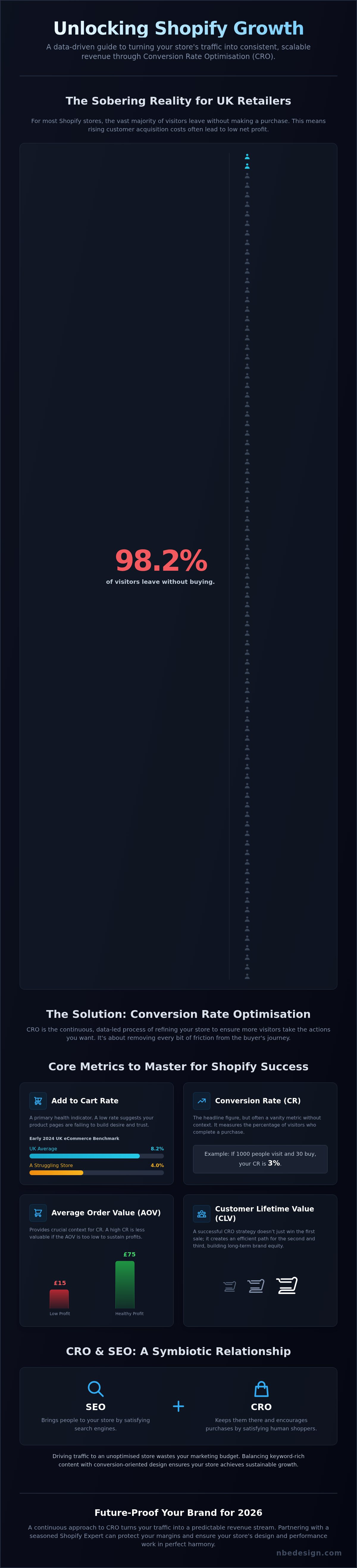
Did you know that 98.2% of your Shopify store visitors currently leave your site without spending a single penny? It's a sobering reality for many UK retailers who see their customer acquisition costs rise every month while their net profit remains low because they haven't yet mastered conversion rate optimisation. You likely feel the pressure of choosing between hundreds of different apps or the fear that a small technical tweak might accidentally break your checkout process. We understand that frustration because we've been helping brands navigate these exact hurdles as a Shopify Expert since 2006.
You deserve a store that doesn't just look professional but actually works as your most efficient salesperson. This guide will show you how to master the art and science of turning your traffic into consistent, scalable revenue. We'll provide a clear roadmap to improve your store performance and increase your average order value by focusing on proven strategies for 2026. From building deep trust with your customers to streamlining the path to purchase, here's how you can transform your Shopify store into a high-performing growth engine. If you're ready to scale, you can get in touch with our team for expert guidance.
Key Takeaways
- Understand how a continuous approach to conversion rate optimisation helps you turn existing traffic into a predictable and scalable revenue stream.
- Explore the psychology of the click by using the Fogg Behaviour Model to reduce cognitive load and simplify the path to purchase.
- Move beyond guesswork with a data-driven framework that prioritises store functionality and user experience to future-proof your brand for 2026.
- Learn actionable strategies to streamline your Shopify checkout and craft high-converting product pages that balance technical detail with emotional appeal.
- Discover why partnering with a seasoned Shopify Expert can protect your margins and ensure your store’s design and performance work in perfect harmony.
What is Conversion Rate Optimisation (CRO) for Shopify Retailers?
Conversion rate optimisation is the continuous, data-led process of refining your Shopify store to ensure more visitors take the actions you want. It isn't a one-time fix. It's a permanent commitment to improving the user experience. Whether it's signing up for a newsletter or completing a purchase, the goal is to remove every bit of friction from the buyer's journey. At NB eCommerce & Design, we've watched the Shopify platform evolve since its birth in 2006. We understand that What is Conversion Rate Optimization involves much more than just changing the colour of a "Buy" button. It's about psychology, technical performance, and trust.
Shopify-specific CRO differs from general website optimisation because of the platform's unique architecture. While Shopify provides a rock-solid foundation, its Liquid templating language and specific checkout flow require a specialist touch. You aren't just tweaking a layout; you're managing how apps, scripts, and theme settings interact to influence the final click. In the 2026 UK market, this distinction is vital. Digital ad spend in the UK is projected to exceed £35 billion by 2026, which naturally drives up competition. As Customer Acquisition Cost (CAC) rises, you can't afford to waste a single visitor. A conversion-focused approach builds long-term brand equity. When a site works perfectly, customers trust the brand. This trust leads to repeat business and a higher return on investment that lasts far longer than a single seasonal sale.
The Core Metrics of Shopify Success
Success starts with understanding your numbers. While Conversion Rate (CR) is the headline figure, it's often a vanity metric without context. If your CR is 3% but your Average Order Value (AOV) is only £15, your business might struggle. We look at the "Add to Cart" rate as a primary health indicator. In early 2024, the average UK eCommerce "Add to Cart" rate was approximately 8.2%. If your store is hitting 4%, your product pages are failing to build desire. We also prioritise Customer Lifetime Value (CLV). A successful conversion rate optimisation strategy doesn't just win the first sale; it creates an efficient path for the second and third.
CRO vs. SEO: A Symbiotic Relationship
SEO brings people to your store, but conversion rate optimisation keeps them there. These two disciplines are deeply linked. Google’s recent algorithm updates increasingly prioritise user engagement signals like time on page and low bounce rates. If you drive traffic to a page that doesn't convert, your rankings will eventually drop. Driving paid traffic to an unoptimised store is a waste of your marketing budget. We balance keyword-rich content with conversion-oriented design to ensure your store satisfies both search engines and human shoppers. If you need help balancing these elements, you can get in touch with our team to discuss a tailored plan for your business.
By focusing on these fundamentals, Shopify retailers in the North East and across the UK can future-proof their growth. It's about making the shopping experience as seamless as possible. When you simplify the path to purchase, you don't just increase sales; you build a rock-solid reputation in a crowded marketplace.
The Psychology of the Click: How CRO Works on Shopify
Understanding why a visitor clicks "Buy" requires looking at the Fogg Behaviour Model. This framework suggests that for a behaviour to occur, three elements must converge at the same moment: Motivation, Ability, and a Prompt. On your Shopify store, high motivation comes from your product's appeal, while "Ability" is about how easy you make the checkout process. According to a business perspective on CRO, ignoring these psychological triggers leads to high bounce rates. We focus on increasing "Ability" by removing friction. If a customer has to think too hard about how to navigate your site, they'll simply leave. This mental effort is known as "Cognitive Load."
A 2024 study by the Baymard Institute found that 18% of UK shoppers abandon carts specifically because the checkout process was too long or complex. By simplifying your navigation and reducing the number of form fields, you lower the cognitive load. It's also vital to track "Micro-Conversions" throughout the journey. These are smaller actions, such as signing up for a newsletter, adding a product to a wishlist, or using a currency converter. These steps build momentum and trust, making the final sale far more likely. We use conversion rate optimisation strategies to ensure every small interaction nudges the customer closer to the finish line.
Social proof and urgency are powerful tools, but they must be handled with care. UK consumers are quick to spot "fake" urgency. Instead of countdown timers that reset every time a page refreshes, use genuine data. Showing that "5 people bought this in the last 24 hours" provides authentic social proof without damaging your brand integrity. This honest approach builds a long-term relationship with your audience rather than just securing a one-off sale.
Building Trust with UK Consumers
UK shoppers are discerning and value professional presentation. High-quality business graphic design creates an immediate sense of reliability that generic templates cannot match. For 2026, essential trust signals include clear UK contact details, transparent VAT pricing, and visible links to your returns policy. Integrating Shopify reviews and user-generated content (UGC) is also critical; 93% of consumers now state that online reviews influence their purchasing decisions. Professional aesthetics paired with transparent business practices form the bedrock of consumer confidence.
The Mobile-First Mandate
Mobile traffic now accounts for over 71% of total sales across the Shopify platform. Mobile conversion rate optimisation isn't just about shrinking your desktop site; it's about thumb-friendly design. Buttons must be large enough to tap easily, and your site should load in under 2 seconds to prevent drop-offs. One-tap solutions like Shop Pay and Apple Pay are non-negotiable for modern retailers. Avoid common UX pitfalls like intrusive pop-ups that are difficult to close on a small screen, as these frustrate users and kill your conversion stats instantly.
If you're finding that your traffic isn't turning into sales, it might be time to get in touch with our Shopify experts for a detailed store audit. We've helped retailers across the North East and globally to streamline their user journeys and maximise their return on investment since 2006.
A Data-Driven CRO Framework for 2026
Forget what you think you know about your customers' preferences. In 2026, guessing is a recipe for stagnant growth. Successful Shopify stores rely on a data-driven CRO framework to turn browsers into buyers. This structured approach moves beyond intuition into a cycle of constant, evidence-based experimentation. We look at conversion through a specific hierarchy: Functionality, Accessibility, Usability, and Persuasion. If your checkout button doesn't work on a specific mobile browser, no amount of persuasive copywriting will save the sale. You must fix the foundation before you can polish the peaks.
Shopify Analytics provides the base data, but heatmaps and session recordings show the "why" behind the numbers. You can see exactly where users get frustrated or which "Add to Cart" button they completely ignore. By 2026, AI has shifted from a novelty to a necessity. Predictive analytics now forecast which segments of your audience are most likely to convert. This allows for hyper-personalised shopping experiences. Your store can now automatically rearrange its homepage based on whether a visitor is a returning customer from London or a first-time browser from Glasgow. This level of automation ensures your conversion rate optimisation efforts are working even when you aren't.
Using Shopify Analytics effectively means looking beyond basic sales reports. We now focus on cohort analysis and customer lifetime value (CLV) to inform our strategy. If a specific traffic source has a high bounce rate but a high CLV for the few who do stay, the strategy shifts from fixing the page to refining the marketing spend. Heatmaps provide the "theatre" of the user journey. They reveal if your UK customers are struggling with specific postcode validation or if your "Free UK Delivery" banner is being obscured by a cookie consent pop-up. These small friction points can cost thousands in lost revenue over a single quarter.
The Audit: Identifying Where You Are Losing Sales
We start by analysing your "leaky funnel" from the initial landing page to the final thank-you page. If your data shows a 65% drop-off at the shipping selection stage, you likely have a hidden cost issue. We conduct user testing with real UK-based shoppers to see how they navigate your store in real-time. Interpreting this volume of qualitative data is complex. You might need a Shopify Expert UK to spot the subtle friction points that automated tools miss. If you're struggling to make sense of your bounce rates, get in touch for a professional review.
Hypothesis and Testing
Every test starts with a solid hypothesis. Use this formula: "If we change X, then Y will happen because of Z." For example, "If we move the trust badges above the fold, then conversion will increase by 5% because it reduces initial buyer anxiety." For stores with over 30,000 monthly sessions, multivariate testing allows you to test multiple elements simultaneously. Smaller stores should stick to A/B testing to reach statistical significance faster. We use the ICE framework to prioritise your roadmap. This ranks tests based on Impact, Confidence, and Ease, ensuring you focus on the high-value changes first.
Actionable Shopify CRO Strategies: Beyond the Basics
Moving your store from a standard template to a high-performing sales engine requires more than just changing button colours. High-growth UK brands succeed by blending technical precision with emotional resonance. Your product pages must do the heavy lifting. Research from 2024 indicates that 82% of shoppers in the United Kingdom prioritise clear, high-resolution imagery and detailed technical specifications over flashy marketing copy. You should provide a "technical deep dive" section for complex products while using lifestyle photography to spark an emotional connection. This balance reduces the "uncertainty gap" that often leads to cart abandonment.
Streamlining the Shopify Checkout is your next priority. While Shopify's native checkout is world-class, you can still refine it. Baymard Institute studies show that 18% of UK users abandon carts because the process feels too long. You should remove every non-essential form field. Don't ask for a "Company Name" or a "Phone Number" unless your courier absolutely requires it for delivery notifications. A cleaner interface keeps the customer focused on the final "Pay Now" button.
Dynamic upsells are a powerful tool for increasing Average Order Value (AOV) without frustrating your audience. Instead of using aggressive pop-ups that interrupt the flow, integrate "Frequently Bought Together" modules directly into the cart drawer. If a customer adds a pair of leather boots, suggest a £10 protective spray. This contextual relevance feels like helpful advice rather than a sales pitch. It's a subtle way to improve your conversion rate optimisation results while building trust.
Unified Commerce and POS Integration
Your physical store is a goldmine for digital data. By using Shopify POS, you can track how customers interact with products in person before they buy online. This "showrooming" behaviour is common in the UK market. Use in-store insights to update your online FAQs. If customers in your Teesside boutique constantly ask about the weight of a specific fabric, add that detail to your web descriptions immediately. Implementing "Buy Online, Pick Up In-Store" (BOPIS) can also boost conversions by up to 14%, as it eliminates shipping costs and provides instant gratification.
Advanced Personalisation Techniques
Personalisation will evolve rapidly as we approach 2026. Shopify apps are moving toward "intent-based" customisation. You can now show different homepage banners based on a visitor's UK region. If it's a rainy Tuesday in Manchester, your store should automatically feature waterproof outerwear. Smart search is equally vital. Customers who use search bars convert at 1.8 times the rate of those who don't. Ensure your search function is predictive and handles typos gracefully, helping users find their desired item in under 3 seconds. This level of detail is what separates a standard store from a market leader.
If you want to refine your digital strategy and see real growth in your conversion rate optimisation metrics, we can help you find the right path forward.
Get in touch with a Shopify Expert todayPartnering for Growth: Why a Shopify Expert Makes the Difference
Attempting DIY conversion rate optimisation often feels like a cost-effective shortcut, but it carries hidden risks that can damage your bottom line. Small, untested changes to a checkout flow or a product page can lead to significant revenue drops. For a store turning over £50,000 a month, a mere 0.5% dip in conversion due to a poorly implemented "buy it now" button results in a £250 loss every single month. Professional intervention replaces guesswork with data-backed certainty, ensuring every tweak moves the needle in the right direction.
A specialist agency provides a balance that's difficult to achieve alone. We weigh technical performance against creative design. A site might look beautiful, but if the high-resolution imagery pushes the Largest Contentful Paint (LCP) over 3 seconds, your mobile customers in rural parts of the UK will bounce before the page even renders. Our approach ensures your store remains "conversion-focussed" by aligning aesthetic appeal with the rigorous technical standards Shopify requires for high-speed performance.
The real value lies in a long-term partnership rather than a one-off audit. Conversion rate optimisation isn't a task you finish; it's a cycle of constant refinement. While an audit identifies current friction points, a partnership allows for iterative A/B testing that responds to changing consumer behaviours. We've seen brands in our NB eCommerce portfolio achieve sustained growth by testing everything from navigation labels to upsell triggers over several months, rather than looking for a "silver bullet" fix.
Why NB eCommerce & Design?
We've been Shopify Partners since 2006, which means we've literally grown with the platform from its earliest days. This deep-rooted history gives us an intuitive understanding of the Shopify ecosystem that newer agencies simply can't match. Based in the North East of the UK, we offer a grounded, approachable service for retailers in Middlesbrough, Durham, and beyond. We don't just build pretty websites; we craft high-performing sales engines. Our "conversion-focussed" philosophy means every design choice is measured against its ability to generate a return on your investment.
Your Next Steps to a Higher Conversion Rate
Getting ready for a professional CRO audit is simpler than you might think. Start by ensuring your Google Analytics 4 (GA4) is correctly tracking your ecommerce events and identify which stages of your funnel show the highest drop-off rates. It's also helpful to set realistic expectations. While we've seen remarkable turnarounds, healthy growth typically involves incremental gains of 10% to 20% in conversion efficiency over a six-month period. These steady improvements compound over time to create a much more resilient business.
Moving your store through a technical transition or a major redesign doesn't have to be a daunting experience. We've guided hundreds of retailers through these shifts, ensuring their data stays secure and their sales remain steady. With the right expertise, your store's evolution becomes a seamless process that empowers you to scale with confidence.
Ready to unlock the full potential of your online store? Book your Shopify CRO consultation today and let's start building a more profitable future for your brand.
Future-Proof Your Shopify Growth Today
Success in 2026 requires more than a standard storefront; it demands a deep understanding of customer psychology and a commitment to data-driven refinement. You've explored how a robust framework and actionable design changes can directly impact your revenue. Since our birth in 2006, we've seen the platform evolve and have helped retailers in the North East and across the globe stay ahead of the curve. True conversion rate optimisation isn't a one-time fix. It's a continuous process of streamlining the user journey to remove friction. As certified Shopify Experts based in Teesside, we combine local reliability with international retail experience to build high-conversion stores that scale. We don't just guess what works; we use nearly two decades of platform knowledge to ensure your business remains future-proof. You don't have to navigate these technical complexities alone. Let's work together to simplify your operations and maximise your sales potential.
Master your Shopify conversions with a UK Expert
Your path to a more efficient, high-performing store starts with a single step. We're ready to help you build something remarkable.
Frequently Asked Questions
What is a good conversion rate for a Shopify store in the UK?
According to IRP Commerce data from 2024, the average e-commerce conversion rate in the UK sits at 1.88%. If your Shopify store achieves between 2% and 3.5%, you're performing well. Top-tier retailers often exceed 5% by focusing on mobile-first design and streamlined navigation. We've helped brands reach these benchmarks since 2006 through tailored Shopify strategies. It's about constant refinement rather than a one-time fix.
How long does it take to see results from conversion rate optimisation?
You can often see initial data shifts within 14 to 30 days of implementing changes. For statistically significant results, most Shopify stores require a testing period of 8 to 12 weeks. This timeframe allows for enough traffic to flow through your funnel to prove which tweaks actually drive sales. Patience is key to ensuring your conversion rate optimisation efforts are based on facts, not just luck or temporary trends.
Can I do CRO on my Shopify store without any coding knowledge?
Yes, you can make impactful changes using the Shopify Theme Editor and integrated apps like Shogun or PageFly. Simple adjustments to product descriptions, high-quality imagery, and trust badges don't require a single line of code. However, for advanced A/B testing or complex layout shifts, working with a Shopify Expert ensures your site remains stable. If you're unsure where to start, you can always get in touch for professional guidance.
Is CRO more important than SEO for e-commerce growth?
Both are vital, but CRO ensures the traffic you've paid for or earned through SEO actually buys something. SEO brings people to the door, while conversion rate optimisation gets them to the checkout. A 2023 study by Econsultancy found that for every £76 spent on acquiring customers, only £1 is spent on converting them. Balancing both is the most efficient way to scale your UK business sustainably over the long term.
How much does a professional CRO audit cost for a Shopify store?
A professional CRO audit from a UK-based Shopify Partner typically costs between £1,200 and £4,500 depending on your store's complexity. This investment provides a deep dive into user journeys, heatmaps, and technical performance. At NB eCommerce & Design, we leverage our experience since 2006 to identify specific friction points. This one-off cost often pays for itself through increased revenue within the first three months of implementation.
What are the most common conversion killers on Shopify stores?
Unexpected shipping costs and slow page load speeds are the primary reasons for cart abandonment. Research from Baymard Institute in 2024 shows that 48% of shoppers drop out if extra costs are too high at checkout. Other issues include a lack of guest checkout options and poor mobile navigation. Ensuring your site loads in under 2.5 seconds is crucial for keeping UK shoppers engaged and ready to spend.
Does Shopify POS really help with online conversion rates?
Shopify POS bridges the gap between your physical shop and your online store, which builds significant brand trust. When customers see a unified presence, they feel more confident purchasing online. Features like buy online, pick up in-store can increase digital sales by 20% according to Shopify's 2023 retail reports. It streamlines your inventory and creates a seamless experience that encourages repeat business across all your UK sales channels.
How often should I be testing new elements on my website?
You should aim to run at least one A/B test every month to maintain momentum. High-volume Shopify stores often run multiple tests simultaneously across different collections. We recommend reviewing your analytics every 30 days to spot new opportunities for improvement. Consistent testing prevents your store from becoming stagnant. If you need help setting up a testing roadmap, get in touch to discuss your growth plans.

- Posted in:
- checkout optimisation
- conversion rate optimisation
- CRO
- eCommerce
- increase sales
- product pages
- Shopify
- Shopify guide
- user experience