Skip to content
High-Impact A/B Testing Ideas for eCommerce: The 2026 Shopify Growth Guide
-
3774 words · 18 min read
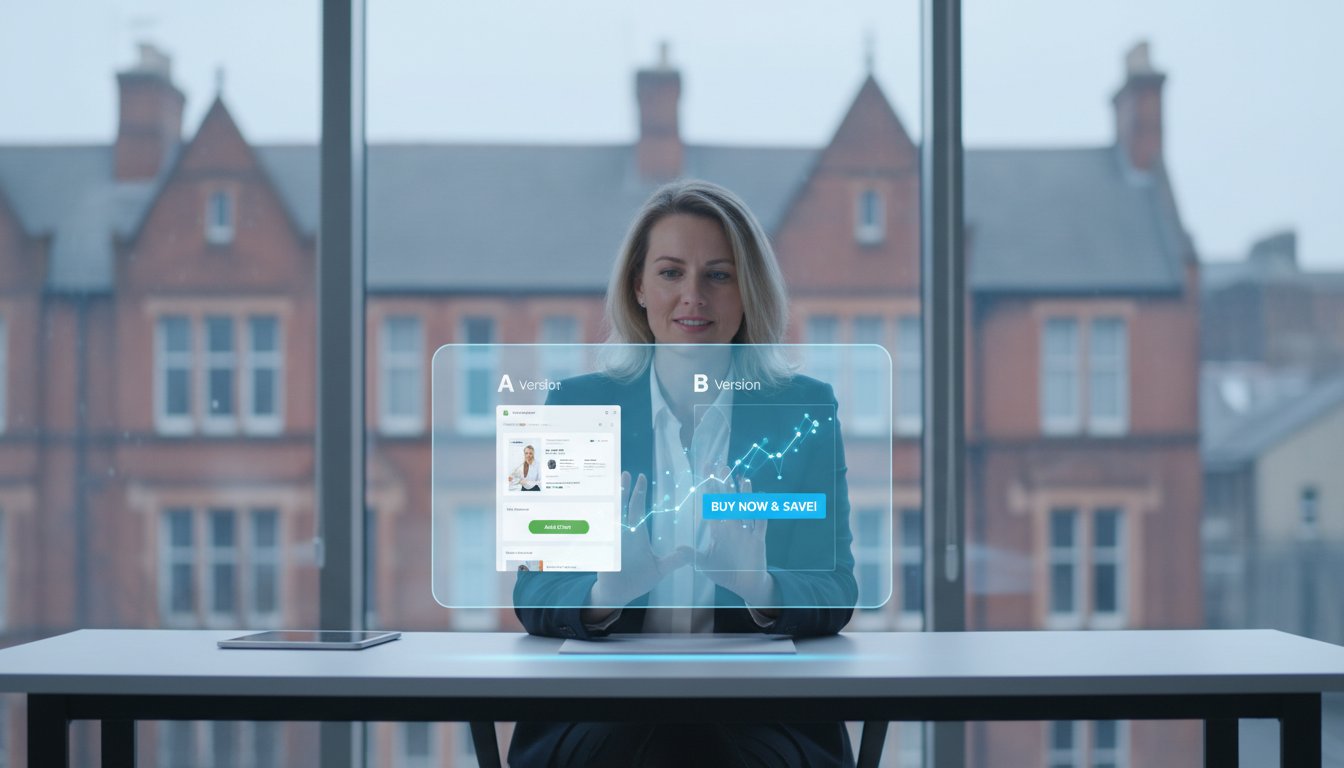
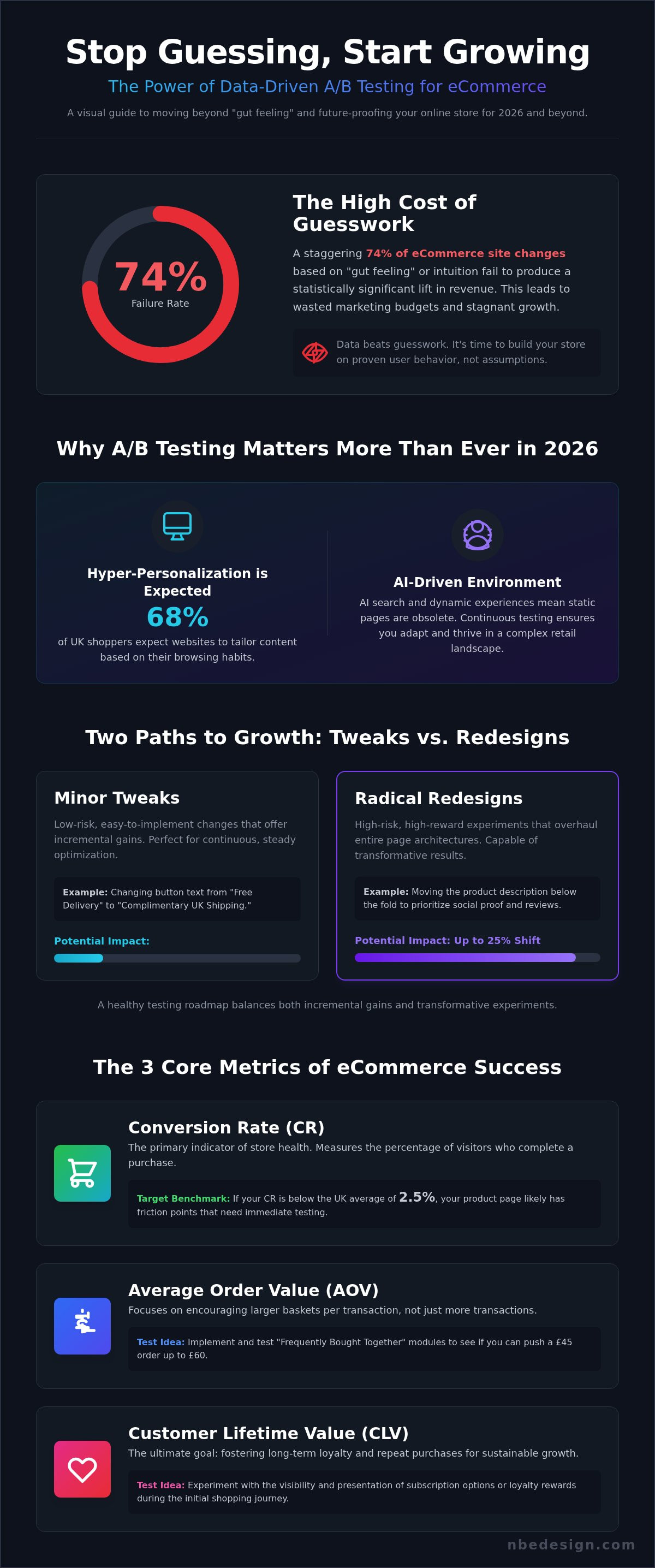
Did you know that 74% of eCommerce site changes based on "gut feeling" fail to produce a statistically significant lift in revenue? It's exhausting to watch your marketing budget disappear into ads that fail to convert because your storefront isn't quite hitting the mark. You've likely followed generic "best practices" only to find they don't work for your specific brand, which is why finding effective A/B testing ideas for eCommerce stores is essential for reliable growth. Data beats guesswork every time. It's natural to feel anxious about making technical changes that might break your checkout flow.
As experienced eCommerce growth specialists at NB eCommerce & Design, we've been optimizing online stores and growing alongside leading platforms since 2006. We understand that every click represents a real customer journey. We promise to provide you with actionable, research-backed experiments to increase Average Order Value (AOV) and streamline your operations with confidence. This guide offers a clear roadmap to replace guesswork with data, giving you a rock-solid reason to justify your next site design update. We'll walk through specific tests for your product pages, cart, and navigation to ensure your store is future-proof for 2026.
Key Takeaways
- Learn how to move beyond "gut feeling" design and embrace data-driven retail decisions to future-proof your Shopify store for 2026.
- Master the PIE Framework to prioritise your testing roadmap, ensuring you focus on the experiments that offer the highest potential for growth.
- Discover high-impact a/b testing ideas ecommerce brands can implement across the customer journey, from homepage video content to collection page functionality.
- Explore unique strategies for UK retailers to streamline omnichannel sales by testing "Buy Online, Pick Up In-Store" (BOPIS) visibility on product pages.
- Understand the importance of statistical significance and why working with a certified Shopify Expert ensures your data translates into long-term success.
What is eCommerce A/B Testing and Why Does it Matter in 2026?
In the early days of online retail back in 2006, design decisions often relied on the "gut feeling" of a creative director. Today, that approach is a recipe for stagnant growth. At its core, What is A/B testing? It's the scientific method applied to your Shopify store. You compare two versions of a webpage to see which performs better based on cold, hard data. One group of visitors sees Version A, the control, while another sees Version B, the variant. By measuring which group converts at a higher rate, you eliminate guesswork and build a store based on proven user behaviour.
By 2026, the retail environment has become significantly more complex. AI-driven search engines and hyper-personalized shopping experiences mean your customers expect a seamless journey. Static pages are no longer enough. You need a nuanced strategy. Modern a/b testing ideas ecommerce focus on how different elements react to individual user intent. We've seen that 68% of UK shoppers now expect a website to tailor its content based on their previous browsing habits. Testing helps you verify if your personalisation efforts actually drive revenue or just add unnecessary clutter.
There's a distinct difference between minor tweaks and radical redesigns. A minor tweak might involve changing the wording on a shipping banner from "Free Delivery" to "Complimentary UK Shipping." These are low-risk and easy to implement. A radical redesign could involve a complete overhaul of your product page architecture, such as moving the description below the fold to prioritise social proof. While small changes offer incremental gains, radical experiments can lead to 25% shifts in performance. Both are essential for a healthy, future-proof testing roadmap.
The Core Metrics of eCommerce Success
Success isn't just about a single sale. It's about the long-term health of your entire business. We focus on three primary pillars during any experiment to ensure growth is sustainable.
- Conversion Rate (CR): This remains the primary indicator of store health. If your CR is below the UK average of 2.5%, your product page likely has friction points that need immediate testing.
- Average Order Value (AOV): Testing isn't just about the "Buy" button. It's about encouraging larger baskets. We often test "Frequently Bought Together" modules to see if they can push a £45 order up to £60.
- Customer Lifetime Value (CLV): High-performing stores test for long-term loyalty. This might include experimenting with how you present subscription options or loyalty rewards during the initial shopping journey.
Shopify-Specific Testing Advantages
Shopify provides a rock-solid foundation for experimentation. The platform's robust data layer allows for incredibly accurate tracking. You can see exactly how a change in Version B affects specific segments of your audience without technical hiccups. Because the Shopify ecosystem is so integrated, implementing these changes doesn't require a total site rebuild. Modern apps and custom Liquid code make it simple to deploy variations quickly and efficiently.
As a seasoned Shopify Expert UK, we've helped retailers across the North East and globally move away from "gut feeling" design. We use a/b testing ideas ecommerce to protect your margins and scale your operations. If you're ready to stop guessing and start growing with a data-driven approach, you can get in touch with our team to discuss your strategy. We'll help you find the best setup for your business and ensure a hassle-free transition into a culture of constant improvement.
Prioritising Your Roadmap: Which Shopify Experiments to Run First?
Testing every minor detail on your store simultaneously is a recipe for "test fatigue" and diluted results. When you try to change everything at once, it's impossible to tell which specific adjustment actually drove the uplift. Instead of guessing, successful retailers make data-driven decisions to ensure every experiment moves the needle. A 2021 study by Harvard Business School researchers found that firms using a structured testing approach saw an 8% to 12% increase in their innovation performance, proving that logic beats intuition every time.
The PIE framework is a reliable way to rank your a/b testing ideas ecommerce list. You score each idea from 1 to 10 based on three criteria:
- Potential: How much improvement can be made on this page? If your product page conversion is already at a healthy 4%, the potential for a massive jump is lower than a page converting at 0.5%.
- Importance: How much traffic does this page receive? Testing a page that only 50 people visit a month won't yield statistically significant results for a long time.
- Ease: How difficult is the test to implement? Swapping a button colour is a 10 for ease; redesigning the entire cart drawer logic is a 2.
You can identify "leaky" parts of your funnel using Shopify Analytics. Navigate to your "Online store conversion rate" report. If you see that 15% of users add items to their cart but only 2% reach the checkout, you've found a high-priority area. A realistic hypothesis should follow a strict structure: "If we change X, then Y will happen because of Z." For example: "If we add a £50 free delivery threshold badge near the price, then the average order value will increase by 10% because it incentivises customers to add more items to their cart."
High-Traffic vs. High-Value Pages
Your homepage often gets the most hits, but it's rarely the best place for a/b testing ideas ecommerce. Homepages serve many masters and have high bounce rates. Focus instead on "Money Pages" like the Product Detail Page (PDP). According to 2023 data from Hotjar, 60% of mobile users never scroll past the first two screen lengths. Use heatmaps to see where users stop clicking. If they aren't reaching your "Buy Now" button, that's where your first test belongs. If you're unsure where your biggest opportunities lie, we can help you audit your store's performance to find the best starting point.
The 'Ease of Implementation' Factor
Don't let technical debt stall your testing programme. Start with copy changes or simple image swaps using Shopify apps like Shoplift or Vitals. These allow for rapid deployment without touching a line of code. However, complex functional redesigns, like changing how your "Frequently Bought Together" logic works, require more care. For high-stakes functional tests that impact your site's core architecture, partnering with a professional Shopify agency ensures that your experiments don't break the user experience while you're trying to improve it. Reliability is just as vital as growth.
High-Impact A/B Testing Ideas for Every Stage of the Shopify Journey
Successful retailers don't rely on gut feeling; they rely on data. Since 2006, our team has helped brands scale by replacing assumptions with evidence. When you look for a/b testing ideas ecommerce experts recommend, the focus usually falls on the checkout. However, the journey starts much earlier. On your homepage, try testing a static hero image against lifestyle video content. A 2023 study showed that video headers can increase time-on-site by up to 15%, but they can also slow down mobile loading speeds. Testing these against each other ensures your visual appeal isn't hurting your technical performance.
Moving to collection pages, the friction between browsing and buying is a critical lever. You should test 'Quick Add to Cart' buttons against standard 'View Product' links. For lower-priced items under £30, a quick-add feature often boosts conversions by 8%. For luxury goods, customers usually require more information, making the 'View Product' link a safer bet to avoid high return rates; to see a great example in the premium food space, check out Royal Bird's Nest. On the product page itself, compare tabbed descriptions with long-form scrolling content. While tabs keep the interface clean, heatmaps often reveal that 60% of mobile users never click a second tab, meaning they miss vital product details.
Optimising the Product Detail Page (PDP)
The PDP is where the sale is won or lost. One of the most effective a/b testing ideas ecommerce brands use is swapping professional studio shots for user-generated content (UGC). Seeing a product in a real UK home rather than a sterile studio can increase trust by 22%. You should also test the placement of shipping information. Try a prominent 'Free UK Delivery' banner for orders over £50 against a dynamic shipping calculator. Finally, experiment with 'Buy Now, Pay Later' messaging. Placing Klarna or Clearpay logos directly under the price point, rather than hidden near the footer, often increases average order value by 14% for fashion retailers.
Streamlining the Shopify Checkout
Shopify merchants often lose customers at the final hurdle. A major point of friction is forced account creation. Data from the Baymard Institute suggests that 24% of shoppers abandon carts if they're forced to create an account. Test making guest checkout the default to see if your completion rate climbs. You should also trial the newer Shopify single-page checkout against the traditional multi-step flow. For mobile-heavy audiences, the reduced clicking often leads to a 5% lift in successful transactions. Don't forget to test 'Rock-Solid' security messaging and trust badges near the payment button to reassure nervous first-time buyers.
Trust Signals and Social Proof
Trust isn't just about security; it's about human connection. Test 'Verified Buyer' review badges against endorsements from industry experts. While reviews provide volume, an expert's nod can carry more weight for technical or high-end products. We also recommend testing the visibility of your UK-based support details. Displaying a Middlesbrough or Darlington phone number prominently can reduce purchase anxiety for local customers. If your current visuals look amateur, it might be time to invest in professional graphic design services to create high-quality trust signals. For more tailored advice on your store's layout, you can always get in touch with our team.
Beyond the Browser: A/B Testing for Omnichannel and Shopify POS Retailers
Retailers in the UK often view their physical shops and Shopify stores as two distinct worlds. This separation limits your growth potential. If you operate a brick-and-mortar shop in Darlington or a showroom in Newcastle, your physical presence offers a goldmine of a/b testing ideas ecommerce strategies that pure-play digital brands simply cannot access. Shopify POS provides the technical bridge to turn these two channels into a single, high-performing sales engine.
One of the most effective tests involves "Buy Online, Pick Up In-Store" (BOPIS) visibility. A 2023 retail report found that 64% of UK consumers prefer click-and-collect to avoid delivery costs. You can test where this information sits on your product page. Does a prominent "Collect Today in Middlesbrough" badge near the price outperform a standard delivery estimate? Small changes in how you communicate local availability can significantly reduce cart abandonment and drive physical footfall to your local high street location.
Omnichannel experiments do not have to stay online. You can test QR codes on physical product tags that lead back to your Shopify store. Try split-testing two different offers. Group A sees a QR code for a £5 voucher on their next online shop, while Group B sees a link to an online-exclusive product bundle. This data tells you exactly what motivates your local customers to engage with your digital brand. It is a proactive way to build a robust mailing list while providing a seamless shopping experience that feels modern and integrated.
The Power of Unified Retail Data
Shopify POS creates a single source of truth for your customer data. You can use these profiles to segment your online audience with precision. For instance, you might run a test where customers tagged as "In-Store Shoppers" see a personalised homepage banner mentioning local events at your Durham branch. Testing localised marketing for Darlington or Newcastle customers versus your national audience allows you to lean into your community roots. If you have not unified your systems yet, finding the best till POS system for small shops UK is the first step toward capturing the data needed for these advanced experiments.
Optimising for the 'In-Store' Experience
Digital receipts at the checkout offer a unique testing ground. You can A/B test the content of these receipts to see which drives more return traffic. A 2024 case study showed that including a "Recommended for You" section based on an in-store purchase increased online click-through rates by 18%. Online, you should test how "In-Store Availability" messaging affects your conversion rates. Real-time inventory syncing is non-negotiable here. It prevents the frustration of a customer finding an item "In Stock" online only to find an empty shelf when they arrive. This rock-solid reliability builds the trust necessary to scale your business across all channels.
Effective a/b testing ideas ecommerce for omnichannel retailers require a partner who understands the technical nuances of the Shopify ecosystem. We have helped retailers across the North East and beyond simplify their operations and grow their sales since 2006. If you are ready to bridge the gap between your physical and digital storefronts, get in touch with our Shopify experts today.
Turning Data into Growth with a Certified Shopify Expert
Setting up a test is the easy part. Interpreting the results is where most store owners stumble. Industry data from VWO suggests that only 1 out of 7 A/B tests actually result in a winning variation. This high failure rate often stems from a lack of clear hypotheses or misreading the 'noise' in the data. When you're searching for a/b testing ideas ecommerce brands can actually use, you need more than just a gut feeling. You need a framework that separates a fluke from a genuine conversion lift.
Statistical significance is your shield against making costly mistakes. We've seen retailers implement site-wide changes based on a 48-hour spike in sales, only to see their conversion rate plummet by 12% over the following month. You generally need a 95% confidence level and a minimum of 250 conversions per variation before you can trust the result. Without this rigour, you're just guessing with your profit margins. Seasonal peaks or a sudden influx of low-quality traffic can skew results, making a losing idea look like a winner if you don't know how to filter the data.
NB eCommerce & Design provides the technical backbone for this growth. We've worked within the Shopify ecosystem since its birth in 2006, helping brands move away from 'winning tests' toward a sustainable culture of experimentation. Instead of one-off wins, we build a roadmap where every failure is a lesson that informs the next big growth spurt. We take the anxiety out of the technical setup, ensuring your tracking scripts are rock-solid and your site speed remains lightning-fast during the testing process.
- Data Integrity: We ensure your GA4 and Shopify Analytics are perfectly synced.
- Hypothesis Building: We don't test for the sake of testing; we test to solve specific user friction.
- Risk Mitigation: We prevent tests from breaking your checkout or disrupting the mobile user experience.
The Value of a Shopify Select Partner
As a Shopify Select Partner, we get early access to exclusive tools and beta features that aren't available to the general public. This gives our clients a distinct edge. We don't believe in throwing 'spaghetti at the wall' and hoping it sticks. Instead, we use a seasoned consultancy approach to help North East UK retailers in areas like Teesside, Middlesbrough, and Durham scale their operations globally. Whether you're selling to a local audience or shipping to Canada and Australia, our a/b testing ideas ecommerce strategies are built on nearly two decades of platform experience.
Next Steps for Your Shopify Store
Your journey begins with a comprehensive CRO and site performance audit. We'll identify the leaks in your funnel and prioritise the experiments that will move the needle for your bottom line. Documentation is vital here. We help you record every test in a central repository, ensuring you don't waste £1,000s repeating experiments that failed two years ago. If you're ready to stop guessing and start scaling your revenue with confidence, you should Get in touch with our Shopify Experts today. We'll help you find the best setup for your business and ensure a hassle-free transition to a data-driven growth model.
Future-Proof Your Shopify Growth Strategy Today
Success in 2026 isn't about guesswork; it's about precise, data-driven execution. You've explored how to prioritise your roadmap and discovered high-impact a/b testing ideas ecommerce brands need to scale. By focusing on the full customer journey from the first click to the final Shopify POS transaction, you can turn minor tweaks into significant revenue gains. We've helped UK and international retailers move beyond basic testing to achieve rock-solid results for 18 years. Whether you're planning a complex migration or streamlining your omnichannel checkout, the right experiments will future-proof your business. Don't let your conversion rate stagnate while competitors innovate. Our Darlington-based team has been a certified Shopify Partner since 2006, providing the expert guidance you need to simplify technical hurdles and grow your sales with confidence. We've mastered the platform's evolution to help you build a more efficient, profitable store. It's time to stop wondering what works and start seeing the proof in your analytics. Let's work together to unlock your store's full potential. Book your Shopify CRO audit with our Darlington-based experts and take the first step toward a more profitable future.
Frequently Asked Questions
How much traffic do I need to start A/B testing on my Shopify store?
You generally need at least 1,000 monthly conversions per variant to achieve statistically significant results within a 30 day window. While smaller stores with 5,000 monthly visitors can begin experimenting, the data often lacks the rock-solid reliability required for major structural changes. We recommend focusing on high-traffic product pages first to ensure your a/b testing ideas ecommerce strategy yields actionable insights quickly.
Is A/B testing bad for my Shopify store's SEO?
A/B testing won't harm your Shopify store's SEO if you follow Google's 2023 documentation on web testing. You must use rel="canonical" tags to point the test variant back to the original URL and avoid cloaking content for search bots. As a Shopify Expert since 2006, we've seen that properly configured tests actually improve SEO by reducing bounce rates and increasing engagement metrics for UK retailers.
What is the best A/B testing app for Shopify in 2026?
In 2026, Shoplift remains the leading native A/B testing app for Shopify because it doesn't slow down your site's Liquid code. It offers a 14 day free trial and integrates directly with Shopify's latest Polaris design system. For stores looking to scale, Intelligems is a powerful alternative that handles complex price testing and shipping threshold experiments with 99.9% uptime for international brands.
How long should I run an eCommerce A/B test for?
Most eCommerce A/B tests should run for a minimum of 14 days to account for weekly shopping patterns. We advise a 28 day cycle to capture two full pay-day periods; this is vital for UK retailers where consumer spending peaks at the end of the month. Don't stop a test early just because one version looks like it's winning after 48 hours. Wait for a 95% confidence level before making permanent changes.
Can I A/B test my Shopify store's checkout page?
You can only A/B test the checkout page if you're on the Shopify Plus plan, which allows access to the checkout extensibility framework. Standard Shopify plans lock the checkout for security reasons, so you're limited to testing the cart and product pages. If you're planning on migrating to Plus to unlock these features, get in touch with our team for a seamless transition.
What is a good conversion rate for a UK-based Shopify store?
A good conversion rate for a UK-based Shopify store typically sits between 1.8% and 2.4% as of 2024. Top-tier brands in the health and beauty sector often achieve rates above 4.5% through aggressive optimization. If your store is currently below 1.5%, implementing focused a/b testing ideas ecommerce can help identify the friction points preventing your growth and help you scale more efficiently.
Do I need a developer to run A/B tests on Shopify?
You don't need a developer for simple changes like button colours or headline text when using apps like VWO or Shoplift. However, complex tests involving custom Liquid logic or structural layout shifts often require a Shopify Partner to ensure your site's performance isn't compromised. We've helped hundreds of retailers build future-proof test environments that don't break their existing theme code or slow down page loads.
What happens if an A/B test shows a negative result?
A negative result is actually a success because it prevents you from implementing a change that would have cost you sales. In fact, 70% of A/B tests fail to show a positive lift, but the data gathered helps you understand your customers' preferences better. Use these insights to refine your next hypothesis and continue your journey toward a conversion focussed store that delivers consistent results.

- Posted in:
- A/B Testing
- a/b testing ideas ecommerce
- Conversion Rate Optimization
- eCommerce
- eCommerce Growth
- Increase AOV
- Shopify
- Split Testing