Skip to content
Replatforming to Shopify in 2026: The Complete UK Retailer’s Guide
-
3173 words · 15 min read

Is your current e-commerce platform a genuine asset, or is it a bottleneck holding your growth hostage? Many UK retailers find that high maintenance costs and frequent crashes during peak traffic are more than just an inconvenience; they're a direct threat to the bottom line. It's frustrating when technical complexity prevents you from being agile, and disconnected inventory makes multi-channel selling a chore. We know that the prospect of replatforming to Shopify can feel like a high-stakes gamble, particularly when you need to protect your hard-earned SEO and customer history.
You need a partner who treats your migration as a strategic reboot rather than a simple data transfer. This guide reveals how to move your business to a more reliable, faster infrastructure that unifies your online and physical stores through Shopify POS. We'll explore the exact steps to ensure a seamless transition that boosts your conversion rates and simplifies your daily operations. By the end, you'll have a clear roadmap to lead the UK retail market in 2026 with confidence and expert guidance.
Key Takeaways
- Understand why legacy platforms are holding you back and how to escape the "maintenance trap" to regain marketing agility.
- Follow a proven 12-step roadmap for replatforming to Shopify that safeguards your hard-earned SEO rankings and customer data.
- Discover how to unify your physical high street presence and online store through seamless Shopify POS integration.
- Learn the benefits of a managed transition with a certified UK Shopify Expert to ensure a secure and low-stress migration experience.
- Explore how migrating to a more reliable ecosystem can significantly improve checkout conversion rates and reduce operational overheads.
Why Replatforming to Shopify is a Strategic Priority for 2026
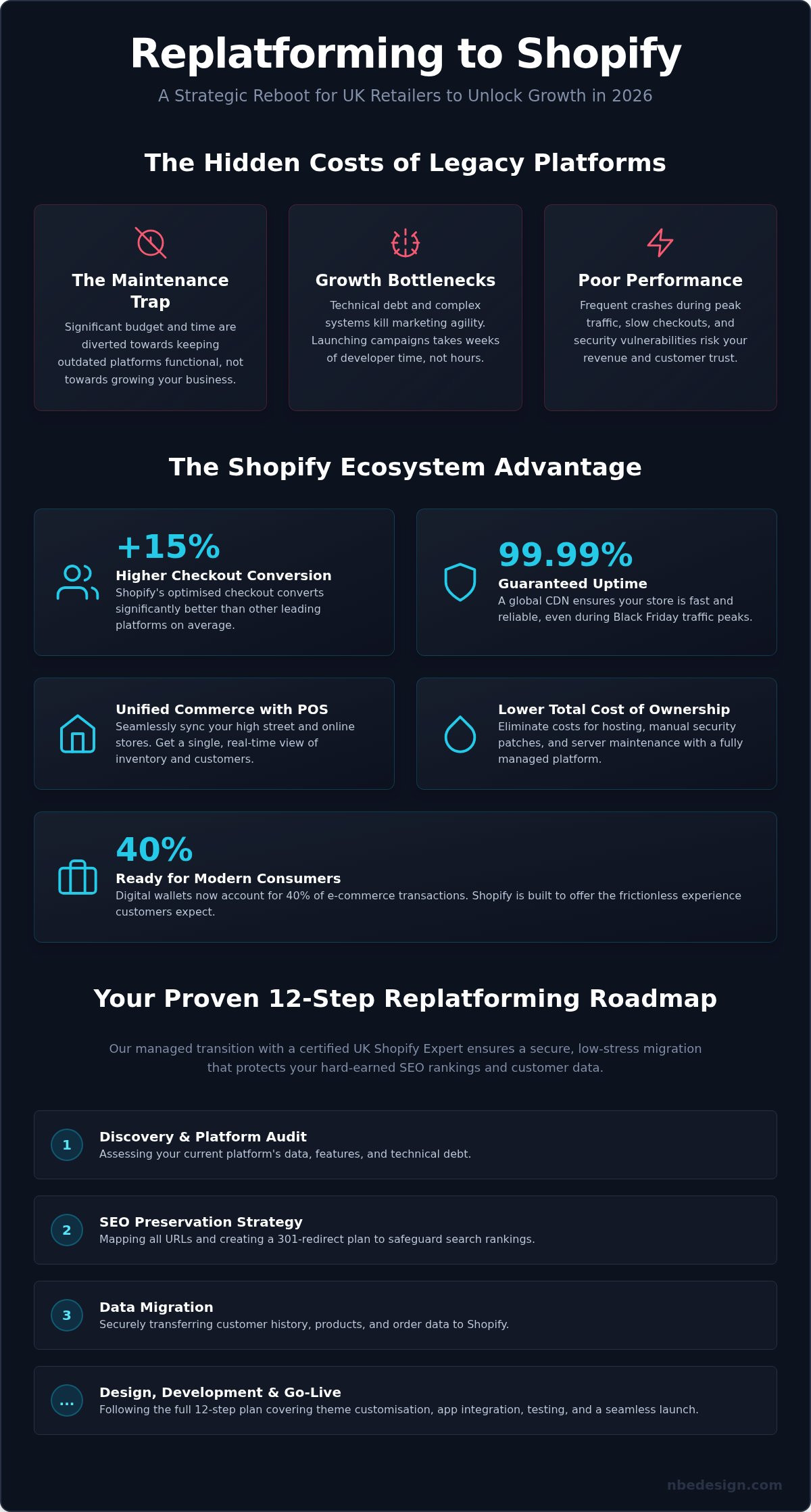
Replatforming is far more than a simple technical migration; it's a strategic reboot of your entire e-commerce ecosystem. In 2026, the gap between agile retailers and those tethered to legacy systems has become a chasm. Many UK businesses are currently caught in the "Maintenance Trap," where a significant portion of their budget is diverted toward keeping outdated platforms like Magento or OpenCart functional. Replatforming to Shopify represents a shift away from manual server management and toward a scalable, cloud-based model that prioritises growth over troubleshooting.
The modern UK consumer expects a frictionless, mobile-first experience. With digital wallets now accounting for 40% of e-commerce transactions, your checkout needs to be instantaneous and secure. Shopify's infrastructure is built for this reality, offering a global CDN and 99.99% uptime that ensures your store remains performant during the highest traffic peaks. By moving to a managed Shopify platform, you eliminate the headaches of hosting and security patches, significantly reducing your Total Cost of Ownership (TCO) while gaining access to a suite of AI-driven tools designed for 2026's competitive market.
Overcoming Growth Bottlenecks and Technical Debt
Technical debt is often the silent killer of marketing agility. If launching a new campaign or adjusting your storefront requires weeks of developer time, your system is a bottleneck. Legacy "free" open-source platforms often carry hidden costs, including expensive specialised hosting and the constant need for manual security updates. In 2026, retailers must prioritise stability. Replatforming to Shopify removes these barriers, allowing your team to deploy new features and marketing strategies in hours rather than months. It's about reclaiming your time so you can focus on brand strategy instead of server logs.
The True Cost of Staying on a Legacy System
Staying on an unpatched or slow legacy system is a high-stakes gamble. Research shows that Shopify's checkout converts 15% better on average than other platforms, meaning every day you delay is a day of lost revenue. Beyond conversion rates, the risk of security breaches on older software is a constant threat to your reputation and GDPR compliance. By partnering with a Shopify Expert UK, you ensure your migration is handled with precision. This managed approach protects your customer data and SEO rankings, moving your business into a secure environment where performance is guaranteed and maintenance is a thing of the past.
The Core Benefits of the Shopify Ecosystem for UK Retailers
For many retailers, the decision to start replatforming to Shopify isn't just about moving a website; it's about joining a robust ecosystem designed for scale. The UK eCommerce market continues to evolve, with consumers demanding seamless experiences across every touchpoint. Shopify provides this through a global Content Delivery Network (CDN) and a guaranteed 99.99% uptime. This reliability is vital during peak trading periods like Black Friday, where even a few minutes of downtime can result in significant lost revenue. It's a platform built to handle the heaviest traffic loads without breaking a sweat.
Beyond stability, the platform simplifies global growth. If you're looking to sell beyond the UK, Shopify Markets handles localised pricing, duties, and taxes automatically. This removes the traditional barriers to international trade that often require expensive custom development on other platforms. Additionally, the Shopify App Store offers thousands of vetted tools that allow you to add complex features, like advanced loyalty programmes or subscription models, without writing a single line of custom code. It's a modular approach that keeps your business agile and ready to pivot as trends change.
Unified Commerce: Integrating Shopify POS with Your Online Store
The modern high street requires a "unified commerce" approach. When you use Shopify POS, your online and physical store inventory stay perfectly synced in real-time. Whether you're running a boutique in Darlington or multiple locations across the UK, you'll never accidentally oversell a product that just walked out the door. This integration provides a single customer view, allowing you to track purchase history across all channels for better-personalised marketing and loyalty rewards. For local retailers, we offer Shopify POS demos and onsite visits in the North East to show exactly how this hardware works in your specific retail environment.
Conversion Rate Optimisation (CRO) Built-In
Shopify is famous for having the world's best-converting checkout. Shop Pay alone can increase checkout speed by 4x, which is crucial since research indicates that Shopify's checkout converts 15% better on average than competitors. A mobile-responsive design isn't just a "nice-to-have" in 2026; it's the foundation of consumer trust. If your site doesn't load instantly and look professional on a smartphone, you're losing customers. If you're curious about how to further refine your store's performance, check out our Conversion Rate Optimisation (CRO): The Ultimate Guide for E-commerce. If you're ready to see how these benefits apply to your specific business model, feel free to get in touch with our team for a professional consultation.
Assessing Your Current Platform: Magento, WooCommerce, or BigCommerce?
Is your current tech stack an engine for growth or a weight around your neck? When considering replatforming to Shopify, the first step is a cold, hard look at your existing technical debt. Many UK retailers find themselves at a crossroads where the cost of maintaining their current system outweighs the benefits of staying. Whether you're battling the manual overhead of open-source software or the limited app ecosystem of other SaaS providers, the goal is to move toward a platform that supports, rather than hinders, your ambition. According to recent e-commerce growth forecasts, the UK market is becoming increasingly competitive, meaning any friction in your backend operations could result in significant lost market share.
While some platforms offer high levels of customisation, they often come with a "complexity tax" that drains your resources. Retailers frequently migrate to Shopify because they're tired of being "platform managers" instead of "brand builders." The move is usually driven by a need for:
- Faster deployment of marketing features
- Lower ongoing development costs
- Superior security without manual patching
- A more intuitive user interface for non-technical staff
Magento to Shopify: Trading Complexity for Conversion
For Magento (Adobe Commerce) users, the struggle often involves expensive, mandatory version upgrades that feel like starting from scratch every few years. This "Magento Tax" includes the high cost of specialised hosting and the constant need for developer intervention just to keep the lights on. Moving to Shopify Plus provides enterprise-grade power without the underlying fragility. You can maintain complex product catalogues and B2B functionalities while enjoying the peace of mind that comes with a fully managed service. It's a shift that allows your team to focus on conversion strategies instead of server stability.
WooCommerce to Shopify: Moving Beyond Plugin Dependency
WooCommerce stores often suffer from "plugin bloat," where dozens of third-party extensions compete for resources, leading to slow load times and frequent site crashes. Scaling a WordPress-based store often leads to a technical ceiling; the more you grow, the more unstable the environment becomes. Replatforming to Shopify removes this dependency on fragile plugin ecosystems. Because Shopify is a native e-commerce platform, core features like security, hosting, and payments are built-in. This results in a cleaner, faster, and more secure site that doesn't break every time you update a single tool. If you're feeling the strain of a DIY setup, speaking with a Shopify Expert UK can help you map out a path to a more professional, reliable storefront.
Your 12-Step Replatforming Roadmap for a Seamless Transition
A managed roadmap for replatforming to Shopify eliminates the guesswork and technical anxiety associated with system transitions. Moving your store isn't a simple weekend DIY project; it's a complex surgical procedure for your digital business. A successful transition is never an accident. It's the result of a rigorous, 12-step roadmap that accounts for every technical nuance of your brand. While the temptation to take a DIY approach might seem like a cost-saver, the long-term price of a broken migration is far higher. A managed plan ensures that your business doesn't skip vital steps, such as the pre-migration data audit. This is your chance to purge "ghost" products and duplicate customer entries, ensuring your new store starts with a clean, accurate database.
Successful replatforming to Shopify hinges on the "SEO First" rule. If you launch without a comprehensive URL redirection strategy, you're essentially telling Google to forget everything it knows about your store. Every old product link, blog post, and category page must be mapped to its new equivalent to preserve your search rankings. This methodical approach prioritises data integrity and search visibility above all else.
The Critical Role of Data Migration and SEO Preservation
Mapping your old URLs to the new Shopify structure is a non-negotiable step. Without 301 redirects, your organic traffic will plummet as customers hit "404 Not Found" pages. Beyond SEO, you must import historical order and customer data securely. This ensures that long-term customers can still access their purchase history and loyalty points after the move. For a deeper look at this process, see our Shopify Migration Services: A Complete Guide to a Seamless Replatform.
Design and UX: Building a Conversion-First Storefront
Replatforming is the ideal time for a brand refresh or a graphic design update. Your new theme should do more than just look pretty; it must be optimised for the 2026 mobile shopper. This means lightning-fast load times and a checkout process that feels intuitive on a smartphone. We focus on ensuring your new Shopify theme aligns perfectly with your UK brand identity while stripping away the friction that kills conversions.
Before hitting the "go live" button, we guide you through the User Acceptance Testing (UAT) phase. This is where we stress-test every button, discount code, and payment gateway to ensure a bug-free experience for your customers on day one. If you're ready to protect your rankings and scale your sales, book a migration consultation with our experts today.
Why Partnering with a UK Shopify Expert is Essential
Choosing a partner for your migration is as critical as choosing the platform itself. While many generalist developers claim they can handle the move, a certified Shopify Expert UK brings a level of specialised craftsmanship that generalists simply can't match. We've evolved alongside the Shopify ecosystem since its inception, giving us a deep-rooted understanding of its architecture and potential. Replatforming to Shopify is a significant investment in your business's future, and it requires a guide who can navigate the technical nuances of SEO preservation, data integrity, and third-party integrations with absolute precision.
The journey doesn't end when the site goes live. A successful transition requires ongoing consulting to refine your operations and scale your growth. We don't just hand over the keys; we act as a long-term strategic partner, helping you interpret performance data and implement new features from the semi-annual Shopify Editions. This supportive relationship ensures you're never left alone with a technical challenge that could disrupt your trade. By positioning ourselves as a "safe pair of hands," we aim to remove the stress from the process, allowing you to focus on your brand while we manage the infrastructure.
The Advantage of a Local North East Shopify Agency
For retailers in Darlington, Newcastle, and across the North East, there's a distinct advantage to working with a local agency. We believe in the power of face-to-face communication. Whether it's an onsite POS training session or a strategy meeting in your boardroom, being grounded in the same region allows us to build a deeper level of trust. We understand the specific challenges of the UK retail landscape, from local consumer expectations to the complexities of UK VAT and e-commerce regulations. This managed, local experience is designed to reduce the anxiety often associated with complex digital transitions, providing a personal touch that global agencies often lack.
Next Steps: Planning Your 2026 Shopify Migration
If you're ready to escape the maintenance trap of your current system, the first step is a comprehensive site audit and migration feasibility study. This allows us to identify potential roadblocks and map out a clear path for your unique business needs. You can see the results of our methodical approach by reviewing our portfolio of successful Shopify migrations, which showcases how we've helped diverse retailers achieve a faster, more reliable online presence. Don't let technical debt hold your business back another year. We're here to ensure your transition is seamless, secure, and geared for long-term stability. To start your journey toward a unified commerce ecosystem, book a consultation with our Shopify Experts today.
Future-proof Your Retail Business for 2026 and Beyond
Replatforming to Shopify is more than a technical upgrade; it's a commitment to your brand's long-term stability and growth. By moving away from the maintenance-heavy legacy systems of the past, you free your team to focus on what matters: delivering exceptional customer experiences. Whether you're unifying your high-street presence via Shopify POS or scaling your online storefront to meet 2026's mobile-first demands, the right infrastructure makes all the difference. You've seen the roadmap and the strategic advantages of a managed transition that protects your hard-earned SEO rankings and customer history.
As a Darlington-based Certified Shopify Expert, NB eCommerce & Design provides the local North East expertise and global reach your business deserves. We specialise in managed migrations and retail integration, acting as the "safe hands" that ensure your data and search visibility remain intact. It's time to stop fighting your platform and start growing your business with a partner who understands the UK retail landscape inside out. Contact our UK Shopify Experts for a Seamless Migration and take the first step toward a simpler, more profitable future. We're ready to help you thrive.
Frequently Asked Questions
How long does it take to replatform to Shopify?
A typical migration takes between 4 and 12 weeks to complete. The exact timeline depends on the complexity of your current data, the number of third-party integrations, and any custom design requirements. Simple stores can often launch faster, while enterprise-level retailers with deep order histories and complex product catalogues require a more methodical, phased approach to ensure a secure transition.
Will I lose my SEO rankings if I move to Shopify?
You won't lose your rankings as long as a comprehensive 301 redirect strategy is implemented. Replatforming to Shopify involves changing your URL structure, so it's vital to map every old page to its new equivalent. This process preserves your search engine authority and ensures that customers clicking on old links are seamlessly guided to the correct page on your new store.
Can I migrate my customer password data to the new store?
No, you cannot migrate passwords because they are encrypted for security on your current platform. While we can securely transfer customer profiles and purchase histories, your customers will need to reset their passwords. The standard practice is to send a professional "Account Invite" email once the new store is live, encouraging users to activate their accounts and choose a new password.
Does Shopify support B2B and wholesale customers?
Yes, Shopify provides robust support for B2B operations, particularly through the Shopify Plus plan. You can manage wholesale price lists, tiered discounts, and net-payment terms directly from your main admin dashboard. This allows UK retailers to run their retail and wholesale channels from a single backend, significantly reducing the administrative overhead and technical complexity of managing two separate systems.
Is Shopify POS included in my monthly subscription?
Shopify POS Lite is included with all plans, but most high-street retailers will require the "POS Pro" version for an additional monthly fee. The Pro version offers essential features for physical stores, such as advanced inventory management across multiple UK locations, staff roles, and "buy online, pick up in-store" functionality. It's a strategic investment for businesses looking to unify their physical and digital sales channels.
Can I keep my existing domain name when I switch?
Yes, you can absolutely keep your current domain name. During the final launch phase of replatforming to Shopify, we simply update your DNS settings to point your domain to Shopify's servers. Your email services and domain registration remain with your existing provider, ensuring there is no disruption to your professional communications or brand identity during the switch.
What happens to my old website once the migration is complete?
Your old website will remain active until you choose to decommission it and cancel your previous hosting. We recommend keeping your old backend accessible for at least 30 days after launch to perform final data audits or retrieve any historical records. Once you're confident the new store is performing perfectly, you can safely shut down the legacy platform while keeping your domain active.
How much does it cost to hire a Shopify migration agency in the UK?
The cost of a managed migration varies significantly based on the scope of your project and specific integration needs. Factors such as the volume of data being moved, the level of custom design, and the complexity of your ERP or POS integrations will influence the final investment. A certified agency will typically provide a bespoke quote following a detailed site audit and feasibility study.

- Posted in:
- eCommerce Migration
- eCommerce SEO
- Replatforming
- replatforming to shopify
- Shopify
- Shopify Guide
- Shopify POS
- UK Retail