Skip to content
What is Shopify? The Ultimate 2026 Guide to the World’s Leading Commerce Platform
-
3747 words · 18 min read

What if the only thing standing between your retail business and a 30% increase in operational efficiency is the software you choose today? It's a question we've helped hundreds of UK retailers answer since we began our journey as a Shopify Expert in 2006. You've likely heard the name, but you're probably still asking: what is Shopify, and can it actually handle the complexities of your specific business? It's completely normal to feel overwhelmed by technical choices or anxious about migrating years of precious customer data into a new system.
The principle of a professional online presence applies universally, from digital products to large-scale physical goods. For an interesting example of a business that markets specialized housing, you can click here.
We agree that choosing a commerce partner shouldn't feel like a high-stakes gamble. That's why this guide cuts through the jargon to show you exactly how the ecosystem works for modern British brands. You'll discover how to unify your high street shop with your online store, manage inventory without manual errors, and understand the real costs starting from approximately £25 per month. We're providing a clear roadmap to help you build a rock-solid, future-proof business. If the technical side feels daunting, you can always get in touch for expert support. From the initial setup to mastering your POS system, here is everything you need to scale with total confidence.
Key Takeaways
- Understand what is Shopify and how its unified commerce model differs from basic website builders to simplify your entire retail management.
- Explore the "Platform + App Store" ecosystem to discover how to customise your store’s functionality and visual identity for a professional, future-proof finish.
- Compare 2026 pricing tiers-from Basic to Shopify Plus-to identify the most efficient and scalable plan for your specific business goals in the UK.
- Master the transition to omnichannel retail by learning how Shopify POS synchronises your brick-and-mortar inventory with your online sales in real-time.
- Recognise why expert strategy is essential for optimising conversion rates and SEO, ensuring your store is built for long-term growth and rock-solid performance.
What is Shopify? A Definition of Unified Commerce
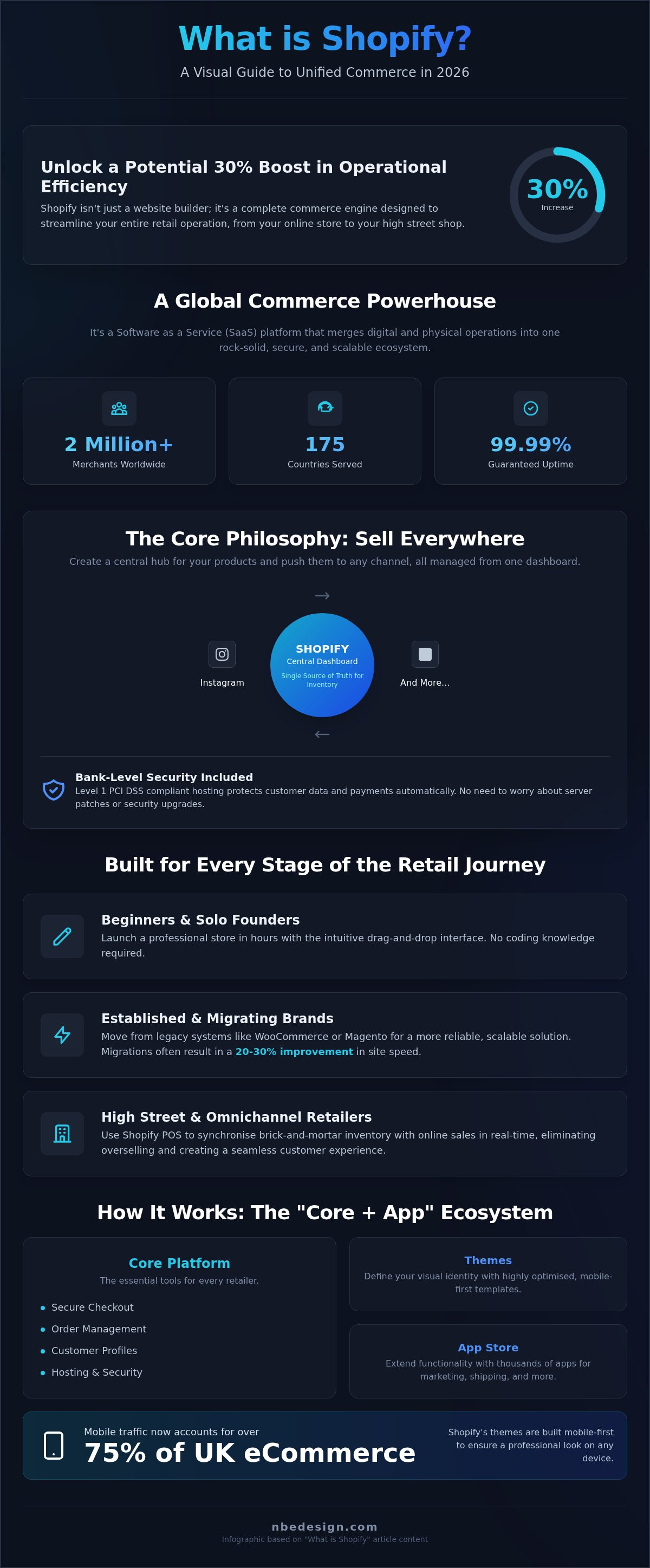
If you're asking what is shopify in 2026, the answer has evolved significantly over the last two decades. It's no longer just a tool for building a website; it's a leading Software as a Service (SaaS) commerce engine that powers the entire retail economy. Since its birth in 2006, Shopify has grown from a small Canadian snowboarding shop into a global powerhouse. Today, it supports over 2 million merchants across 175 countries, processing hundreds of billions of pounds in annual sales.
Unlike basic website builders that only handle your online storefront, this is a unified commerce platform. It merges your digital and physical operations into one rock-solid ecosystem. This approach is why global brands like Gymshark, which started in a garage in 2012 and now generates over £400 million in annual revenue, choose it to scale. It provides a foundation that handles the technical heavy lifting, allowing you to focus on growth rather than server maintenance.
The platform offers a 99.99% uptime guarantee, ensuring your shop remains active even during the most intense traffic spikes. By 2026, the system has integrated advanced AI features through Shopify Magic, automating everything from product descriptions to sophisticated customer segmentation. This level of automation ensures that even a solo founder can operate with the efficiency of a much larger corporation.
The Core Philosophy: Selling Everywhere
The platform operates on a multi-channel philosophy. You aren't just building a standalone site; you're creating a hub that pushes products to Instagram, TikTok, Amazon, and eBay simultaneously. Everything is managed through a centralised dashboard. This single source of truth ensures your inventory levels are always accurate, which prevents the risk of overselling across different platforms.
Managing the technical hurdles of hosting and security used to be a full-time job for developers. Shopify simplifies this by including Level 1 PCI DSS compliant hosting as standard. This means your customer data and payment information are protected by the same security standards used by major banks. You don't need to worry about patching software or upgrading servers; the platform handles it all automatically.
Who is Shopify For?
It's built for every stage of the retail journey. Beginners find it accessible because the drag-and-drop interface requires zero coding knowledge. You can launch a professional, conversion-focussed store in a matter of hours. The learning curve is gentle, but the ceiling for customisation is incredibly high for those who want to push the boundaries of design.
Established retailers often use the platform as a migration destination. We frequently help businesses move from legacy systems like WooCommerce or Magento to streamline their operations. These migrations often result in a 20% to 30% improvement in site speed and mobile performance. It's a future-proof choice for brands that have outgrown their current setup and need a more reliable, scalable solution.
High street shops in the UK also benefit from this unified approach. By using Shopify POS, a brick-and-mortar shop can synchronise its physical and digital inventory in real time. If you sell a jacket in your Middlesbrough or Durham shop, your online stock levels update instantly. This eliminates the frustration of "out of stock" emails and provides a seamless experience for your customers. If you're ready to make the switch with confidence, you can get in touch with our team to discuss your specific business needs.
How Shopify Works: The Ecosystem Explained
At its core, understanding How Shopify Works involves seeing it as a centralised hub for your entire retail operation. It isn't just a website builder; it's a proprietary Software as a Service (SaaS) platform that handles everything from hosting to security. By 2026, the platform has evolved to offer even deeper integration between online and offline sales, ensuring your inventory stays synced across every channel. When people ask what is shopify, they often focus on the storefront, but the real power lies in how it unifies your business data into one manageable dashboard.
The platform follows a "Core + App" model. The core provides the essential tools every retailer needs: a secure checkout, order management, and customer profiles. You define your visual identity through themes, which are highly optimised templates that ensure your store looks professional on any device. Since mobile traffic now accounts for over 75% of UK eCommerce visits, these themes are built to be responsive and fast. Behind the scenes, Shopify handles the technical heavy lifting. You'll benefit from 99.99% uptime and Level 1 PCI DSS compliance, meaning your customers' payment data is always protected without you needing to manage complex server security.
Managing the day-to-day becomes much simpler with Shopify's backend. You can track every order from placement to delivery, create detailed customer segments for marketing, and use predictive analytics to forecast stock levels. This rock-solid foundation allows you to focus on growth rather than troubleshooting technical glitches.
The Shopify App Store: Extending Functionality
While the core platform is robust, the Shopify App Store is what allows for unlimited customisation. You can add features like advanced loyalty programmes, product reviews, or specialised SEO tools with just a few clicks. However, it's easy to fall into the trap of "app bloat." Installing too many third-party scripts can slow your site down, which directly hurts your conversion rates. To build a future-proof tech stack, many retailers work with Shopify Experts in the UK to select only the most efficient, high-performing apps. This curated approach keeps your site lean and ensures every tool adds genuine value to the customer journey.
Payments and Checkout: The World’s Best Converting
The checkout is the most critical part of your store, and Shopify’s is widely regarded as the best in the world. By using Shopify Payments, you can accept all major credit cards, Apple Pay, and Google Pay without setting up a third-party gateway. The standout feature is Shop Pay, an accelerated checkout that can improve conversion rates by up to 50% compared to standard guest checkouts. It securely stores customer details, allowing them to complete a purchase with a single tap. In the competitive UK market, reducing friction at this stage is the fastest way to increase your revenue. If you're ready to see how these features can streamline your specific business, it's a great time to get in touch with a specialist who can guide your setup.
By 2026, the question of what is shopify has changed from "how do I build a site" to "how do I scale my brand." The ecosystem is designed to grow with you, whether you're processing your first ten orders or managing a multi-million pound international enterprise. It provides the stability of a hosted platform while maintaining the flexibility of a custom-built solution.
Evaluating the Costs: Shopify Pricing and Plans in 2026
Understanding what is Shopify requires a clear look at the financial commitment involved in running a modern store. In 2026, the platform remains the gold standard for retail because it consolidates hosting, security, and commerce tools into a single monthly subscription. For most UK retailers, the journey begins with one of three core plans. The Basic plan, priced at approximately £25 per month, provides everything a new business needs to start selling. The mid-tier Shopify plan, at roughly £65 per month, adds professional reporting and additional staff accounts. For scaling businesses, the Advanced plan at £344 per month offers the lowest transaction rates and enhanced 10:1 custom report building capabilities.
Enterprise retailers with high transaction volumes typically move to Shopify Plus. Starting at around £1,600 per month, this tier provides a dedicated account manager and the ability to handle over 10,000 transactions per minute without a glitch. When reviewing Shopify Pricing and Plans, it's vital to distinguish between subscription fees and processing costs. If you use Shopify Payments, you avoid third-party transaction fees entirely. However, if you choose an external gateway like PayPal or Klarna, Shopify charges an additional fee ranging from 0.5% to 2% depending on your plan. This structure encourages users to stay within the integrated ecosystem for maximum efficiency.
We view these costs as an investment in a future-proof retail infrastructure. Instead of paying for fragmented services, you're securing a platform that evolves with the market. If you're unsure which tier fits your current turnover, you can get in touch with our team for a tailored breakdown.
Hidden Costs to Budget For
While the monthly sub covers the essentials, growth requires a few extras. A custom .co.uk or .com domain typically costs £15 to £20 annually. Professional email hosting via Google Workspace or Outlook adds about £5 per user each month. While free themes are functional, most serious brands invest £250 to £350 in a premium, high-conversion theme. You should also budget for bespoke graphic design services. High-quality visuals are non-negotiable for brand consistency, as 75% of users judge a business's credibility based on its website aesthetics.
Is Shopify Worth the Monthly Fee?
The "total cost of ownership" is where Shopify truly shines against self-hosted alternatives like WooCommerce or Magento. On a self-hosted platform, you might pay £80 per month for high-performance hosting plus an average of £150 per hour for a developer to fix security vulnerabilities or broken plugins. Shopify removes these headaches. You save roughly 40 hours of maintenance time per year because the platform handles all updates and PCI compliance automatically.
The ROI becomes clear when you factor in conversion rates. Shopify's checkout is proven to convert up to 36% better than competing platforms. When you're not worrying about server crashes during a Black Friday sale, you're free to focus on marketing and customer service. For a UK business looking to scale without technical friction, the monthly fee is a small price for a rock-solid foundation. What is Shopify if not a tool to simplify your growth? It provides a predictable cost model that allows you to forecast your margins with 100% accuracy.
Bridging the Gap: Shopify POS for UK Retailers
Success on the UK High Street in 2026 requires more than just a physical presence. It demands a seamless connection between your shop floor and your digital storefront. This is where Shopify POS (Point of Sale) becomes your most valuable employee. It's a unified system that ensures your brick-and-mortar sales and online orders live in perfect harmony. When new clients ask us what is Shopify, we explain that it's a bridge between two worlds that used to be separate. It turns a fragmented business into a streamlined, single-engine operation.
The most immediate benefit is real-time inventory synchronisation. If you sell your last pair of limited-edition trainers in your physical shop, Shopify updates your website in less than a second. This prevents the frustration of overselling and having to issue refunds. It's about maintaining a rock-solid reputation for reliability. Your stock levels stay 100% accurate, whether you're selling from a boutique in Teesside or a warehouse serving the entire country. You don't have to manually count stock at the end of every day because the system does the heavy lifting for you.
Data drives modern retail growth. With a single customer view, your staff can see a shopper's entire history the moment they provide an email address. If a regular customer walks into your store, your team can see their previous online orders and suggest matching items. This level of personalised service was once reserved for high-end luxury brands; Shopify makes it accessible for every small business owner in Britain. It allows you to build genuine loyalty by acknowledging your customers' preferences across every touchpoint.
The Best Till Systems for Small Shops
Setting up a professional checkout doesn't need to be a technical headache. We often recommend the Shopify POS Go, an all-in-one mobile device that lets you take payments anywhere on the shop floor. For those looking for a fixed counter setup, the hardware is sleek and integrates perfectly with iPad systems. You can find the best till POS system for small shops UK through our dedicated hardware guide. It's designed to be plug-and-play, so you're ready to trade in minutes without complex wiring or difficult software installs.
Managing Multi-Location Retail
Growth often leads to opening a second or third location. Shopify handles this complexity with ease. You can move stock between warehouses and shops with simple transfer orders. The "Buy Online, Pick Up In-Store" (BOPIS) feature, often called Click & Collect, is now a standard expectation for 68% of UK consumers according to the 2025 Retail Trends Report. It drives footfall into your physical space while providing the convenience of online shopping. Detailed reporting shows you exactly which location is performing best, allowing you to make data-backed decisions about where to invest your marketing budget next.
Retailers who unify their sales channels see an average revenue increase of 30% within the first year of switching. If you're still wondering what is Shopify capable of for your specific business, it's the tool that turns your physical shop into a high-tech fulfilment hub. It's about working smarter to meet the demands of the 2026 shopper. By removing the friction between online and offline, you future-proof your business against changing consumer habits.
Success on Shopify: Why Expert Guidance Matters
Opening a digital storefront is simpler than it used to be, but building a profitable, scalable brand requires more than just a basic setup. When people ask what is shopify, they often view it as a plug-and-play tool for beginners. While the platform is accessible, the gap between a hobbyist site and a high-revenue enterprise is vast. In 2026, the UK eCommerce market is more competitive than ever. You need a rock-solid strategy to ensure your investment actually delivers a return.
DIY setups often lead to hidden technical debt that stifles growth. A store that loads just one second slower than the industry average can see a 7% drop in conversions. Without professional input, many retailers fall into the trap of "app bloat," where too many conflicting plugins drag down site speed and compromise security. Understanding what is shopify in a professional context means recognising it as a powerful engine that requires expert tuning. This applies even to niche passion projects; for instance, a store where customers can explore OO9 Locomotive & Wagon Kits needs a professional setup to scale successfully.
We've been a Shopify Partner since the platform's birth in 2006. We act as long-term growth allies for our clients, helping them skip the expensive trial-and-error phase that costs many startups their first £10,000 in lost sales. Our role is to provide the calm expertise you need to navigate technical shifts with total confidence.
The Benefits of a Professional Migration
Moving from older platforms like Magento or WooCommerce is a high-stakes operation. A botched DIY move can cause a business to lose 30% of its organic traffic overnight if 301 redirects aren't mapped correctly. We ensure a hassle-free transition by protecting your hard-earned SEO rankings and safely migrating years of customer records and order history. You can explore our portfolio of Shopify projects to see how we've helped UK brands move to the cloud without losing a single pound in visibility.
Crafting a Conversion-Focused Store
A generic template won't build the brand authority required to win in 2026. Mobile-first design is now the absolute standard, as over 82% of UK retail traffic originates from handheld devices. We build bespoke, conversion-focussed stores that guide customers naturally toward the checkout. Our designs focus on reducing cart abandonment, which currently sits at a staggering 70% for unoptimised sites. We use data-driven layouts to ensure your store isn't just pretty, but a high-performing sales machine. Ready to scale your business? Contact our team to discuss your Shopify project and future-proof your retail operations.
Future-Proof Your Retail Business with Shopify
Understanding what is shopify involves seeing it as a unified commerce engine that connects your online presence with the UK high street. By 2026, the platform has become the gold standard for retailers who need to sync inventory and sales data without the technical headaches. It's a rock-solid foundation for growth. We've been an official Shopify Partner and Expert since 2006, literally growing up alongside the platform to support retailers in the North East and across the globe. Our team specialises in seamless platform migrations and complex POS integrations, ensuring your transition is efficient and future-proof.
Don't let the technical details of a migration or a new store launch hold your business back. We're here to provide the calm expertise and supportive guidance you need to thrive in a competitive market. Ready to build your dream store? Get in touch with our Shopify Experts today.
Let's start building your success story today.
Frequently Asked Questions
Is Shopify easy to use for a complete beginner?
Shopify is exceptionally user-friendly for beginners because it uses a visual drag-and-drop interface that requires zero coding knowledge. You can manage your entire inventory and process orders from a single dashboard. As a Shopify Partner since 2006, we've seen retailers launch their first store in just 7 days. The platform handles the complex hosting and security, so you can focus on selling.
Can I use my own domain name with Shopify?
You can absolutely use your own custom domain name to maintain a professional brand identity. If you already own a .co.uk or .com domain through a provider like 123 Reg or GoDaddy, you can connect it to your store in minutes. Alternatively, you can purchase a new domain directly through the admin panel starting at approximately £11 per year, which simplifies your billing into one monthly payment.
How does Shopify handle UK VAT and taxes?
Shopify automates UK VAT calculations by applying the standard 20% rate to applicable products based on your customer's location. The system identifies UK tax registrations and can generate VAT-compliant invoices automatically using free apps like Shopify Order Printer. For businesses with a turnover exceeding the £90,000 threshold, the platform's integrations ensure 100% accuracy for Making Tax Digital requirements.
What is the difference between Shopify and Etsy?
The primary difference is that Shopify is a dedicated eCommerce platform where you own the digital real estate, while Etsy is a shared marketplace. When people ask what is shopify, they're often looking for a way to build a standalone brand without competing against other sellers on the same page. Shopify gives you full control over your customer data, whereas Etsy charges a 6.5% transaction fee per sale. For those exploring the marketplace model, resources like Living the Hustle offer insights into succeeding on platforms like Etsy.
Do I need a business licence to sell on Shopify in the UK?
You don't need a specific Shopify licence to start, but you must register as a sole trader or limited company with HMRC if you earn more than £1,000 in a tax year. Most UK sellers operate as a Private Limited Company to protect personal assets. If you're selling restricted goods like alcohol or tobacco, you'll need specific local authority licences regardless of the platform you use.
Can Shopify handle thousands of products and high traffic?
Shopify is built to scale and currently powers brands like Gymshark that manage over 10,000 SKUs and millions of monthly visitors. The platform boasts a 99.99% uptime, even during high-pressure events like Black Friday. For high-volume retailers, Shopify Plus provides a rock-solid infrastructure that handles up to 10,000 transactions per minute without the site slowing down or crashing.
What happens if I want to leave Shopify later?
You own all your customer and product data, which you can export as CSV files at any time if you decide to migrate. While you can't take the proprietary Shopify theme code with you to a platform like WooCommerce, your database remains your property. We've helped dozens of retailers with seamless migrations, ensuring that 100% of their historical order data is preserved during the transition.
How long does it take to build a professional Shopify store?
A basic store using a pre-made theme can be launched in 14 days, while a fully bespoke, conversion-focussed site typically takes 6 to 12 weeks. The timeline depends on your product count and the complexity of your backend integrations. If you need a professional finish that's ready for the 2026 market, get in touch with our team of experts to discuss your project.

- Posted in:
- Ecommerce
- Omnichannel Retail
- Online Store
- Shopify
- Shopify Guide
- Shopify POS
- Shopify Pricing
- UK Retail
- what is shopify