Skip to content
North East England Ecommerce Solutions: Shopify for Local Retailers
-
3315 words · 16 min read

What if your online orders, shop-floor sales and stock could work together in one connected retail setup? For North East retailers, managing separate systems can mean repeated updates and extra manual checks. Choosing a platform or planning a migration can also feel like a big step. Effective north east england ecommerce solutions should support the whole operation, not just launch a website.
Shopify can connect online and in-store retail, with shared inventory and customer profile management through Shopify POS. The right setup depends on how your business sells, the systems you use and your plans for growth, so a clear, considered approach matters. Based in Teesside, NB eCommerce & Design supports retailers across the North East with Shopify store design and development, migration and POS integration. The team has worked with Shopify since its launch in 2006 and became a Shopify Select Partner in January 2026.
Here, you’ll discover what a joined-up Shopify solution can involve, how to approach design or migration, and how to identify a sensible next step for your retail business. You’ll also find practical ways to prepare for a project, from reviewing product information to mapping how your team handles stock across sales channels.
Key Takeaways
- North east england ecommerce solutions should reflect how your retail business actually sells, rather than rely on a generic list of features.
- Identify where gaps in stock visibility or customer information are creating extra work across your sales channels.
- Match your next step to your needs, whether you’re building a store, improving an existing one, migrating platforms or integrating POS.
- Set a clear project scope by reviewing business goals, current systems, product data and in-store requirements.
- Learn how a North East Shopify partner can bring design, migration and POS integration into a considered plan for your business.
Why North East England retailers need joined-up ecommerce solutions
A retailer might take orders through an online shop, serve customers at a physical till and manage stock in a separate system. When those parts don’t share information, staff may need to update records more than once, check availability manually or make platform decisions without a clear view of how each system fits. These processes can become harder to manage as a business adds sales channels or locations.
North East England retailers operate in a varied regional economy, serving local communities as well as customers further afield. The region’s industrial history and transition towards a service economy provide context for its changing business landscape, as outlined in this overview of the North East England economy. A practical ecommerce setup should start with a retailer’s own customers, operations and plans, rather than assumptions about what every business needs.
Joined-up retail ecommerce brings an online shop and in-store operations together so a retailer can manage sales, stock and customer information across channels. Shopify can support that setup through store design and development, Shopify POS integration, migration from an existing platform, and ongoing Shopify support. The right scope depends on the systems already in use, how customers shop and the retailer’s plans.
- Current systems: Identify where product, stock and customer information is held. Note where staff have to repeat updates or check details manually.
- Customer needs: Consider how people browse, buy and interact with your business online and in person.
- Future plans: Decide whether the priority is launching a first online shop, improving an existing setup or connecting retail locations.
What does a joined-up ecommerce solution include?
The customer-facing online shop presents products and supports online purchases. Behind it, operational systems help staff manage the business. Shopify store design and development shapes the online experience, while Shopify POS can connect inventory and customer profiles across online and in-store channels. If you already have an online shop, migration services can help move it to Shopify, with the plan shaped around your current systems and requirements.
Which North East retailers can benefit?
An independent shop in Middlesbrough might be building its first online storefront. A Darlington retailer could be looking to connect shop-floor sales with online stock, while a Durham business might need to coordinate sales across multiple locations. Each situation calls for a different project scope, from store design to migration or POS integration.
For a smaller retailer, a useful first priority may be making product information and stock easier to manage across channels. A medium-sized business might need a migration plan that accounts for its existing store and day-to-day processes. A multi-location chain may focus on connecting in-store operations with online sales. Retailers interested in seeing how Shopify POS can fit a physical shop can explore North East Shopify POS demos and onsite visits.
How Shopify connects online and in-store retail for North East businesses
Shopify provides a platform for online stores, point of sale and connected retail operations. Retailers can plan their digital storefront and physical shop as parts of the same business, rather than treating an ecommerce website as a separate project. The Office for National Statistics publishes UK retail sales statistics, including information about internet sales, which businesses can use as a reference when reviewing how customers shop.
For North East England ecommerce solutions, the practical question is how online and in-store activity can be managed together. Shopify POS connects inventory and customer profile management across channels. Retailers can present products through an online shop and sell them in person, with inventory and customer profiles managed across both channels.
How Shopify POS supports connected retail
Consider a retailer selling the same products online and from a physical shop. If stock is maintained separately for each channel, staff may need to reconcile records manually. Shopify POS supports inventory management across online and in-store channels, helping the business manage stock information together. The setup should reflect the retailer’s products, processes and current systems.
Customer profiles can also be managed across both channels. This gives the retailer a shared way to handle customer information, whether someone shops through the website or visits the shop. Staff can work with customer profiles across channels instead of treating online and in-store customers as entirely separate groups.
Unified inventory and customer profiles give retailers a shared view of stock and customer information across online and in-store sales.
A typical workflow might begin with a retailer adding or updating product information for its online shop, then selling those products at a physical till through Shopify POS. When a product sells in store, inventory management across channels helps the retailer account for that sale alongside online activity. The aim is to choose a setup that fits how the business trades, rather than add technology for its own sake.
When a Shopify migration may be the right next step
A migration may make sense when an existing platform no longer fits a retailer’s needs, or when the business wants to bring its online shop and POS into a more connected setup. Planning involves more than moving product information. Shopify migration services can include data transfer, design, launch and a migration guide to help the retailer understand the new platform.
Before deciding, map what the current platform holds, how product and customer information is organised, and which parts of the existing design should inform the new store. The migration plan can then reflect the retailer’s requirements without assuming that a platform change will automatically produce a particular business result. If you’re weighing up a connected Shopify setup or migration, talk through your Shopify project with the team.
Compare North East ecommerce solutions by retail need, not feature lists
A long list of platform features won’t tell you which project is right for your shop. Start with the task that needs attention: launching an online store, improving the one you have, moving from another platform or linking online sales with a physical shop. This makes it easier to shape north east england ecommerce solutions around day-to-day priorities, rather than focusing on features you may not need.
| Retail situation | Relevant Shopify support | What to consider |
|---|---|---|
| Boutique launching online | Shopify store design and development | Product presentation, customer experience and the information shoppers need to choose items. |
| Established retailer refreshing an existing store | Store improvements, theme customisation and UX design | Which parts of the current design work, and where customers may need a clearer journey. |
| Retailer moving platforms | Shopify migration services | Product and customer data, design requirements, launch preparation and the current platform setup. |
| Business with one or more physical shops | Shopify POS integration and relevant hardware solutions | Whether shared inventory and customer profile management across channels fits the way the business operates. |
The scale and shape of the business matter, too. A boutique may prioritise a distinctive, easy-to-manage online shop. An established retailer may want to retain useful parts of its current setup while addressing design or platform limitations. A multi-location chain may place greater emphasis on how its online operation and shop-floor processes work together across locations. These are starting points, not fixed packages: project scope should reflect the retailer’s systems, products and plans.
Choosing between a new Shopify store and a redesign
If you’re opening an online shop for the first time, the project starts with store design and development. If you already sell online, decide whether the current store needs a focused refresh or a more substantial redesign. Customisable templates, theme customisation and UX design can help shape the storefront around your products and customer journey. Conversion optimisation can inform design decisions, but no particular sales result should be assumed.
Deciding whether Shopify POS fits a physical shop
Shopify POS may suit retailers who want inventory and customer profiles managed across online and in-store channels. Consider how staff handle products and customer information today, and whether a connected approach fits those processes. Shopify POS hardware solutions are available for UK retailers; the setup should reflect the shop’s requirements. Retailers exploring the in-store side can view Shopify POS demos and onsite visits in the North East.
Choose a project by its purpose, not by the number of features on a platform page. A clear brief helps define whether you need a new storefront, targeted design work, a migration or POS integration, and which elements belong in scope now. That gives you a practical basis for discussing the right Shopify setup for your retail operation.
Plan a Shopify ecommerce project with clear steps and local support
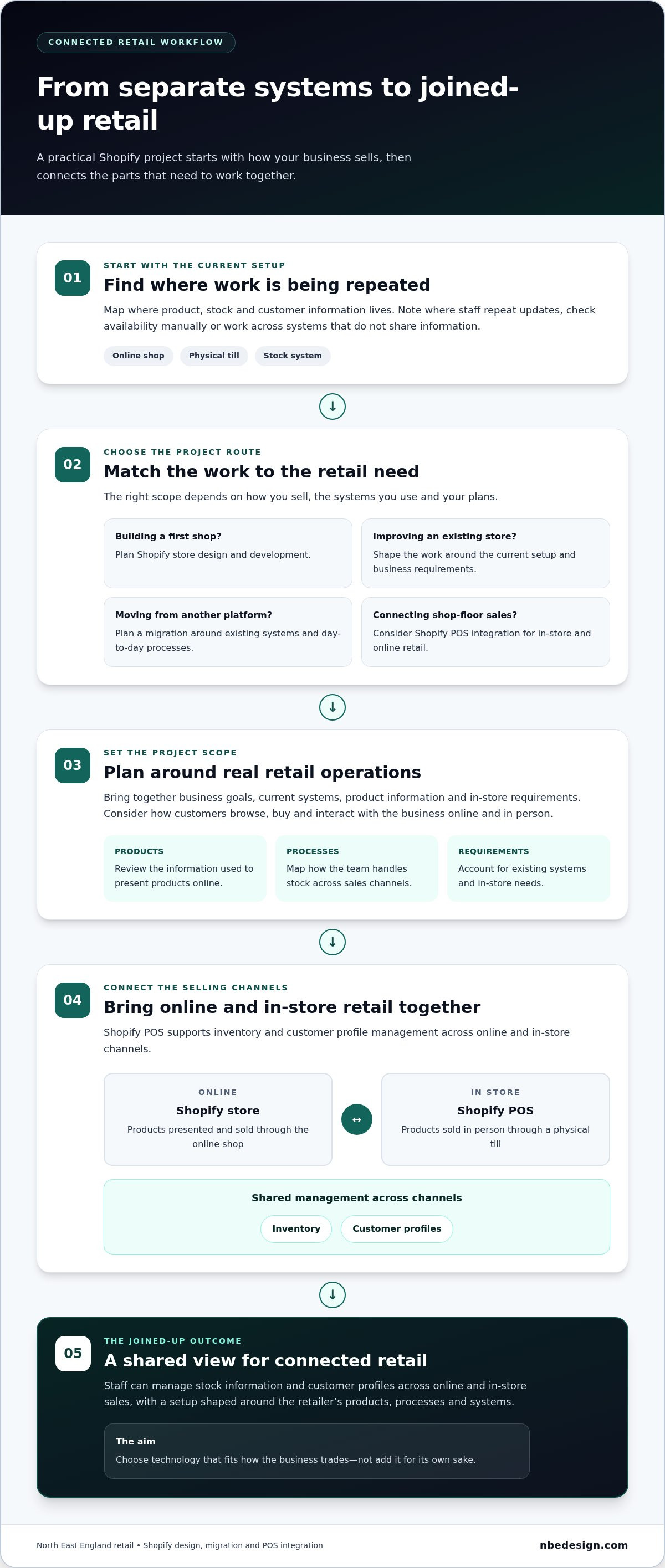
A well-scoped Shopify project starts with the way your retail business works, not a software checklist. Before choosing what to build or change, clarify the outcome you want, the systems involved and the tasks your team needs to manage day to day. This gives the project a practical foundation and separates essential requirements from ideas to consider later.
Plan in this order: set business goals, map current systems, review products and stock, define store or POS requirements, then agree the project scope.
Prepare your requirements before a Shopify project
Gather the details that will shape the work. You don’t need a technical document; a clear picture of your current retail operation is a useful starting point. Note where you sell, how product information is maintained and what staff need to know about stock. If you use an existing ecommerce platform, include how its data and design support your business.
- List sales channels: Record where customers can buy, such as your online shop and physical locations.
- Review product information: Note how product details, options and images are organised, and identify information that needs attention.
- Describe stock processes: Explain how stock is recorded, updated and checked by the team.
- Define the project type: Clarify whether you need a new Shopify store, store design improvements, a migration, POS integration or a combination.
- Set priorities: Separate must-haves for the initial scope from future improvements to keep planning focused on business needs.
For a migration, review the information and existing setup that need to be considered during the move. For a new store, focus on the products and customer journey the design must support. If POS is part of the project, describe how the shop-floor team handles sales and stock. These details help shape north east england ecommerce solutions around your retail business, rather than a generic specification.
Use local expertise while planning a regional project
NB eCommerce & Design is based in Teesside and works with retailers across North East England. Local knowledge can make planning conversations more grounded in the realities of running a shop in the region, whether your business is in Middlesbrough, Darlington, Durham or nearby. For a project involving a physical store, the North East Shopify POS demos and onsite visits page relates directly to exploring the in-store setup.
Once the project is live, ongoing Shopify support and consulting can help retailers manage their store and work through questions as their needs evolve. Support can be useful when a project includes connected parts such as store design, migration and POS integration. Agree which areas need attention so the work remains aligned with your business priorities.
Bring your goals, current systems and priority list into a conversation about scope. Discuss your Shopify project with NB eCommerce & Design to identify a clear next step for your retail business.
Work with a North East England Shopify partner to take the next step
The right Shopify project is the one that fits your retail operation. You might need a new online store, a migration from an existing platform, Shopify POS integration for a physical shop, or support with a store you already run. The scope can be shaped around your systems, customers and priorities, whether you need one area of support or several coordinated elements.
NB eCommerce & Design is based in Teesside and supports retailers across North East England, as well as Shopify clients internationally. Its Shopify specialism gives retailers a clear way to discuss their requirements with a team working within the Shopify ecosystem. The goal is to shape a project around your business needs, rather than assume every retailer needs the same approach.
What NB eCommerce & Design can help retailers with
Shopify store design and development can support a retailer launching online or shaping an existing storefront. Shopify migration services help businesses plan a move to Shopify, while Shopify POS integration addresses the needs of physical retail. Ongoing support and consulting are available to Shopify retailers in the UK and internationally, helping them work through platform and store-management questions as their needs change.
These services can be considered together without assuming every retailer needs the same project. A business moving platforms may also want to review its store design, while a retailer with an established online shop may be focused on POS integration. Start with your current setup and the operational issue you want to address. To discuss specialist Shopify support in the UK, get in touch with NB eCommerce & Design.
- Store design and development: Shape an online shop around your products and the way customers browse.
- Migration: Plan a move to Shopify around your current store and business requirements.
- POS integration: Address the needs of your physical retail operation.
- Ongoing support and consulting: Get help with Shopify questions as your store and priorities develop.
Start a conversation about your ecommerce project
A useful first conversation can begin with a simple outline: which platform or store setup you use now, whether you sell in person as well as online, and what you most want to address. Sharing these priorities helps frame a discussion about the right Shopify support without needing a finished technical brief.
If you’re ready to consider the next step, discuss your Shopify ecommerce project with NB eCommerce & Design. Describe your current retail setup and priorities, and start shaping an approach around your business.
Take the next step towards a more connected retail setup
Your next move doesn’t need to address every part of your retail operation at once. Start with the issue that matters most: planning a new online shop, making an existing store easier to use, moving platforms or connecting in-store and online processes. A clear priority gives you a practical starting point for shaping north east england ecommerce solutions around your business, rather than trying to solve everything in one project.
Bring a short outline of your current setup and what you’d like to improve. From there, you can discuss which Shopify support fits your priorities and how the work could be scoped. A considered conversation can turn a broad ambition into a manageable next step, whether your immediate focus is design, migration or POS integration.
Discuss your Shopify ecommerce project with NB eCommerce & Design and start shaping an approach that fits your retail business.
Frequently Asked Questions
What ecommerce solutions are available to retailers in North East England?
Retailers can explore north east england ecommerce solutions by identifying the operational issue they want to address. Is the priority making products easier to browse, reducing duplicated admin, or preparing the business to sell through another channel? Write down the current process and the change you want to make. This gives a project discussion a useful starting point and helps distinguish immediate needs from ideas to revisit later.
Can Shopify connect an online shop with a physical retail store?
Yes. A retailer can plan its online shop and physical checkout as parts of a Shopify setup. Before deciding on the requirements, map how staff process in-person transactions, handle exchanges and check product availability, then note where the online workflow differs. This comparison can clarify what the team needs from its setup and where staff guidance may be useful. Shopify POS hardware solutions are available for UK retailers.
Is Shopify suitable for a small independent shop?
Yes. An independent shop can use Shopify, with the project shaped around its product range and the time available to maintain the store. Before starting, decide who will update product details, how often information needs reviewing and which items should appear online first. These practical choices help keep the store manageable for a small team and give design decisions a clear purpose.
Can an existing ecommerce store be migrated to Shopify?
Yes. An existing ecommerce store can be migrated to Shopify. Alongside reviewing products and workflows, make an inventory of customer-facing content that matters to the business, such as key information pages, policies and links customers may have saved. This gives the project team a clearer picture of what the new store should retain or revise. The migration plan can then account for those priorities rather than treating every page alike.
Does NB eCommerce & Design work with retailers outside North East England?
Yes. NB eCommerce & Design supports Shopify clients internationally, including in Europe, the USA, Canada and Australia. For a retailer working across markets, outline which audiences the store serves and whether product information or business processes differ between them. Sharing that context at the outset helps frame the Shopify project around the retailer’s operating needs, whether the business is nearby or overseas.
What does a Shopify ecommerce project cost?
Pricing details are available on request. The scope depends on the work required, so describe the outcome you’re planning for and any requirements that may affect the project’s complexity. For example, distinguish essential launch needs from optional refinements, and note any existing systems the new setup needs to account for. Share your Shopify project requirements to discuss relevant scope and pricing.
How can I see Shopify POS in action in North East England?
Retailers can explore the North East Shopify POS demos and onsite visits. To make the discussion useful, prepare a few typical shop-floor scenarios, such as how staff serve customers during busy periods or deal with a product query at the till. These examples can help focus the conversation on your team’s practical questions and the way your shop operates.

- Posted in:
- ecommerce solutions
- inventory management
- north east england ecommerce solutions
- North East retail
- retail migration
- Shopify
- Shopify POS
- Teesside