 Skip to content
Ecommerce Conversion Rate: The Ultimate Guide for Shopify Stores (2026)
-
2704 words · 13 min read

You're investing time and money driving traffic to your online store, but the sales just aren't matching your efforts. It's a frustratingly common challenge for UK retailers: plenty of clicks, but not enough customers. The key to bridging this gap and unlocking sustainable growth lies in mastering one powerful metric: your ecommerce conversion rate.
But what does that number actually mean for your business? How do you know if your store's performance is good or bad against UK benchmarks? If the concept of Conversion Rate Optimisation (CRO) feels overwhelming and you don't know where to start, you're in the right place. Making impactful improvements is more straightforward than you might think.
In this definitive 2026 guide, we provide the clarity you need. As NB eCommerce & Design, we'll walk you through how to calculate and track your performance, what a realistic benchmark looks like for your industry, and the key steps to turn more visitors into buyers. You’ll leave with an actionable plan to increase sales and ensure your marketing budget delivers a rock-solid return.
Key Takeaways
- Understand why your conversion rate is the ultimate measure of your store's effectiveness and the key to unlocking sustainable growth.
- Discover what a 'good' conversion rate really means for your specific industry and move beyond generic benchmarks to set meaningful targets.
- Identify the core on-site elements that directly impact your ecommerce conversion rate, providing a clear framework for turning more visitors into customers.
- Learn how to move from guesswork to a data-driven strategy with a clear introduction to Conversion Rate Optimisation (CRO).
What Is Ecommerce Conversion Rate and Why It's Your Most Important Metric
In the competitive UK market, attracting visitors to your online store is only half the battle. The real measure of success lies in turning those visitors into paying customers. This is precisely what your ecommerce conversion rate measures. In simple terms, it’s the percentage of your website visitors who complete a purchase within a specific period.
Think of it as the ultimate scorecard for your business. It’s a direct reflection of how effectively your store’s design, marketing messages, product photography, and pricing strategy work together to persuade a user to buy. While increasing traffic is important, focusing on improving your conversion rate means generating more revenue from the visitors you already have. This process of systematic improvement is known as Conversion rate optimization (CRO), and it's one of the most efficient ways to scale your online revenue.
The Simple Formula to Calculate Your Conversion Rate
Calculating your store's conversion rate is straightforward. The formula is a fundamental metric for any online retailer:
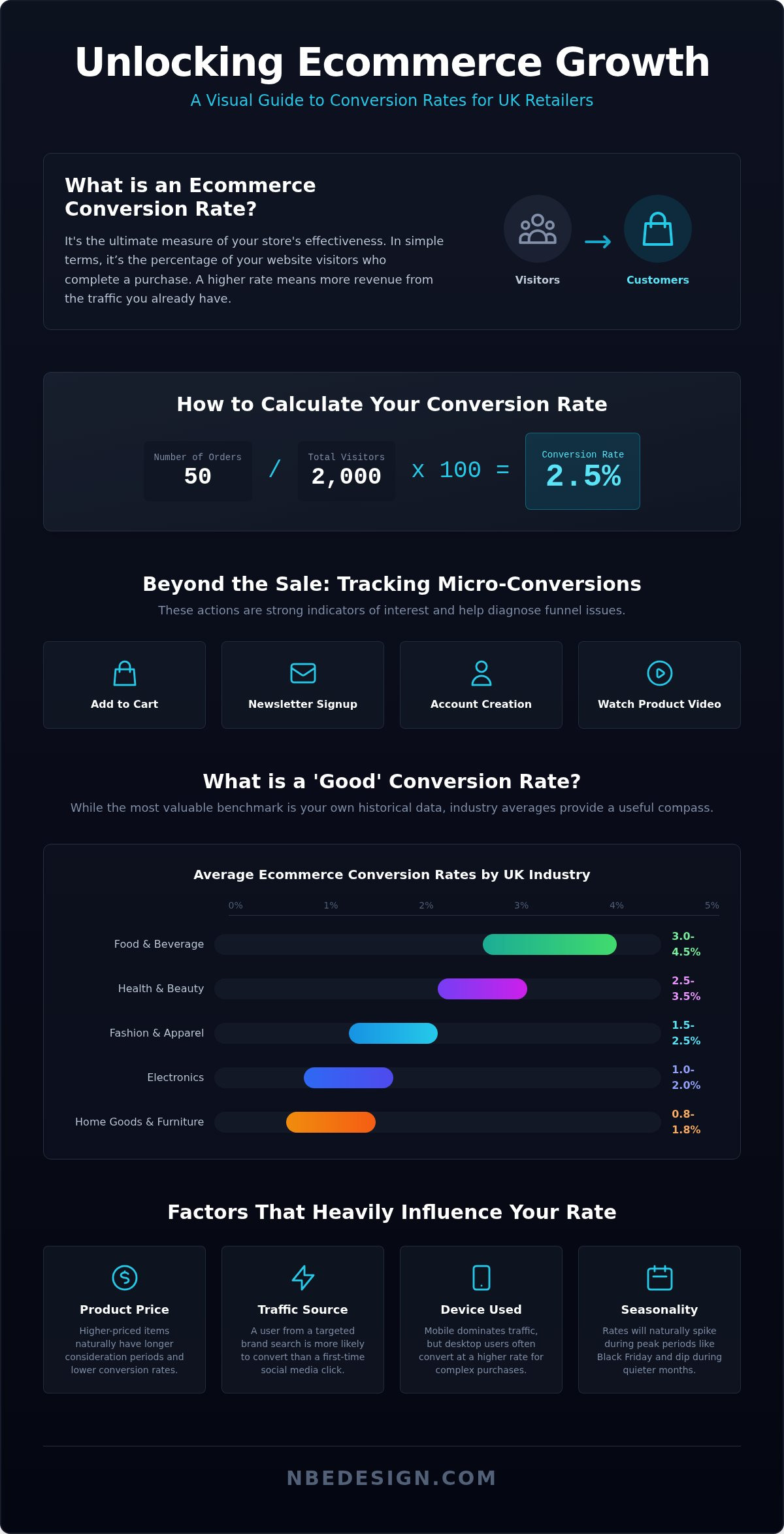
(Number of Orders / Total Number of Visitors) x 100 = Conversion Rate %
For example, if your store had 2,000 unique visitors last month and generated 50 orders, your conversion rate would be 2.5%. You can easily find this data within your Shopify Analytics dashboard or in Google Analytics. For accurate tracking, it is crucial to use a consistent time frame (e.g., month-over-month or year-over-year) to identify trends and measure the impact of any changes you make.
Beyond the Sale: Understanding Micro-Conversions
While a completed sale (a macro-conversion) is the primary goal, other valuable user actions, known as micro-conversions, provide critical insight into customer behaviour. These are strong indicators of interest and can help you diagnose problems in your sales funnel before they impact your bottom line. Key micro-conversions to track include:
- Adding an item to the shopping basket
- Signing up for your email newsletter
- Creating a customer account
- Watching a product video
By monitoring these actions, you can see where customers might be dropping off. For instance, a high number of 'add to cart' actions but a low final conversion rate often points to issues with shipping costs or a complicated checkout process.
What Is a 'Good' Ecommerce Conversion Rate? (Benchmarks vs. Reality)
It's the question every UK retailer asks: "Is my conversion rate good?" While it’s natural to seek a simple number for comparison, the reality is that a 'good' ecommerce conversion rate is entirely relative to your business. Industry benchmarks are a helpful starting point, but they should never be the ultimate measure of your success. The most valuable benchmark is your own historical data.
Think of industry averages as a compass, not a destination. They provide a general sense of direction, but your unique brand, products, and audience define the actual landscape you're navigating. A rate that is exceptional for one store might be average for another.
Average Ecommerce Conversion Rates by Industry
To give you a general idea, most studies show that the average ecommerce conversion rate globally hovers between 1% and 3%. However, this varies significantly across different sectors. Here are some widely accepted benchmark ranges for popular UK industries:
- Fashion & Apparel: 1.5% - 2.5%
- Health & Beauty: 2.5% - 3.5%
- Electronics & Appliances: 1.0% - 2.0%
- Food & Beverage: 3.0% - 4.5%
- Home Goods & Furniture: 0.8% - 1.8%
Note: These are illustrative averages. Your performance can and will differ based on the factors below.
Factors That Heavily Influence Your 'Good' Rate
A single percentage point doesn't tell the whole story. Your store's conversion potential is shaped by several key variables:
- Product Price: A store selling bespoke furniture for over £2,000 will naturally have a lower conversion rate than one selling £15 novelty socks. The higher the price, the longer the consideration period.
- Traffic Source: A visitor arriving from a targeted brand search on Google is far more likely to convert than someone who clicked a social media ad for the first time.
- Device: While mobile traffic is dominant, desktop users often show higher purchase intent and convert at a better rate, especially for complex or high-value products.
- Seasonality: Your conversion rate will inevitably spike during peak trading periods like Black Friday or Christmas and dip during quieter months.
Focus on Your Own Growth, Not Just Competitors
Instead of obsessing over a generic industry number, the most productive approach is to compete with yourself. A consistently improving conversion rate is the truest sign of a healthy, growing business. Track your store's performance month-over-month and year-over-year to identify real trends. Set internal, incremental goals-like improving your rate from 1.8% to 2.0% this quarter. This data-driven, internal focus is how you build a resilient and truly conversion-focussed online store.
The Core Elements of a High-Converting Shopify Store
Understanding the numbers is the first step, but improving your ecommerce conversion rate requires moving from 'what' to 'why'. Why are visitors leaving? Why aren't they adding to their cart? The answers almost always lie within the foundational pillars of your on-site experience. A great store doesn't just display products; it guides the user seamlessly from discovery to a confident purchase. Optimising the following core areas will provide the biggest positive impact for most UK retailers.
Intuitive Design and User Experience (UX)
First impressions are critical. A clean, professional, and easy-to-navigate site builds instant confidence. In today's market, a mobile-first design isn't optional-it's essential for capturing sales where most customers are browsing. Slow page load speeds are a primary cause of visitor frustration and high bounce rates, directly harming your conversion potential. A thoughtful design anticipates user needs, especially on mobile, where ecommerce conversion rate benchmarks often show different user behaviour. You can see examples of our conversion-focused designs to understand the impact of a streamlined UX.
Compelling Product Pages
Your product page is your digital salesperson. It must be persuasive, informative, and engaging. This starts with high-quality product photography and, where possible, video to showcase your items from every angle. Descriptions should go beyond a simple list of features; they need to sell the benefits and solve the customer's problem. To build confidence, prominently display customer reviews and social proof. Finally, be completely transparent with pricing and shipping costs-unexpected fees at checkout are the number one cause of cart abandonment.
For a strong example of this in a technical niche, the e-commerce store Topdon Norge AS effectively presents complex automotive equipment to build customer confidence and drive sales. Another great example is Supreme Magnets, whose product pages clearly detail the strength and specifications of their products, a crucial step for converting customers in a specialized market.
Building Trust and Credibility
Customers will only part with their money if they trust your store. This trust is built through a combination of professional presentation and clear communication. Displaying secure payment badges (like Visa, Mastercard, and PayPal) and other trust seals reassures visitors that their data is safe. A clear, easy-to-find returns policy and accessible contact information show that you stand behind your products. This all stems from a strong brand identity, which ensures a consistent, professional look that builds consumer confidence from the first click.
A Frictionless Checkout Process
The final hurdle is the checkout. Getting a customer this far only to lose them due to a complicated process is a major missed opportunity. The goal is to make paying as simple as possible. Key strategies include:
- Minimising the number of steps and form fields required.
- Offering a guest checkout option to avoid mandatory account creation.
- Providing multiple payment options, including digital wallets like Apple Pay and 'Buy Now, Pay Later' services like Klarna.
- Clearly displaying an order summary and a progress bar throughout the checkout flow.
How to Start Optimising Your Conversion Rate (CRO First Steps)
Understanding your average conversion rate is the first step; actively improving it is where real growth happens. This is the discipline of Conversion Rate Optimisation (CRO). Far from being guesswork, CRO is a systematic, data-driven process for increasing the percentage of website visitors who make a purchase. By following a clear methodology, you can turn valuable insights into tangible revenue and consistently improve your ecommerce conversion rate.
Here are the foundational steps any UK store owner can take to begin this journey.
Step 1: Dig into Your Analytics
Your data holds the key to discovering your biggest opportunities. Using tools like Shopify Analytics or Google Analytics 4, your first task is to find the 'leaky buckets' in your customer journey. Focus on identifying where your investment in traffic is being wasted.
- Identify problem pages: Look for pages with high traffic but also a high exit rate. Why are people leaving from these specific pages?
- Analyse the funnel: Where do most users drop off between viewing a product, adding it to their basket, and completing the checkout?
- Segment your data: Compare the behaviour of mobile users versus desktop users, or visitors from Google versus social media. This often reveals device-specific or channel-specific issues.
Step 2: Gather Qualitative Feedback
Analytics tell you what is happening, but direct customer feedback tells you why. This human insight is crucial for understanding friction points that data alone can't explain. Simple tools can provide a wealth of information. Consider using on-site polls asking why a visitor is hesitant to purchase, or reading through customer service emails and product reviews to find common complaints or points of confusion.
Step 3: Form a Hypothesis and A/B Test
Armed with quantitative data and qualitative feedback, you can form an educated hypothesis. This is a simple statement like, "Changing the main product button text from 'Add to Cart' to 'Buy Now' will increase clicks because it creates more urgency." A/B testing is the most reliable way to prove that a change positively impacts your ecommerce conversion rate. Start with simple tests on high-impact elements like headlines or product images, and remember to only test one change at a time for clear, unambiguous results.
Step 4: Know When to Call an Expert
While these initial steps can yield positive results, achieving significant and sustained growth often requires specialist expertise. A comprehensive CRO strategy involves a deep understanding of user psychology, technical implementation, and advanced analytics. For a robust strategy designed to scale your business, consider partnering with a Shopify Expert. An experienced agency can accelerate your results and help you avoid common, costly pitfalls on your path to growth.
From Insights to Action: Elevating Your Shopify Conversion Rate
Understanding your Shopify store's performance is the first step towards significant growth. As we've explored, your conversion rate isn't just a benchmark to chase; it's a direct reflection of your customer experience. By focusing on the core elements of a high-converting store-from seamless navigation and fast page speeds to building undeniable trust-you create a solid foundation for turning more visitors into loyal customers.
But you don't have to navigate this journey alone. Optimising your ecommerce conversion rate requires expertise and a strategic, data-driven approach. If you're ready to unlock your store's true potential, our UK-based team of Certified Shopify Experts is here to help. With a proven track record of growing sales for retailers from our base in the North East, we provide the specialist guidance you need to achieve tangible results.
Take the next step towards sustainable growth. Book a free discovery call with our Shopify Experts today and let's build a higher-converting future for your business.
Frequently Asked Questions
How is conversion rate different from click-through rate (CTR)?
Click-through rate (CTR) measures the initial interest in your ad or link, calculating the percentage of people who click it after seeing it. In contrast, conversion rate measures the final action, calculating the percentage of website visitors who complete a desired goal, such as making a purchase. Think of it this way: CTR gets potential customers through the door, while your conversion rate determines how many actually buy something. Both are vital metrics for tracking your sales funnel's effectiveness.
Can a high 'add to cart' rate but low conversion rate mean my shipping is too expensive?
Yes, this is a classic sign of friction in the final stages of the checkout process. A high 'add to cart' rate shows customers want your product at its listed price. If they abandon their purchase after this point, it often points to an unexpected surprise, with high shipping costs being the most common culprit. A sudden £5.95 delivery fee can be enough to deter a buyer who was otherwise ready to complete their purchase. Always review your checkout analytics for drop-off points.
How long does it take to see an improvement in conversion rate after making changes?
The timeframe depends on your website's traffic volume and the scale of the change. For a high-traffic store, a simple A/B test on a button colour might yield statistically significant results within a week. However, for a major change like a complete product page redesign, you should allow several weeks to a month to gather enough data. This ensures you're making decisions based on genuine trends rather than daily fluctuations, allowing for a true measure of impact.
Does my store's traffic volume affect my conversion rate?
It can, but the quality of your traffic is far more important than the quantity. A sudden surge in traffic from a poorly targeted marketing campaign can actually lower your conversion rate, as these visitors may have no real interest in your products. The goal is to attract qualified visitors who are likely to buy. Focussing on attracting the right audience, even if it's smaller, will yield a healthier and more meaningful conversion rate for your business.
What are the most common mistakes that kill ecommerce conversion rates?
Several common pitfalls can severely damage ecommerce conversion rates. The most frequent issues include surprise costs at checkout, such as unexpected shipping fees or taxes. Other major factors are a slow-loading or non-mobile-responsive website, a complicated or lengthy checkout process, and a lack of trust signals like customer reviews, clear return policies, and secure payment icons. Streamlining these areas provides a solid foundation for improving conversions and driving growth.
Is a 1% conversion rate always bad?
Not at all. Context is everything when evaluating your ecommerce conversion rate. For a business selling high-ticket items, like bespoke furniture costing £2,000, a 1% rate could be incredibly profitable. Conversely, for a store selling low-cost items with thin margins, a 1% rate might be unsustainable. Your industry, average order value (AOV), and traffic source all play a crucial role in defining what a "good" conversion rate looks like for your specific business.

- Posted in:
- Conversion Rate
- CRO
- Ecommerce
- ecommerce conversion rate
- Ecommerce Growth
- Shopify
- Shopify Tips
- UK Ecommerce





)