Skip to content
Essential Apps for Shopify Store Success in 2026: The Expert Vetting Guide
-
3458 words · 17 min read

Is your app stack actually a silent tax on your conversion rate? Every time you add a new tool to your dashboard, you might be trading away the very site speed that keeps your UK customers from clicking "back." It's a common struggle for retailers who want to stay competitive. You want a feature-rich experience, but you don't want to pay for tools you never use or deal with apps that clash with your Shopify OS 2.0 theme.
At NB eCommerce & Design, we've been helping retailers grow since 2006 and have vetted over 500 integrations to find what truly works. We've identified the high-performance tools that scale your sales without compromising your store's performance. This guide highlights the essential apps for shopify store 2026 that offer the best return on investment for British businesses. We'll show you how to automate your marketing, sync your brick-and-mortar inventory seamlessly, and build a future-proof tech stack. If you're ready to declutter your dashboard and boost your revenue, let's get started. You can also reach out to our team at https://nbedesign.com/pages/contact for a bespoke audit of your current setup.
Key Takeaways
- Learn how to audit your tech stack to eliminate 'app bloat' and ensure your store remains rock-solid and lightning-fast for modern shoppers.
- Understand the non-negotiable infrastructure required for UK compliance and the essential apps for Shopify store 2026 that safeguard customer trust.
- Discover how to drive conversions through hyper-personalised marketing and the shift toward video reviews as the new gold standard for social proof.
- Streamline your operational efficiency by unifying online and offline sales with Shopify POS and integrating seamless UK shipping via Royal Mail, DPD, and Evri.
- Master our expert vetting process to determine when to invest in a monthly app and when a custom-built feature offers better long-term value for your brand.
The 2026 Strategy: Why App Selection is Different for Modern Retailers
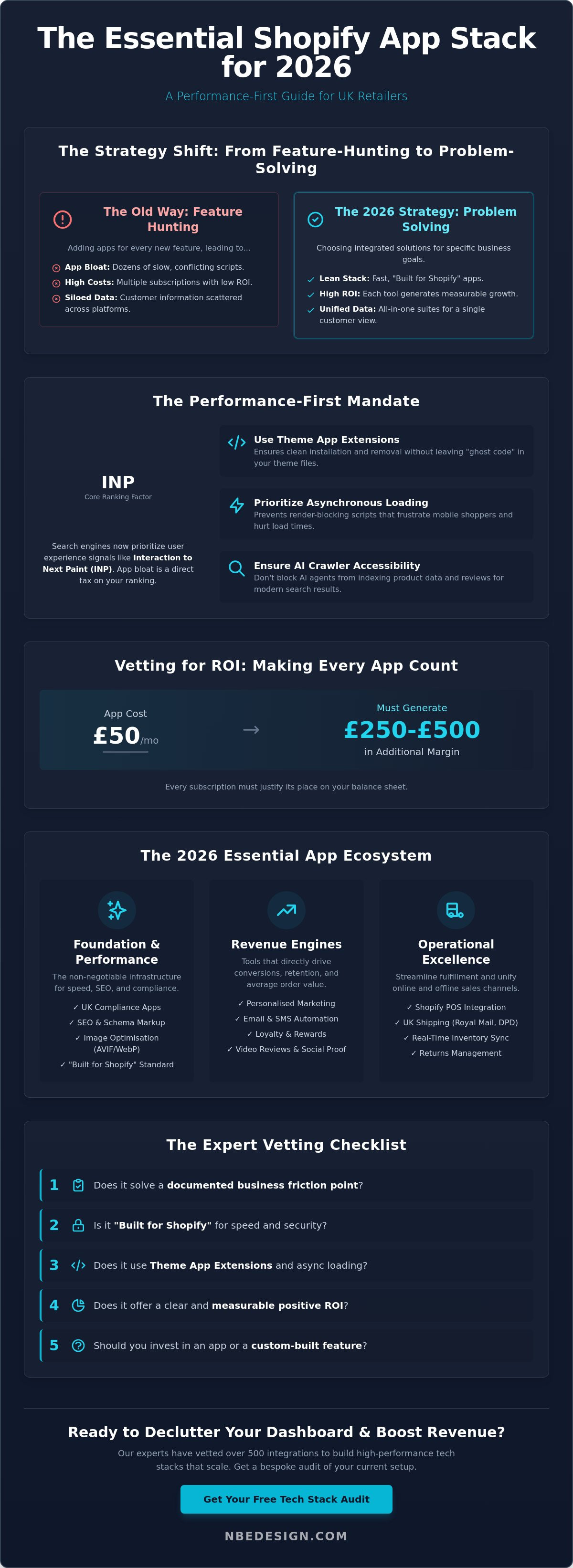
The criteria for selecting essential apps for shopify store 2026 success have shifted from "what can this do?" to "how does this integrate?". Since we began working as a Shopify Expert in 2006, we've watched the ecosystem evolve from a handful of basic tools to a marketplace of thousands. In the current e-commerce environment, an app is only essential if it solves a documented business friction point without compromising the technical integrity of your theme. Modern retailers must move away from "feature-hunting" and instead adopt a problem-solving tech stack that prioritises lean code and measurable growth.
The Performance-First Mindset
By 2026, search engines and AI-driven discovery engines have moved beyond simple keywords. They now prioritise user experience signals like Interaction to Next Paint (INP), which became a core ranking factor in March 2024. If your apps load heavy, unoptimised scripts, your visibility will drop. App bloat is the accumulation of redundant third-party scripts that increase page load times and degrade Core Web Vitals metrics. To combat this, we look for the "Built for Shopify" tag, which ensures the app meets Shopify's highest standards for speed and security.
- Theme App Extensions: Only install apps that use these extensions, as they allow for clean installation and removal without leaving "ghost code" in your Liquid files.
- AI Crawler Accessibility: Ensure your apps don't block AI agents from indexing your product data and reviews.
- Script Loading: Prioritise apps that use asynchronous loading to prevent "render-blocking" that frustrates mobile shoppers.
Vetting for ROI and Integration
Every subscription in your sidebar must justify its place on the balance sheet. If an app costs £50 per month, it needs to generate at least £250 to £500 in additional margin to be considered a viable part of your essential apps for shopify store 2026 strategy. We often see retailers using 15 different single-purpose apps when two or three "all-in-one" suites could handle email marketing, loyalty, and reviews more efficiently. This reduces your monthly overhead and ensures your customer data isn't siloed across different platforms.
Your tech stack must also communicate with your physical operations. If you're running a brick-and-mortar shop in the North East or beyond, your apps must seamlessly sync with your POS system to keep inventory accurate in real-time. Before hitting "install," ask if the app supports Shopify OS 2.0 and whether it integrates with your existing workflows. If you're unsure how a new tool might affect your site's performance or conversion rate, it's best to consult a Shopify Expert UK to perform a technical audit. If you need help streamlining your current setup, you can get in touch with our team for a professional review of your tech stack.
Foundation & Performance: The Non-Negotiable Infrastructure Apps
Your store's technical foundation is the difference between a scaling business and a stagnant one. In 2026, the baseline for "fast" has shifted significantly. Google's Core Web Vitals are no longer a suggestion; they're a requirement for survival. Experts suggest that Shopify will dominate eCommerce growth over the next year because of its robust API and rock-solid infrastructure, but the wrong app stack can still cripple your performance. Selecting the right essential apps for shopify store 2026 requires a balance between front-end functionality and back-end efficiency.
SEO and Image Optimisation
Image files often account for 60% of a page's total weight. By 2026, using legacy formats like JPEG is a mistake that costs you search rankings. You need tools like TinyIMG to automate the conversion to AVIF and WebP formats. These formats offer superior compression without losing visual quality. Beyond file size, your essential apps for shopify store 2026 must handle automated alt text and JSON-LD schema markup. This helps your products show up in AI-driven search results and visual search engines like Google Lens. AI search agents rely on this structured data to recommend your products to high-intent shoppers. Don't be fooled by marketing claims; "set and forget" SEO apps are a myth because search algorithms and your inventory change every single day.
Speed and Performance Monitoring
Third-party scripts are the silent killers of conversion rates. Every second of delay can drop conversions by up to 7%. You need monitoring tools to see which apps are dragging down your Liquid files and increasing time-to-interactive. In 2026, lazy-loading isn't just for images; it's for every non-critical script on your site. If your store feels sluggish despite having optimisation apps, it's time for a professional audit. Our Shopify Expert UK team often finds that removing two redundant apps does more for speed than adding five new ones. We've seen stores improve mobile load times by 40% simply by cleaning up old app code and streamlining script execution.
Compliance and Visual Builders
Trust is the currency of 2026. For UK retailers, compliance with UK GDPR and the Data Protection Act is mandatory. Apps like Pandectes or Consentmo ensure your cookie banners and data requests are legally sound. Using a generic banner that doesn't block scripts before consent can lead to fines and a loss of customer confidence. For store design, visual builders like PageFly or Shogun are excellent for landing pages. However, for your core brand experience, heavy builders can bloat your code. If you're looking to scale, a Shopify web design agency can provide custom-coded sections that offer flexibility without the performance tax. If you need help choosing the right path for your infrastructure, feel free to get in touch for a chat.
Revenue Engines: Essential Apps for Conversion and Retention
By 2026, the cost of acquiring a new customer has increased by roughly 22% compared to three years ago. This shift means your choice of essential apps for shopify store 2026 must focus on protecting your margins by squeezing every bit of value from your existing traffic. It's no longer enough to just have a shop; you need a high-performance engine that drives repeat business and boosts basket values automatically.
This principle of maximizing value applies beyond retail to high-touch service sectors; for example, you can discover Sit Means Sit Dog Training to see how specialized providers use immersive programs to build trust and long-term client relationships.
Marketing Automation (Klaviyo vs. Alternatives)
Klaviyo remains the benchmark for Shopify marketing because of its deep data integration. By 2026, the platform's predictive analytics can flag a customer as a "churn risk" with 85% accuracy based on their browsing patterns. For UK retailers, the growth of SMS and WhatsApp marketing is the biggest trend. These channels offer a direct line to customers that email often misses, with open rates frequently hitting 98% within the first ten minutes. An expert analysis of the 2026 Shopify platform highlights that the most successful stores are those using these integrations to create a hyper-personalised experience that feels helpful rather than intrusive.
Video reviews have replaced text as the primary trust signal for British consumers. Data shows that 74% of UK shoppers feel more confident buying a product after seeing a real person use it on camera. Apps like Okendo or Loox allow you to automate the collection of these videos, building immediate social proof. When combined with AI-powered upselling tools like ReCart or Candy Rack, you can suggest products that actually make sense for the buyer. These tools typically lift Average Order Value (AOV) by 12% to 18% by predicting needs at the checkout stage. To keep these customers coming back, loyalty programs like LoyaltyLion turn one-time buyers into brand advocates through exclusive perks and points.
Conversion Rate Optimisation (CRO) Tools
Understanding user friction is vital for scaling. Heatmapping apps allow you to see exactly where mobile users drop off or get frustrated. When selecting the essential apps for shopify store 2026, prioritising tools that reduce friction on mobile devices is the smartest move you can make. For the UK market, mobile-first features are mandatory. Implementing a "Sticky Add to Cart" button and a "Free Shipping Bar" for orders over £50 can reduce bounce rates on product pages by up to 14%.
If you're looking to refine your store's performance or need a technical audit, our Shopify expert UK team can help you identify the right mix of tools for your specific niche. For a bespoke consultation on your app stack, feel free to get in touch with us today.
Operational Excellence: Streamlining Fulfillment and Shopify POS
Scaling a retail business requires a backend that doesn't buckle under pressure. By 2026, the most essential apps for shopify store 2026 success will be those that bridge the gap between your warehouse and your customer's doorstep. Efficiency isn't just a buzzword; it's the difference between a 2% and a 10% profit margin in the competitive UK market. We've seen many retailers struggle with disconnected systems, but a unified approach ensures your data remains a "single source of truth."
Mastering Shopify POS in the UK
Unifying your sales channels is no longer optional. If you run a boutique in Durham or a showroom in London, your stock must sync instantly to avoid overselling. We recommend apps that facilitate local pickup and "buy online, return in-store" (BORIS) workflows. These features reduce shipping costs and drive foot traffic back to your physical location. For a deeper look at hardware, view our guide on the best till POS system for small shops UK to ensure your physical setup is as robust as your digital one. Using a Shopify expert UK to configure these integrations ensures that gift cards and loyalty points work seamlessly across both environments.
Shipping and Logistics Automation
UK retailers face unique challenges, particularly regarding the 2021 IOSS regulations for EU trade. Automating tax documentation via apps like Matrixify or specialised IOSS connectors is vital for post-Brexit growth. For daily operations, integrating your store directly with Royal Mail, DPD, and Evri through apps like Veeqo or ShipStation eliminates manual data entry. This reduces label printing errors by up to 30% and keeps your customers informed with real-time tracking notifications. Returns management is another area where you can save. Apps like Loop or RevenueHunt help recover 15% of potentially lost revenue by encouraging exchanges over refunds, making the reverse logistics process far more efficient.
Inventory management for multi-location brands requires precision. If you're balancing stock between a warehouse in Middlesbrough and a retail shelf in Darlington, you need apps like Stocky or Inventory Planner. These tools use historical data to forecast demand, ensuring you aren't sitting on dead stock. While AI-chatbots handle 70% of routine tracking queries, they must be balanced with a human touch. Use Gorgias or Tidio to automate the basics, but ensure your team is ready to step in for complex customer issues. This balance builds the trust necessary for long-term loyalty.
Ready to future-proof your operations? Get in touch with our team to build a rock-solid fulfilment strategy.
The Expert Vetting Process: How We Curate Your Shopify Tech Stack
Selecting essential apps for shopify store 2026 success requires more than a glance at the App Store ratings. At NB eCommerce & Design, we prioritise clean code instead of flashy features. Many apps promise "all-in-one" solutions but end up injecting heavy scripts that slow your site down. Since a site loading in 1 second has a conversion rate 3x higher than a site loading in 5 seconds, performance is our first filter. We look for lean apps that solve specific problems without compromising your rock-solid foundation.
We often guide our clients through the "Build vs. Buy" debate. While a £40 monthly subscription feels manageable, it adds up to £1,440 over three years. If we can build that same feature directly into your theme for a one-off fee, you'll save money and keep your codebase clean. We only recommend paid apps when the developer provides ongoing security updates and features that are too complex to build custom. Your tech stack should be efficient, not expensive.
An app is a tool, not a strategy. You must build your business strategy first. Adding a loyalty app won't fix a retention issue if your product quality is lacking. We help you define your goals; then we find the tools to reach them. This includes a quarterly audit to remove redundant scripts. Abandoned apps often leave behind "ghost code" that continues to drag on your performance. Regular maintenance ensures your store remains future-proof.
Why Experience Matters Since 2006
We've literally grown up with the platform since Shopify's birth in 2006. This historical context gives us a unique perspective on which developers have staying power and which ones might disappear next month. As a certified Shopify Partner, we have access to beta features and direct support channels that generalists don't. Our deep-rooted knowledge allows us to spot potential conflicts before they break your checkout. You can contact our team for a bespoke app stack audit to ensure your store is running at its peak.
Getting Started with Your 2026 Tech Stack
Focus on the "Core Four" categories: marketing, operations, customer experience, and conversion. Before you add anything new, your first step should be pruning. Look at your current list and ask if every app is earning its keep. If it isn't driving growth or saving time, it's just clutter. To build a high-performing Shopify store that's ready for the 2026 retail landscape, you need a streamlined approach. This means selecting the essential apps for shopify store 2026 success while ignoring the noise of flashy trends. We're here to help you simplify the complex and scale with confidence.
Future-Proof Your Tech Stack for 2026 and Beyond
Building a high-performing store requires more than just installing the latest plugins. By 2026, the gap between basic shops and market leaders will be defined by technical infrastructure and how well you've unified your online and POS channels. Success depends on moving away from app bloat and focusing on a vetted, rock-solid stack that streamlines fulfilment while driving customer retention. We've been a Certified Shopify Partner since 2006, literally growing up with the platform to help retailers across the UK and globally navigate these technical shifts.
From our office in Darlington, we've spent nearly two decades mastering the art of the perfect tech stack. Choosing the right essential apps for shopify store 2026 isn't a task you should tackle alone when your conversion rates and operational efficiency are on the line. Our team ensures your systems sync seamlessly so you can focus on scaling your business with confidence. It's time to turn your technology into a competitive advantage instead of a source of frustration.
Book a Shopify App Stack Audit with our North East Experts
We're ready to help you navigate the next era of retail and ensure your store remains ahead of the curve.
Frequently Asked Questions
What are the most essential apps for a new Shopify store in 2026?
The most essential apps for shopify store 2026 focus on hyper-personalisation and AI-driven automation. You should start with a robust email marketing tool like Klaviyo, an AI search app like Searchspring, and a loyalty platform like LoyaltyLion to build your foundation. These tools help you scale efficiently by automating customer journeys. Recent industry data shows that 75% of high-growth merchants now prioritise AI-native apps to handle repetitive tasks and improve user experience.
Can having too many Shopify apps slow down my website?
Yes, excessive apps can significantly impact your site's performance and load times. Each app that adds features to your storefront typically injects additional JavaScript, which can increase your page weight by over 200KB. We recommend auditing your apps quarterly to ensure they're still providing tangible value. If an app isn't actively contributing to your conversion rate or streamlining operations, it's best to remove it to keep your store fast and responsive.
How do I know if an app is compatible with Shopify Online Store 2.0?
You can verify compatibility by checking if the app supports "App Blocks" within the Shopify Theme Editor. Modern apps designed for Online Store 2.0 allow you to drag and drop elements directly into your sections without touching any liquid code. Since Shopify's major update in 2021, 90% of top-rated apps have migrated to this architecture for better performance. If you're unsure about a specific integration, you can get in touch for a technical review.
Are there any free Shopify apps that are actually worth using?
Several free apps provide immense value, particularly those developed by Shopify itself, such as Shopify Search & Discovery or Shopify Inbox. For reviews, the free tier of Judge.me remains a popular choice for new UK retailers starting their journey. While free tools are great for starting out, they often have limits. For instance, free email plans might cap your monthly sends at 500 contacts before requiring a paid upgrade to access more advanced features.
How much should I expect to spend on Shopify apps per month?
A typical small-to-medium Shopify store in the UK usually spends between £50 and £200 per month on their app stack. This budget generally covers essential tools for email marketing, review collection, and a basic page builder. As you scale, these costs can rise to over £1,000 for enterprise-level features and advanced automation. We always advise calculating the return on investment for every paid subscription to ensure it's helping your business grow rather than just adding overhead.
Which Shopify apps are best for UK-based shipping and logistics?
For UK retailers, ShipStation and Royal Mail Click & Drop are the gold standards for managing domestic logistics. These apps seamlessly sync with your store to automate label printing and tracking updates for your customers. If you're managing complex inventory across multiple brick-and-mortar sites, Veeqo is an excellent choice that integrates directly with major UK carriers. Using these tools can reduce manual shipping tasks by up to 15 hours per week for growing businesses.
Do I need a separate app for SEO on Shopify?
You don't strictly need an app for SEO, but they're useful for automating technical tasks like image compression and schema markup. While Shopify has strong built-in SEO features, tools like Plug in SEO or SEO Manager are often considered essential apps for shopify store 2026 to stay competitive in search rankings. These apps help you identify broken links and optimise meta tags across thousands of products in seconds. However, no app replaces a solid content strategy and high-quality backlinks.
Should I use an app or hire a developer for custom features?
Choosing between an app and a developer depends on your specific needs and long-term goals. Apps are cost-effective for standard features like loyalty programmes, but custom development is better for unique functionality that gives you a competitive edge. Custom code is often cleaner and won't slow your site down like a heavy third-party app might. If you're planning a complex project or a bespoke integration, contact us to discuss a future-proof solution for your store.

- Posted in:
- essential apps for shopify store 2026