 Skip to content
How to Choose a Conversion Rate Optimisation (CRO) Agency in the UK
-
2941 words · 14 min read

Your website analytics show a steady stream of visitors, but your sales figures aren't keeping pace. Sound familiar? It’s a frustrating position for any e-commerce owner: you’ve done the hard work of attracting an audience, yet potential customers are abandoning their carts or leaving without making a purchase. The gap between traffic and transactions is where your real growth opportunity lies, but guessing what needs to change is a recipe for wasted time and money.
This is precisely why partnering with the right conversion rate optimisation agency UK businesses can rely on is one of the most impactful investments you can make. A skilled CRO partner doesn't just guess; they use a data-driven methodology to understand user behaviour, test hypotheses, and implement changes that deliver tangible results. This guide breaks down exactly what to look for, the critical questions to ask, and how to identify a team genuinely focused on delivering sustainable revenue growth for your e-commerce store. Let's turn your visitors into loyal customers.
Key Takeaways
- Look beyond simple A/B testing; a top-tier conversion rate optimisation agency uk uses a data-driven, systematic process to deliver measurable revenue growth.
- For Shopify retailers, generic CRO is not enough. Demand an agency with deep platform expertise to leverage e-commerce-specific strategies and tools effectively.
- A transparent and structured process is a hallmark of a reliable agency. Learn the key phases from audit to ongoing growth to ensure you're partnering for success.
- Arm yourself with the right questions before any sales call. We provide a practical checklist to help you cut through the noise and identify a truly competent partner.
What Does a Conversion Rate Optimisation Agency Actually Do?
When business owners think of Conversion Rate Optimisation (CRO), they often picture simple tweaks like changing button colours or rewriting headlines. While these can be part of the process, they are merely tactics within a much broader, more strategic discipline. At its core, CRO is the systematic process of increasing the percentage of website visitors who take a desired action-be it making a purchase, filling out a form, or signing up for a newsletter. To fully grasp the concept, it's helpful to understand What is Conversion Rate Optimization as a scientific method for your website.
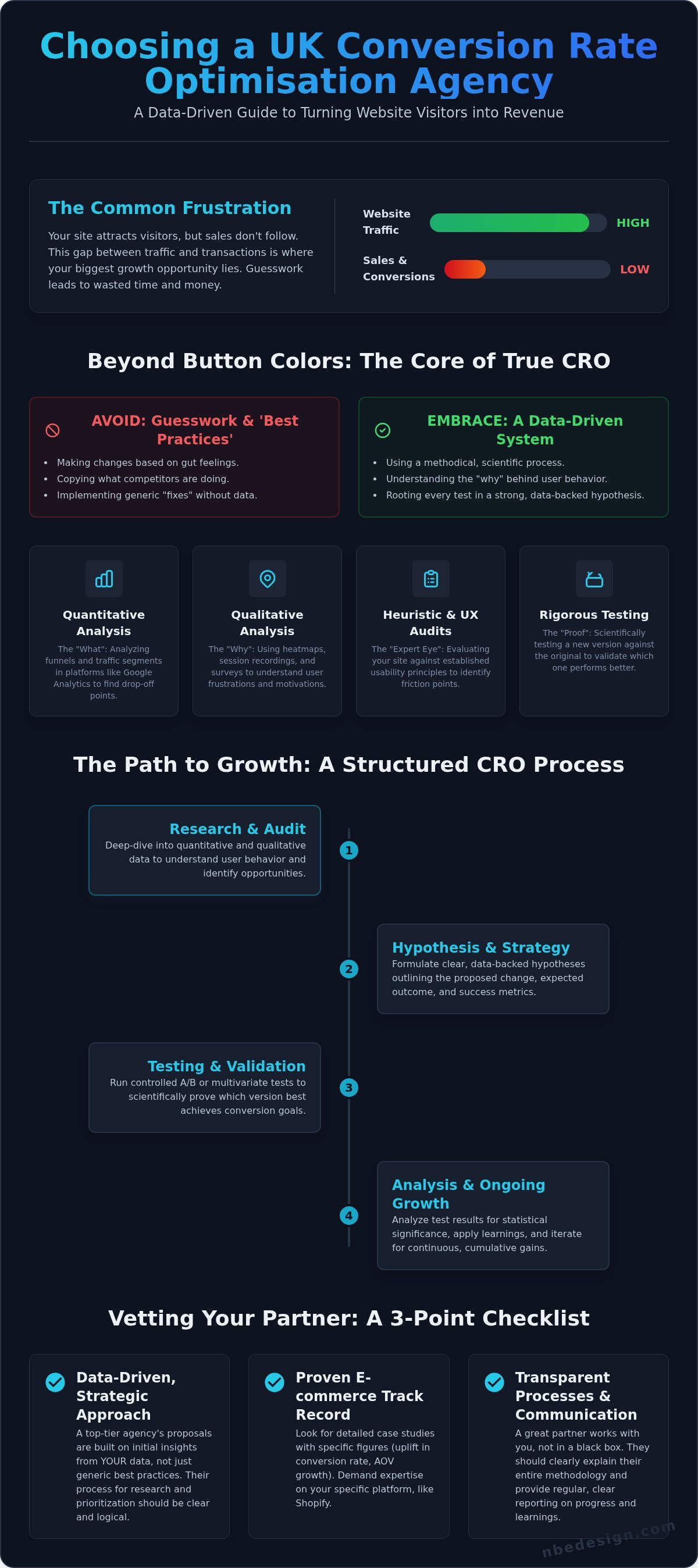
The primary goal is to turn more of your existing traffic into tangible revenue. Instead of just guessing what might work, a professional conversion rate optimisation agency in the UK dives deep into user behaviour. It’s about understanding why users aren't converting and using that insight to make targeted improvements. This is built on four key pillars: in-depth research, forming a data-backed hypothesis, rigorous testing, and detailed analysis of the results.
The Core Services of a CRO Agency
A structured CRO programme moves far beyond simple A/B testing. It involves a suite of services designed to gather a complete picture of your user experience and identify the most significant opportunities for growth:
- Quantitative Analysis: This is the "what." Experts dig into your analytics platforms, like Google Analytics, to identify patterns. They analyse user funnels, segment traffic, and pinpoint specific pages where visitors are dropping off.
- Qualitative Analysis: This answers the "why." Using tools like heatmaps, session recordings, and user surveys, an agency can see how users actually interact with your site and gather direct feedback on their frustrations and motivations.
- Heuristic & UX Audits: A seasoned expert evaluates your website against established usability principles and best practices, quickly identifying points of friction in the user journey that data alone might miss.
- A/B & Multivariate Testing: This is the validation stage. Based on all the research, the agency will test a new version of a page (the "variant") against the original to scientifically prove which one performs better at achieving your goals.
Why 'Guesswork' Isn't CRO
Making changes to your website based on a gut feeling or what a competitor is doing is one of the quickest ways to harm your conversion rate. True CRO is the antidote to opinion-based decision-making. Every single test should be rooted in a strong, data-backed hypothesis that clearly states what change is being made, why it's expected to work, and how its success will be measured. This methodical process ensures that every result-whether a win or a loss-provides valuable learning, leading to cumulative, long-term gains for your business.
Key Qualities to Look for in a UK CRO Agency
Once you have a shortlist, how do you separate a genuine growth partner from a slick sales pitch? Any firm can claim to get results, but a truly effective conversion rate optimisation agency uk will demonstrate its expertise through tangible qualities. Use the following points as a checklist to vet potential partners and ensure you’re making a rock-solid investment.
A Data-Driven, Strategic Approach
The foundation of all successful CRO is data, not guesswork. A top-tier agency won’t offer generic solutions. Instead, their first step should be to understand your unique situation by requesting access to your analytics. Their proposals should be built on initial insights from your data, not just a standard checklist of CRO best practices. Ask them to outline their process for research, forming hypotheses, and prioritising experiments-it should be clear, logical, and methodical.
A Proven Track Record in E-commerce
Results speak louder than words. Look for detailed case studies that go beyond vanity metrics. They should clearly show the "before and after" with specific figures, such as uplift in conversion rate, growth in Average Order Value (AOV), or a reduction in cart abandonment. Don't hesitate to ask for examples of their work with businesses similar to yours in size or industry. Finally, check for client testimonials and reviews on independent platforms to get an unbiased view of their performance. We believe in this transparency ourselves. See our own results in our portfolio.
Transparent Processes and Communication
A great CRO partner works with you, not in a black box. They should be able to clearly explain their entire methodology, from initial user research to A/B testing and final analysis. Enquire about their reporting process: what key metrics will they track, how often will you receive updates, and who will be your main point of contact? A true expert aims to educate and empower your team, helping you understand your customers better, rather than simply delivering a report without context.
The CRO Process: From Initial Audit to Ongoing Growth
Understanding what a conversion rate optimisation agency in the UK actually does is crucial for building a confident partnership. A professional CRO programme isn’t about guesswork or chasing the latest design trends; it’s a disciplined, data-driven cycle designed to deliver sustainable growth. This structured workflow ensures every action is purposeful and that you understand exactly what your investment is achieving. Below, we break down the typical four-phase process.
Phase 1: Deep-Dive Research and Audit
This foundational stage is all about understanding your users and identifying their pain points. We don't make assumptions. Instead, we gather data by connecting analytics, setting up tracking tools like heatmaps and session recorders, and conducting user research. This quantitative and qualitative data is combined with a thorough UX and technical audit of your site to uncover the biggest barriers to conversion and the most promising opportunities for growth.
Phase 2: Hypothesis and Test Prioritisation
With solid research complete, we translate insights into testable hypotheses. These aren't vague ideas; they are structured statements like, “We believe that simplifying the checkout form will increase completions because user recordings show significant drop-offs at this stage.” Using a prioritisation framework (such as PIE: Potential, Importance, Ease), we then score each hypothesis to create a clear, high-impact roadmap of experiments for the coming months.
Phase 3: Design, Development, and Testing
This is where the ideas come to life. Our team designs the new variations for the A/B test, ensuring they are on-brand and built to solve the identified problem. The experiment is then developed and rigorously quality-assured (QA) across different devices and browsers to guarantee a flawless user experience. Once approved, the test is launched and run until it reaches statistical significance, ensuring the results are reliable and not just down to chance.
Phase 4: Analysis, Learning, and Iteration
Once a test concludes, we analyse the results to declare a winner. But the process doesn't stop there. Crucially, every experiment-even one that doesn't produce an uplift-provides valuable learnings about your customers. We document these insights and use them to refine our understanding and inform the next round of hypotheses. This creates a powerful feedback loop, turning each test into a stepping stone for continuous improvement and long-term success.
Why Platform Expertise is Crucial for Shopify Store CRO
When searching for a partner to improve your sales, it’s easy to assume all CRO agencies are created equal. However, a generalist agency that applies the same broad principles to every website will miss the specific nuances and powerful opportunities unique to Shopify. E-commerce CRO isn't just about changing button colours; it's about understanding the intricate architecture of the platform your business is built on.
For UK businesses, choosing a specialist conversion rate optimisation agency uk with deep Shopify knowledge is not just an advantage-it's a critical factor for sustainable growth. They move beyond generic advice to deliver strategies that are built for, and tested on, the Shopify ecosystem.
Understanding the Shopify Ecosystem
A true Shopify specialist understands the platform from the inside out. This includes intimate knowledge of its Liquid coding language, theme structures, and inherent limitations. They know which Shopify apps for reviews, pop-ups, and subscriptions will enhance performance without slowing your site down. Crucially, they can implement complex A/B tests and site-wide changes without risking your store’s core functionality. For rock-solid results, it’s always best to work with a certified Shopify Expert in the UK.
Optimising the Entire Customer Journey
Effective CRO on Shopify extends far beyond the homepage or product page. The entire journey, from first click to repeat purchase, presents opportunities for optimisation. A platform expert can refine the Shopify checkout process, implement strategic one-click upsells, and streamline subscription flows to increase customer lifetime value. They also understand how to create a seamless omnichannel experience, unifying your online store and brick-and-mortar sales with integrated tools like Shopify POS.
Faster Implementation and Better Results
The primary benefit of hiring a specialist is efficiency. An agency that works exclusively with Shopify can develop, build, and launch experiments significantly faster than a generalist who needs to learn the platform's quirks. They have a library of proven tests and have already navigated the common pitfalls, saving you time and money. This accelerated process means you see a return on your investment sooner, creating a more agile and impactful CRO programme that drives real-world results for your business.
Top Questions to Ask Before You Hire a CRO Agency
Once you have a shortlist of potential partners, the discovery call is your opportunity to look beyond the sales pitch. Asking the right questions is crucial for vetting the true expertise of any conversion rate optimisation agency uk. Use this checklist to guide your conversations and find a partner who can deliver genuine, sustainable growth for your eCommerce business.
Questions About Their Process & Strategy
A top-tier agency runs on a rock-solid, data-driven process, not guesswork. These questions will reveal the quality of their strategic thinking.
- What is your research process before you suggest any tests? Look for a comprehensive answer that includes quantitative analysis (e.g., Google Analytics 4), qualitative analysis (e.g., heatmaps, session recordings, user surveys), and heuristic evaluation.
- How do you decide which tests to run first? A strong response will reference a prioritisation framework like PIE (Potential, Importance, Ease) or ICE (Impact, Confidence, Ease). This demonstrates a methodical approach to getting you the quickest wins.
- What tools do you use for analytics, heatmapping, and A/B testing? While the tools themselves are less important than the strategist using them, you want to hear familiar, industry-standard names like Google Analytics, Hotjar, VWO, or Optimizely.
Questions About Their Experience & Results
A great process is meaningless without a track record of success. These questions help you validate their experience and understand how they handle both wins and losses.
- Can you show me a case study for a Shopify store in my industry? The more relevant their experience is to your specific business, the faster they will be able to generate results.
- What was the result of your last 'failed' test and what did you learn? This is a critical question. An honest agency will openly discuss inconclusive or negative tests as valuable learning opportunities that inform future strategy. A lack of an answer is a major red flag.
- Who on your team will be working directly on my account? Ensure you know the experience level of the strategists and developers who will be hands-on with your website.
Questions About Contracts & Reporting
Finally, get absolute clarity on the commercial and communication aspects of the partnership to avoid any surprises down the line.
- What do your monthly reports look like? Ask for a sample. A good report clearly outlines test results, key learnings, the impact on your KPIs, and the plan for the following month.
- What is the typical contract length and what are the payment terms? Most UK CRO programmes run on a monthly retainer with a minimum term of 6-12 months to allow for meaningful testing and results.
- How do you measure the ultimate ROI of the programme? The best agencies connect their work directly to revenue. Their answer should focus on how they attribute uplifts in conversion rate to tangible increases in your sales and profit.
Partner with the Right UK CRO Experts for Sustainable Growth
Choosing the right partner is a critical business decision. It’s about finding a team that not only understands data but also has a transparent, proven process for turning insights into revenue. For Shopify merchants, this is even more crucial, as deep platform expertise is the key to unlocking your store's full potential and achieving sustainable growth.
As you evaluate your options for a conversion rate optimisation agency uk, consider a partner with a verifiable track record. At NB eCommerce & Design, we combine a data-driven methodology with unparalleled Shopify knowledge. As a Certified Shopify Select Partner based in the North East, we have a proven portfolio of helping high-growth e-commerce stores across the entire UK to streamline their user experience and scale their sales.
Ready to transform your website traffic into tangible results? Let's discuss a future-proof strategy for your brand. Book a free CRO consultation with our Shopify experts today.
Frequently Asked Questions
How much does it cost to hire a conversion rate optimisation agency in the UK?
The cost of hiring a conversion rate optimisation agency in the UK varies based on the scope of work and the agency's expertise. Typically, you can expect to see monthly retainers ranging from £2,500 to over £10,000. Some agencies may offer project-based pricing for specific audits or a series of tests. It's crucial to view this as an investment in growth, as a successful programme should deliver a strong, measurable return on your spend.
How long does it take to see results from a CRO programme?
While initial insights from audits can be uncovered in the first month, seeing a tangible impact from testing takes time. A single A/B test often needs 2-4 weeks to gather statistically significant data. You should expect to see meaningful, cumulative improvements in your conversion rate and revenue within 3 to 6 months. CRO is a long-term strategy focused on continuous, incremental gains that build upon each other for rock-solid growth.
What is a good conversion rate for an e-commerce store?
There is no single "good" conversion rate, as it depends heavily on your industry, price point, and traffic source. However, a general benchmark for e-commerce stores in the UK is often cited as being between 1.5% and 3%. The most important metric is your own. The goal of CRO is not to hit an arbitrary industry average, but to continuously improve your store’s baseline conversion rate, ensuring you are consistently turning more visitors into customers.
Will A/B testing negatively impact my website's SEO?
No, when implemented correctly, A/B testing will not harm your website's SEO. Google actively encourages testing to improve user experience. A professional agency ensures best practices are followed, such as using the correct canonical tags to avoid duplicate content issues and not running tests for excessively long periods. This ensures that your experiments improve user engagement without any risk to your search engine rankings, making it a safe way to optimise your site.
What's the difference between CRO and UX design?
While closely related, CRO and User Experience (UX) design have different primary goals. UX design focuses on making a website easy, intuitive, and enjoyable for the user to navigate. Its goal is a positive overall experience. CRO is more data-driven and specifically focused on persuading users to complete a desired action, such as making a purchase. In short, good UX creates a smooth journey, while effective CRO ensures that journey leads to a conversion.
Do I need a certain amount of traffic to start with CRO?
To conduct statistically reliable A/B testing, a certain volume of traffic is necessary. As a general guideline, having at least 5,000 unique visitors per month to the page you want to test, or over 1,000 monthly conversions, is a good starting point. However, if your traffic is lower, you can still benefit from foundational CRO activities like heuristic analysis, user session recordings, and customer surveys to uncover valuable insights for future growth.

- Posted in:
- Conversion Rate Optimisation
- conversion rate optimisation agency uk
- CRO
- CRO Agency
- E-commerce
- Increase Sales
- Shopify
- UK Business





%20Agency%20in%20the%20UK)