Skip to content
Shopify Agency vs Freelancer: Which is Right for Your UK Retail Business in 2026?
-
3226 words · 16 min read

Could the "affordable" choice for your store build actually be the most expensive mistake you make this year? It's a question many ambitious UK retailers face when weighing up the shopify agency vs freelancer dilemma. You want a partner who understands the nuances of the local market, from HMRC's digital record-keeping requirements to the complexities of the latest Shopify "Renaissance" Edition updates. It's natural to feel a sense of unease about technical debt or the risk of being ghosted by a lone developer during a critical sales period.
We recognise that managing a growing brand is challenging enough without worrying about "app bloat" or broken integrations. This guide will help you discover the critical differences between hiring a Shopify agency and a freelancer so you can choose the partner that best scales your sales and simplifies your operations. We'll explore how to achieve a conversion-focused website that unifies your online and in-store sales, ensuring you see a measurable ROI on your development spend while staying compliant with the Electronic Commerce Regulations 2026.
Key Takeaways
- Identify the "growth ceiling" where basic setups stop working and learn how to navigate the technical complexities of the 2026 Shopify ecosystem.
- Understand when a freelancer provides the agile support needed for smaller tasks and how to maintain direct communication for quick wins.
- Evaluate the shopify agency vs freelancer debate by looking at the strategic benefits of a specialist team for complex migrations and POS integrations.
- Uncover the "false economy" of low hourly rates and learn how to measure the real impact of technical debt and missed conversion opportunities on your ROI.
- Master a 5-point vetting framework to select a partner who understands UK-specific retail requirements and HMRC compliance for long-term stability.
Choosing Your Shopify Partner: The Agency vs Freelancer Debate in 2026
The Shopify ecosystem has shifted dramatically. In 2026, it's no longer just a platform for listing products; it's a comprehensive retail operating system. For UK retailers, this means managing everything from HMRC-compliant VAT records to complex omnichannel inventory. You might have started with a DIY theme or a basic setup, but as sales grow, you eventually hit a "growth ceiling." This is the point where technical glitches, slow load times, and fragmented data start costing you more than the price of professional help.
The choice in the shopify agency vs freelancer debate isn't just about who writes the code. It's about the difference between individual execution and collective strategic intelligence. A freelancer might fix a bug or tweak a layout, but an agency looks at your entire business model. They provide a roadmap that turns your website into a high-performance engine. Deciding between a shopify agency vs freelancer is often the turning point for a retailer's long-term success, as your choice of partner becomes the most significant ROI driver for your store.
The Evolution of the Shopify Expert
Shopify has evolved far beyond its origins as a simple tool. Today's experts must understand more than just Liquid or CSS. They need to be architects of conversion. When developing digital marketing strategies, your platform's architecture becomes the foundation for every campaign. If your site doesn't convert, your ad spend is wasted. Modern e-commerce requires a partner who focuses on user experience and psychological triggers, not just making things look pretty. You need someone who understands how the latest "Renaissance" Edition features can actually drive sales.
Defining Your Business Goals
Before you hire, you must be honest about your ambitions. Are you running a local side hustle or building a scalable retail brand? If your goal is to unify online sales with physical storefronts, your technical needs are much higher. Choosing a Shopify expert in the UK ensures your business is prepared for specific regional requirements like POS integration and local stock control. Setting clear expectations from day one prevents the anxiety of outgrowing your partner just as your business starts to thrive. A well-defined goal helps you recognise whether you need a quick fix or a long-term strategic ally.
The Shopify Freelancer: Agile Support for Early-Stage Retailers
Hiring a freelancer is often the first step for a startup or micro-business. When your requirements are narrow and your budget is modest, the lower overheads of an independent developer are undeniably attractive. You get a direct line to the person writing the code, which creates a fast feedback loop for simple aesthetic changes. In the early stages of choosing a marketing partner, according to choosing a marketing partner, the flexibility of a freelancer can help you launch quickly without the commitment of a full agency contract.
However, the shopify agency vs freelancer debate isn't just about the initial invoice. A freelancer usually wins on immediate cost but carries a higher risk of becoming a "single point of failure." If your developer falls ill, takes a holiday, or accepts a larger project elsewhere, your store's progress stops instantly. While many freelancers are exceptionally talented at "how it looks," they may lack the broader commercial experience to understand "how it sells." They might build a beautiful page that fails to convert because it isn't optimised for the specific customer journey or lacks deep SEO integration. If you're feeling overwhelmed by these choices, you can always get in touch with our team to discuss your specific needs.
Ideal Scenarios for Freelance Hire
Freelancers are perfect for well-defined, isolated tasks that don't require a full strategic team. If you need minor theme tweaks, such as adjusting a button colour or fixing a CSS alignment issue, a freelancer is the most efficient choice. They are also well-suited for setting up basic Shopify stores for micro-businesses where the product range is small and the technical requirements are minimal. One-off app installations that require very little configuration also fall into this category, allowing you to add functionality without a large investment.
The Hidden Risks of the Lone Developer
The "Ghosting" phenomenon is a genuine anxiety for UK retailers. We've spoken to many business owners who were left stranded mid-build when a developer simply stopped responding to emails. Beyond availability, there's the risk of limited specialised knowledge. A lone developer might be great at Liquid code but struggle with complex POS integration or the nuances of HMRC's Making Tax Digital requirements. This often leads to technical debt. You might save money today, but if the code is messy or the apps are poorly configured, you'll eventually pay an agency to rebuild the entire site from scratch.
The Shopify Agency Advantage: Strategic Growth and Unified Commerce
While a freelancer offers individual talent, an agency provides a collective brain trust. This "Team of Specialists" model ensures your store isn't built in a vacuum. Instead, designers, developers, and strategists work in sync to address every facet of your business. When you're evaluating hiring needs for your digital platform, the primary benefit of an agency is the shift from a task list to a growth roadmap. They don't just fix what's broken; they identify what's missing and project how new features will impact your bottom line.
Choosing a shopify agency vs freelancer often comes down to the level of security you require. Working with a certified Shopify Partner and Expert provides a layer of professional accountability that an individual cannot match. Agencies excel at complex projects, such as large-scale migrations, where data integrity is paramount. They have the resources to manage thousands of SKUs and complex customer records without the risk of downtime. This structured approach replaces the anxiety of "lone developer" projects with a managed, low-stress experience that prioritises long-term stability.
Unifying Online and In-Store Operations
For UK retailers with physical storefronts, the real challenge lies in creating a seamless omnichannel experience. Agencies specialise in implementing Shopify POS solutions that bridge the gap between your digital and physical presence. This involves synchronising multi-location inventory and customer data across the UK, ensuring your stock levels are accurate whether a customer buys in-store or online. Freelancers often struggle here. The complexities of retail hardware and the nuances of physical retail workflows require a team that understands the operational reality of a busy shop floor.
Conversion-Focused Design and Development
An agency moves your brand beyond standard templates to create high-performance retail experiences. Their approach to conversion rate optimisation is data-driven rather than purely aesthetic. They analyse user behaviour to remove friction points that kill sales. By focusing on the shopify agency vs freelancer distinction, you'll see that agencies invest in the "why" behind the design. Professional development leads to tangible sales growth because every pixel is placed with intent. This methodology ensures your store isn't just a digital brochure, but a conversion engine that delivers a measurable ROI on your development spend. For niche retailers like Sygeplejebutikken, this professional approach is essential for presenting technical healthcare equipment in a way that builds customer confidence and drives sales.
Beyond the Hourly Rate: Evaluating the Total Cost of Ownership
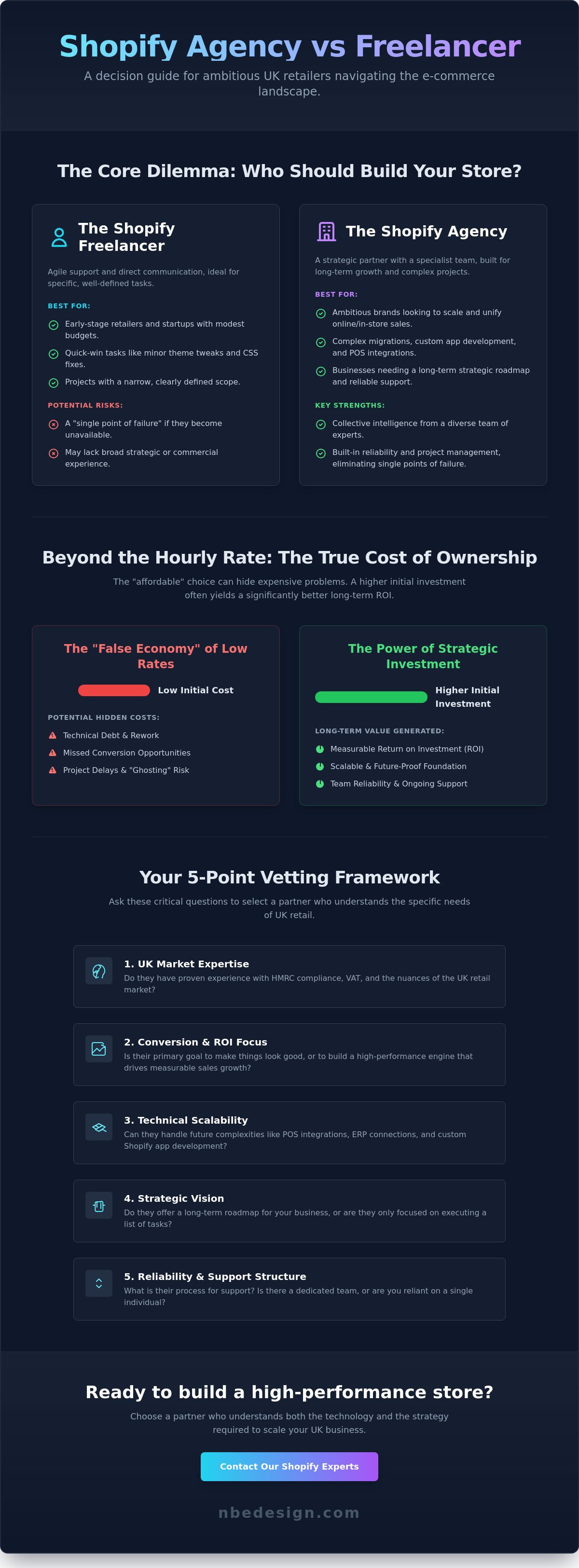
The initial quote is only one part of the equation. When you compare a shopify agency vs freelancer, looking solely at the hourly rate is often a false economy. A lower price point often masks the hidden costs of technical debt, unoptimised code, and missed conversion opportunities. If a freelancer takes twice as long to complete a task or builds a solution that breaks during a high-traffic sale, that "affordable" choice suddenly becomes a significant financial burden. You aren't just paying for code; you're paying for the reliability of your entire business infrastructure.
Agencies operate on a proactive model rather than a reactive one. While a freelancer might fix a bug after you've already lost sales, an agency team monitors your store to prevent issues before they occur. This transition from "fixing things" to "optimising growth" is where the real ROI lies. As a business owner, your time is your most valuable asset. Managing a lone developer requires you to act as a project manager and technical lead. Partnering with a professional team, such as FNP Digital, allows you to step back from the technical minutiae and focus on high-level strategy, knowing your platform is in capable hands.
The ROI of Expert Shopify Migration
Platform transitions are high-stakes projects where a single mistake can lead to an SEO disaster or permanent data loss. Professional Shopify migration services ensure that your hard-earned search rankings and customer history remain intact. We've seen many retailers lose significant organic traffic because redirects weren't handled correctly or customer tags were stripped during a manual transfer. Expert handling of your data is critical for maintaining customer trust; your shoppers expect their accounts and order histories to be ready and waiting from the moment you relaunch.
Ongoing Support and Scalability
Your business goals for 2026 likely involve scaling beyond your current capacity. This requires a partner who understands your long-term vision and can prepare your store for high-pressure periods like Black Friday. A specialised agency acts as a seasoned expert, providing the stability needed to handle sudden spikes in traffic without performance degradation. Unlike generalist developers, specialised teams are masters of their craft, staying ahead of Shopify's rapid update cycles to ensure your store remains secure and competitive. If you're ready to move beyond reactive fixes and start building for the future, you can book a consultation with our team to discuss your growth roadmap.
Making the Right Call: A Decision Framework for Your UK Business
Deciding between a shopify agency vs freelancer isn't just about your next project; it's about the next three years of your brand's growth. If you find yourself constantly explaining your business model to your developer or worrying about site stability during peak times, you've likely outgrown your current arrangement. Transitioning to an agency provides the infrastructure needed to support complex Shopify POS integrations and high-volume sales. It's a strategic pivot from maintaining a website to scaling a retail brand.
To ensure you choose a partner that can truly support your ambitions, use this 5-point checklist during your vetting process:
- Official Status: Do they hold verified Shopify Partner and Expert certifications?
- Regional Expertise: Can they demonstrate deep experience with UK-specific retail requirements, such as HMRC compliance?
- Team Depth: Do they have dedicated specialists for design, development, and migration?
- Communication: Is their project management structured, proactive, and reassuring?
- Proven ROI: Can they provide references from other UK retailers that show tangible sales growth?
Working with a UK-based Shopify expert ensures your partner understands the local landscape. They'll be familiar with the expectations of British shoppers regarding delivery, payments, and the nuances of the UK market. This regional expertise eliminates the friction often found with offshore freelancers who may not grasp local consumer behaviour or regulatory standards. When you have a partner who speaks your language and understands your market, the entire development process becomes a managed, low-stress experience.
The "Expert" Litmus Test
Being a "Certified Shopify Expert" is more than just a badge; it signifies that Shopify has vetted the agency's technical proficiency and client satisfaction levels. This status provides a layer of security that an individual freelancer simply cannot offer. You should always review an agency's NB eCommerce portfolio to see if their craftsmanship and technical capability align with your brand's vision. Don't hesitate to ask for specific case studies that show how they've handled complex migrations or POS implementations for businesses similar to yours.
Next Steps for Your Shopify Journey
Start by auditing your current store performance and identifying technical gaps. Look for areas where your manual workload is too high or where your conversion rate is lagging behind industry standards. When you're ready to engage a professional team, prepare a brief that focuses on business outcomes rather than just features. Instead of asking for a new layout, ask for a system that unifies your inventory and reduces technical stress. To begin this journey and discuss your specific growth plans, you can contact a Shopify expert for a professional consultation.
Scaling Your UK Retail Brand with the Right Shopify Partner
The choice in the shopify agency vs freelancer debate ultimately depends on your brand's stage and your long-term ambitions. While freelancers offer agility for minor tweaks, a certified agency provides the strategic depth needed for unified commerce and complex migrations. You now have the framework to evaluate the total cost of ownership and understand why a growth roadmap is more valuable than a simple task list. It's about moving from reactive fixes to proactive scaling.
We are a Certified Shopify Partner & Expert based in the North East of England, helping UK retailers achieve global reach through high-performance storefronts. Our team specialises in Shopify POS and omnichannel retail, ensuring your physical and digital operations work in perfect harmony. We take the stress out of technical transitions so you can focus on what you do best. Your platform should be a growth engine, not a source of anxiety.
Ready to scale your sales and simplify your operations? Book a consultation with our certified Shopify Experts today. We are here to guide you toward a more resilient and profitable retail future.
Frequently Asked Questions
Is a Shopify agency always more expensive than a freelancer?
An agency typically has higher upfront costs, but it often proves more cost-effective when you calculate the total cost of ownership. While a freelancer might offer a lower hourly rate, the shopify agency vs freelancer comparison should account for the speed of execution and the prevention of technical debt. Agencies reduce the risk of lost revenue caused by bugs or slow site performance, which can quickly outweigh any initial savings on developer fees.
What are the risks of hiring a freelancer for a Shopify migration?
The primary risks include permanent data loss and significant drops in search engine rankings due to poorly managed redirects. A lone developer often lacks the specialized tools and multi-stage testing environments that a professional team uses to safeguard your customer and order history. If a single point of failure occurs during the transition, your business could face extended downtime without a backup team to resolve the issue immediately.
How do I know if I have outgrown my current Shopify developer?
You have likely outgrown your current developer if they can no longer provide strategic advice on scaling your operations or if technical glitches are frequently delaying your marketing campaigns. As your business grows, you need more than just code; you need a partner who understands complex inventory logic and omnichannel workflows. If your developer is struggling to keep up with the latest Shopify updates or feels overwhelmed by your project's scope, it's time to consider a more robust partnership.
Can a Shopify agency help with my physical retail store and POS?
Yes, specialized agencies are experts at unifying your online and offline worlds through professional Shopify POS integration. They ensure your stock levels, gift cards, and customer profiles are synchronised across all your UK locations in real-time. This level of technical complexity requires an understanding of retail hardware and physical workflows that goes far beyond standard theme customisation. A professional team will ensure your in-store experience is just as seamless as your digital storefront.
What should I look for in a Shopify agency portfolio?
Look for evidence of technical problem-solving and measurable business outcomes rather than just attractive designs. A strong portfolio should showcase complex migrations, custom app integrations, and examples of how the agency helped a brand scale its revenue. Pay close attention to case studies that involve UK retailers with similar operational needs to your own, as this demonstrates they understand your specific market challenges and consumer expectations.
Why is it important to hire a certified Shopify Partner in the UK?
Hiring a certified partner ensures you are working with a team whose technical skills and client satisfaction levels have been directly vetted by Shopify. In the shopify agency vs freelancer debate, certification acts as a mark of proven capability and professional accountability. Certified experts also stay ahead of platform changes, such as the 2026 Renaissance Edition updates, and understand regional requirements like HMRC's Making Tax Digital standards for e-commerce businesses.
How long does a typical Shopify agency project take compared to a freelancer?
Agencies generally follow a more structured timeline that includes a deep discovery phase and rigorous quality assurance testing. While a freelancer might promise a faster launch by skipping these steps, this often leads to bugs that need fixing later. An agency project might take longer to reach the initial launch, but the result is a more stable, high-performance store that is built to handle high traffic volumes from day one.
What ongoing support do Shopify agencies provide after a store launch?
Agencies provide proactive support that includes regular security audits, performance monitoring, and strategic consulting to improve your conversion rates. Unlike the reactive "fix-it-when-it-breaks" approach often seen with freelancers, an agency partner works with you to identify new growth opportunities. They help you plan for major events like Black Friday and ensure your store remains optimised as Shopify releases new features and APIs throughout the year.

- Posted in:
- eCommerce
- eCommerce Strategy
- Shopify
- Shopify Agency
- shopify agency vs freelancer
- Shopify Development
- Shopify Freelancer
- Technical Debt
- UK Retail