Skip to content
Shopify Migration Checklist 2026: Seamless Guide
-
3166 words · 15 min read

What if the biggest risk to your e-commerce growth isn't staying on an outdated platform, but the fear of moving to a better one? Many UK retailers hesitate to upgrade because they dread the potential technical fallout. It's a valid concern; a botched move can lead to broken links and a sudden drop in organic traffic. However, by following a professional shopify migration checklist, you can turn this complex transition into a strategic advantage that strengthens your brand's digital foundation.
We understand the anxiety that comes with protecting years of customer data and order history. You've built a reputation, and you don't want to see it compromised by technical downtime or lost records. This guide provides a clear, expert-verified path to a faster website that unifies your online store with your physical retail operations via Shopify POS. We'll walk you through every critical stage, from pre-launch data audits to managing 2026-07 API requirements, ensuring your business remains stable and profitable throughout the entire process.
Key Takeaways
- Learn how to bridge the gap between your physical storefront and online presence using Shopify POS for a unified view of stock and sales.
- Follow our expert-verified shopify migration checklist to preserve your SEO authority and ensure a smooth transition for your organic traffic.
- Understand how to securely audit and transfer complex data, including customer history and product variants, without losing vital business information.
- Identify which apps in your current stack are essential for 2026 and which should be replaced to optimise your store's performance.
- Master the post-launch testing phase to ensure seamless order fulfilment and warehouse synchronisation from the moment you go live.
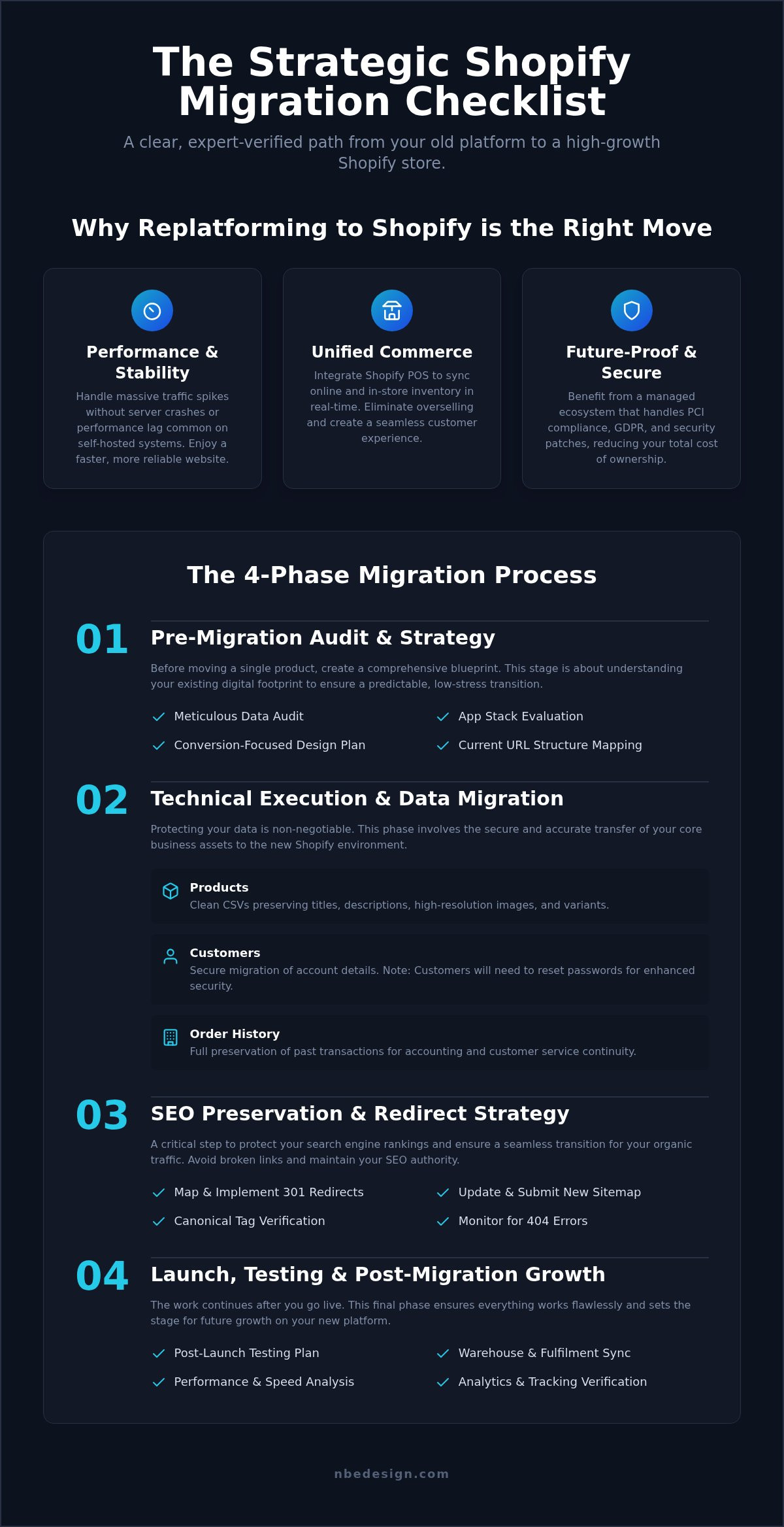
Why Replatforming to Shopify is the Right Move in 2026
The e-commerce landscape has transformed significantly by late 2026. Retailers no longer view their website and physical shop as separate entities; they require a unified engine that handles everything from AI-powered product discovery to complex stock control. Choosing the right platform is the first critical step on your shopify migration checklist. Shopify has emerged as the clear leader for UK businesses seeking stability, boasting a market share that now commands a significant portion of all e-commerce sales. The platform's infrastructure ensures your store can handle massive traffic spikes without the server crashes or performance lag common on self-hosted systems.
Beyond simple hosting, Shopify provides access to a cutting-edge commerce ecosystem. The "Spring '26 Edition" introduced the Universal Commerce Protocol, allowing your products to be discovered by AI-powered agents across new digital channels. This forward-thinking approach means your business isn't just catching up to the market; it's staying ahead of it. By moving to a managed environment, you also reduce the total cost of ownership. While platforms like Magento require expensive security patches and constant developer oversight, Shopify handles these complexities as part of your subscription, allowing you to reinvest those funds into growth and customer acquisition.
Shopify vs. The Competition: A 2026 Perspective
Many retailers are abandoning the "plugin bloat" of WooCommerce or the high maintenance demands of Magento. While self-hosted platforms offer perceived control, they often lead to security vulnerabilities and fragmented data. A successful Data migration to Shopify allows you to move from a maintenance-heavy mindset to a high-growth strategy. Shopify manages the technical heavy lifting, including PCI compliance and evolving global privacy regulations like GDPR. This transition is essential for businesses that have outgrown their current setup and need a platform that scales automatically as order volumes increase.
Unified Retail: Connecting Online and In-Store
For retailers with physical storefronts in Darlington or Newcastle, the integration of Shopify POS is a strategic game-changer. It eliminates the frustration of overselling stock because your online and in-store inventory syncs in real-time. This single source of truth is vital for modern retail operations. We offer Shopify POS demos to help local business owners visualise how this technology unifies their operations. By centralising your retail data, you reduce administrative overhead and provide a seamless experience for your customers. Whether they browse your local shelves or buy online for home delivery, your system remains accurate and reliable. Including this integration in your shopify migration checklist ensures your physical and digital presence work in perfect harmony.
Phase 1: The Pre-Migration Audit & Strategy
Before you move a single product, you need a blueprint. This first stage of your shopify migration checklist is about understanding the depth of your current digital footprint. You're not just moving a shop; you're relocating a business. This requires a meticulous audit of your existing data, including product variants, customer profiles, and years of order history. It's also the perfect time to evaluate your app stack. By 2026, privacy regulations like GDPR have become stricter, meaning every third-party tool you use must be vetted for compliance. If an app isn't driving revenue or improving operations, it's time to bin it.
Design is another core pillar of this phase. Moving to Shopify is an opportunity to shift from a basic template to a conversion-focused experience. We focus on how your store looks and how it performs for the user. Mapping your URL structure is equally vital. Every product link and blog post needs a destination on the new site to prevent a wave of 404 errors that could frustrate customers and damage your authority. Planning these details early ensures the technical execution remains predictable and low-stress.
Data Integrity: What Exactly Are You Moving?
Protecting your data is non-negotiable. We start by creating clean product CSV files that preserve titles, descriptions, and high-resolution images. Customer records are more sensitive. While you can migrate account details, Shopify's security protocols mean customers will need to reset their passwords upon their first visit to the new store. This is a standard safety measure that builds trust and maintains data security. Preserving order history is also essential for your accounting and customer service teams, ensuring they can reference past transactions without switching between legacy systems.
The SEO Audit: Protecting Your Rankings
Your organic search traffic is a valuable asset. To protect it, you must identify your top-performing pages and keywords before the move. We recommend crawling your entire site to document every live URL. This map becomes the foundation for your redirect strategy and is a core component of any shopify migration checklist. Following Google's official site move guide ensures that search engines understand where your content has moved, allowing you to maintain your hard-earned rankings. If you're feeling overwhelmed by the technical requirements of this audit, you can reach out to our team for expert guidance on managing this transition safely.
Phase 2: Technical Execution & Data Migration Checklist
This is the moment your store transitions from a concept into a functional reality. The technical execution phase requires a steady hand and a methodical approach to ensure every digital asset finds its correct place. Using a structured shopify migration checklist allows you to manage the complexity of setting up your Shopify admin, from basic store settings to advanced tax configurations. We begin by establishing your core business identity within the platform, ensuring your UK business details and currency (£) are correctly aligned with local regulations.
Importing your product data is the most labour-intensive part of this phase. You aren't just moving text; you're transferring the lifeblood of your business. This involves mapping product titles, detailed descriptions, and high-resolution images to their new home. For a deeper look at the granular technical steps involved, you can consult this expert's step-by-step migration guide. We pay close attention to variant data, such as size and colour, to ensure that your customers see exactly what is in stock, whether they are shopping online or visiting your physical storefront.
Configuring your payment gateways and shipping zones is equally critical. For UK retailers, this means setting up Shopify Payments to accept GBP securely while also defining precise shipping rates for Royal Mail, DPD, or international carriers. A unique advantage we provide is the seamless integration of your physical retail presence. While many generalists overlook the shop floor, we prioritise connecting your Shopify POS. This ensures that a sale made in your Darlington or Newcastle shop immediately reflects in your online inventory, providing a truly unified commerce experience.
Product and Collection Setup
Modern e-commerce requires intelligent organisation. We specialise in creating automated collections that use specific conditions to group your products by brand, price, or seasonal trends. This improves the user experience by making your catalogue easy to navigate. By 2026, mobile commerce accounts for approximately 60% of global sales, so we prioritise optimising every product image. This ensures your site remains lightning-fast on smartphones without sacrificing the visual quality your brand deserves.
Integrations and App Configuration
Your Shopify store must work in harmony with your wider business tools. We manage the connection of your ERP, CRM, and accounting software to ensure data flows smoothly across your entire operation. Additionally, we configure essential apps for customer loyalty, reviews, and marketing to drive engagement from day one. If you're looking for inspiration on how a high-performance store should look and feel, browse our Shopify Expert Portfolio to see our latest work for retailers across the UK.
Phase 3: The SEO Preservation & Redirect Strategy
One of the biggest anxieties retailers face is the potential for a sudden drop in organic search rankings. This fear is justified. Without a rigorous shopify migration checklist, search engines can lose track of your pages, leading to a significant loss in traffic and revenue. We treat SEO preservation as a core priority rather than a post-launch afterthought. By implementing a comprehensive 301 redirect strategy, you signal to Google that your content has simply moved to a new, better home, preserving the authority you've built over years of trading.
Updating your meta data is the next essential step. Shopify’s structure is highly optimised for search engines, but it requires your existing meta titles and descriptions to be correctly aligned with new character limits and formatting rules. This isn't just about moving data; it's about refining it to perform better in a more competitive 2026 landscape. We ensure your most valuable keywords are integrated naturally into your new site structure, from product pages to collection headers.
The 301 Redirect Map
Mapping your old URL structure to Shopify's specific paths is a non-negotiable task. For example, many legacy platforms use /product/ while Shopify requires /products/. Every single live link must have a corresponding redirect to prevent 404 errors. We use bulk-uploading tools to manage thousands of redirects simultaneously, ensuring no page is left behind. This technical precision is what allows for a seamless transition. While you're improving your site's foundation, it's also worth considering Conversion Rate Optimisation to ensure your preserved traffic actually turns into sales.
Content and Meta Data Migration
Moving your blog posts and static pages requires more than just copying text. We ensure that formatting, internal links, and embedded media remain intact during the move. Optimising image alt text for Shopify's CDN is another crucial step in our shopify migration checklist, as it aids accessibility and image search rankings. We also verify that your schema markup is correctly implemented, allowing search engines to display rich snippets for your products, which can improve click-through rates from day one.
Once your store goes live, the work doesn't stop. We monitor your site for 404 errors during the critical first 48 hours to catch any missed redirects. Submitting your new sitemap to Google Search Console is the final piece of the puzzle, prompting crawlers to index your new Shopify structure immediately. Managing these technical nuances requires a specialist's eye to avoid costly mistakes. If you want to ensure your organic traffic remains protected during your move, contact our experts in Darlington and Newcastle for a managed migration.
Phase 4: Launch, Testing, and Post-Migration Growth
Launch day is a significant milestone, but it's not the finish line. The final phase of your shopify migration checklist involves rigorous testing to ensure your store performs perfectly under real-world conditions. We don't just flip a switch; we conduct full end-to-end checkout tests using real GBP (£) transactions. This process verifies that every shipping rule, UK tax calculation, and payment gateway is functioning as intended. We also pay close attention to your physical operations. If you're managing stock from a Darlington warehouse, we verify that Shopify POS is syncing inventory levels in real-time. This prevents the frustration of overselling and ensures your staff can trust the data on their screens from the moment you go live.
Training your team is equally vital for a stress-free transition. We guide your staff through the Shopify admin, covering everything from processing orders to managing customer returns. When your team feels confident with the new system, the entire business runs more smoothly and your customers receive better service. We also help you set up post-purchase automations. These flows welcome your existing customers to the new site, explaining the benefits of the upgrade and encouraging them to explore the improved shopping experience. This proactive communication helps maintain customer loyalty during the transition period.
The Final Pre-Launch Checklist
Before the site goes live to the public, we handle the technical nuances of domain pointing and DNS settings. This ensures your URL directs traffic to the new Shopify servers with minimal downtime. We also perform final checks on mobile responsiveness and page speed scores. By late 2026, a slow mobile site is a major deterrent for UK shoppers who expect instant results. Finally, we ensure all legal pages, including your Privacy Policy and Terms of Service, are correctly linked and compliant with current UK regulations and GDPR standards. These final steps are what separate a professional migration from a risky one.
Scaling with a Shopify Expert
A successful migration is just the beginning of your growth journey. Ongoing support is vital for long-term e-commerce success because the digital market never stands still. As a certified Shopify Partner based in North East England, NB eCommerce & Design provides the local expertise and global perspective needed to help UK retailers thrive. We don't just build stores; we build partnerships that focus on performance, craftsmanship, and long-term stability. If you're ready to move your business forward with a managed, low-stress experience, book your Shopify migration consultation with our UK experts today. Our goal is to ensure your new platform becomes a powerful engine for your retail growth.
Ready to Future-Proof Your Retail Business?
A successful transition to Shopify is more than a platform change; it's a strategic move toward unified commerce. By following an expert-verified shopify migration checklist, you protect your hard-earned SEO rankings while gaining a store that is faster, more secure, and ready for the demands of 2026. Whether you're prioritising mobile performance or seeking to connect your Darlington storefront with your online inventory via Shopify POS, the right preparation makes all the difference.
As a Certified Shopify Expert UK with a dedicated team based in North East England, we specialise in making these complex transitions low-stress and highly rewarding. We combine local craftsmanship with deep technical knowledge to ensure your data remains secure and your operations stay uninterrupted. Don't let technical anxiety hold your growth back; our experts are here to guide you every step of the way.
Get a Professional Shopify Migration Quote today and start building a commerce engine that drives long-term success. We're ready to help you take your brand to the next level.
Frequently Asked Questions
How long does a typical Shopify migration take in 2026?
A typical migration in 2026 can take anywhere from four to twelve weeks depending on your catalogue size and custom design needs. This timeline includes the initial data audit, theme development, and rigorous testing phases. While smaller stores might move faster, larger retailers with complex integrations should allow ample time to ensure every product and customer record is transferred accurately without disrupting daily operations.
Will I lose my Google rankings if I move to Shopify?
You won't lose your rankings if you follow a professional shopify migration checklist that prioritises SEO preservation. The key is implementing a comprehensive 301 redirect map that guides search engines from your old URLs to your new Shopify paths. When combined with a fresh sitemap submission to Google Search Console, your organic traffic should remain stable and often improves due to Shopify's superior loading speeds.
Can I migrate my customer order history from WooCommerce or Magento?
Yes, you can securely migrate your full customer order history from platforms like WooCommerce or Magento. Preserving this data is essential for maintaining customer loyalty and providing consistent support after your move. We use specialised tools to map historical data into Shopify's database, ensuring your team has access to past transactions for accounting purposes and your customers can still see their previous purchase records in their new accounts.
Do I need a Shopify Expert to handle my migration?
While you can attempt a migration yourself, hiring a Certified Shopify Expert reduces the risk of technical errors and ranking drops. Moving a business involves complex data mapping and custom theme work that requires a specialist's eye. Our team in Darlington and Newcastle provides a managed, low-stress experience, handling the technical heavy lifting so you can focus on running your retail operations without worrying about downtime or lost data.
What happens to my physical store stock during a Shopify POS migration?
During a Shopify POS migration, your physical store stock becomes part of a unified inventory system. This means your Darlington or Newcastle storefront shares a single source of truth with your online shop. Any sale made in-store immediately updates your digital stock levels, preventing overselling. This synchronisation is a core benefit of our migration services, allowing you to manage your entire retail business from one central dashboard.
How do I handle customer passwords when moving to Shopify?
Customer passwords cannot be migrated directly because they are encrypted for security on your current platform. When you move to Shopify, your customers will need to activate their accounts on the new site. We typically handle this by sending a professional account invitation email post-launch. This allows your customers to securely set a new password, ensuring their personal data remains protected while they enjoy your upgraded shopping experience.
Is Shopify Plus necessary for my migration?
Shopify Plus isn't a requirement for most migrations, though it's the ideal choice for high-volume enterprise retailers needing advanced customisation and lower transaction fees. Most UK businesses find that the Basic, Grow, or Advanced plans offer everything they need to scale effectively. During our initial consultation, we'll help you determine which plan aligns with your current turnover and growth projections to ensure you aren't overpaying for unnecessary features.
Can I keep my current domain name when I switch to Shopify?
You can certainly keep your existing domain name when you switch to Shopify. You don't need to purchase a new URL; instead, you simply update your DNS settings to point your current domain toward Shopify's servers. We manage this technical switch during the launch phase to ensure a seamless transition for your customers. Your brand identity remains intact while your store benefits from Shopify's faster, more reliable global hosting infrastructure.

- Posted in:
- Data Migration
- E-commerce
- Platform Migration
- SEO Migration
- Shopify
- Shopify Migration
- shopify migration checklist
- Shopify POS
- UK Retail