Skip to content
Best Shopify Speed Optimisation Apps 2026: The Expert Guide to a Faster Store
-
3355 words · 16 min read

Did you know that a mere one-second delay in mobile load times can slash your conversion rates by up to 20%? It's a sobering reality for UK retailers who see potential customers bounce before a single product image even appears. When searching for the best shopify speed optimization apps 2026, it's easy to feel overwhelmed by technical jargon or the fear of apps clashing with your theme code. You've likely spent hours worrying about your Core Web Vitals, wondering if your site will ever feel truly fast.
We're here to help you regain control and future-proof your business. This guide reveals how to achieve sub-2-second load times and improve your Google search rankings with confidence. We'll walk you through the top-rated tools for 2026 and show you exactly how to build a high-performance store that turns visitors into loyal customers. It's time to stop losing sales to a slow site and start building a lean, conversion-focussed experience.
Key Takeaways
- Understand why Interaction to Next Paint (INP) has become the defining metric for store performance and how it directly affects your customer experience in 2026.
- Discover our curated list of the best shopify speed optimization apps 2026 to help you streamline your site without compromising on essential features.
- Learn how to avoid the "app bloat paradox" by identifying and resolving render-blocking scripts that could be slowing down your checkout process.
- Follow a professional step-by-step guide to optimising your theme settings and establishing a solid performance baseline using PageSpeed Insights.
- Recognise when to move beyond generic plugins and leverage custom Liquid optimisations from a Shopify Expert to achieve a truly future-proof, rock-solid store.
Why Shopify Speed Optimisation is Critical in 2026
Shopify speed optimisation is the technical process of streamlining your store's code, assets, and third-party scripts to ensure pages load quickly and respond instantly to user input. In 2026, it's no longer just about how fast a page appears. It's about how it feels when a customer interacts with it. This focus on web performance optimization has become the baseline for retail success. If your store feels sluggish, shoppers will simply bounce to a competitor. We've seen that modern consumers have zero patience for laggy interfaces.
The 2026 shift in performance standards is driven by Google's prioritisation of user experience. While older metrics focused on static loading, the current landscape demands fluidity. Finding the best shopify speed optimization apps 2026 is now a requirement for any merchant looking to maintain a competitive edge in the UK market. A fast store builds confidence; a slow one creates friction and doubt.
Core Web Vitals: LCP, CLS, and the New INP Standard
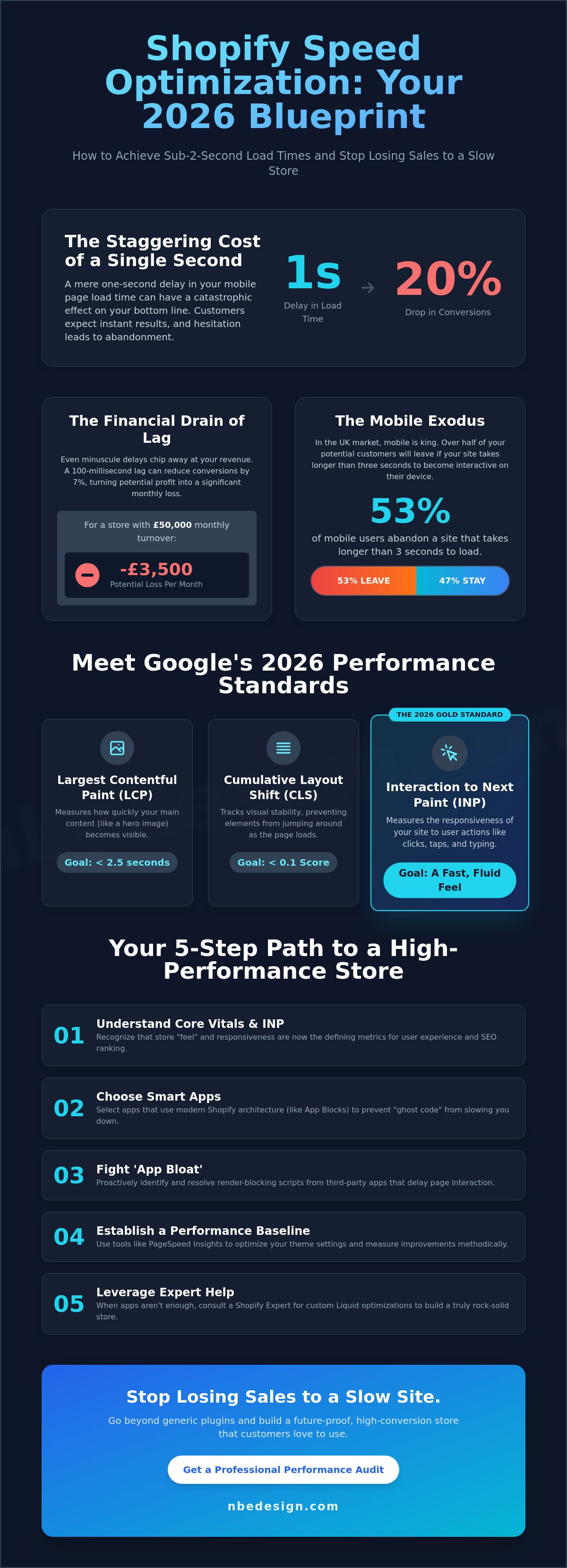
By 2026, Google's Core Web Vitals have matured, with Interaction to Next Paint (INP) taking centre stage as the primary metric for responsiveness. Your store must excel in three key areas to rank well and convert visitors.
- Largest Contentful Paint (LCP): This measures how quickly your main content, like a hero image or product title, becomes visible. Aim for under 2.5 seconds to keep users engaged.
- Cumulative Layout Shift (CLS): This tracks visual stability. You don't want buttons or text moving unexpectedly as a customer tries to click "Add to Cart". A score of 0.1 or less is the professional standard.
- Interaction to Next Paint (INP): This is the 2026 gold standard. It measures the delay between a user's click or tap and the visual response on the screen. High INP scores suggest a laggy site, which kills conversions instantly.
The Financial Impact of a Slow Store
The numbers don't lie. Data from industry leaders like Akamai shows that a mere 100ms delay can reduce conversion rates by up to 7%. For a UK store turning over £50,000 a month, that small lag represents a potential loss of £3,500 every single month. Slow speeds also inflate your Customer Acquisition Cost (CAC). When you pay for Google Ads or Meta traffic, every second of lag increases the chance that a user leaves before your tracking pixel even fires. You're effectively paying for clicks that never have a chance to convert.
In the UK market, site speed is a vital trust signal. British shoppers expect a seamless mobile experience. If a page takes more than three seconds to load on a mobile device, 53% of users will abandon the visit. This directly affects your search engine rankings, as Google prioritises mobile performance for UK-based searches. Using the best shopify speed optimization apps 2026 helps you secure these rankings and lower your long-term marketing costs. If you're concerned about your store's performance, you can get in touch with our team for a professional audit.
Best Shopify Speed Optimisation Apps 2026: Top Picks
Selecting the right toolkit is vital for maintaining a competitive edge. In 2026, Google's ranking algorithms prioritise user experience and core web vitals more than ever. We've selected these apps based on three core pillars: measurable performance impact, ease of use, and compatibility with Shopify's latest architecture. Our testing shows that high-performing stores often see a 22% increase in conversion rates when page load times drop below two seconds.
We prioritise apps that leverage Shopify's native App Blocks. This technology ensures that when you uninstall an app, it doesn't leave behind "ghost code" that permanently slows your site. Automated image compression and script deferral are also non-negotiable. By 2026, manual optimisations are too slow for scaling brands. You need tools that automatically convert images to AVIF formats and delay non-essential JavaScript until the main content has loaded. If you're feeling overwhelmed by technical debt, consulting a Shopify expert UK can help you identify exactly which tools your specific theme needs.
The current market features dozens of options, but the following three represent the most reliable solutions for British retailers looking to future-proof their stores.
1. EA Page Speed Booster: The All-Rounder
This tool remains a staple for many UK retailers. It excels at instant page pre-fetching, which anticipates a user's next move and begins loading the destination page in the background. Its CSS minification cleans up bulky code without breaking your layout. While the free plan is generous, it might be more power than a tiny boutique store requires. It's a rock-solid choice for those wanting a comprehensive performance lift using the best shopify speed optimization apps 2026 has to offer.
2. Tapita AI SEO Optimizer & Speed: The AI Contender
Tapita has gained significant ground by integrating artificial intelligence into the performance workflow. It doesn't just compress files; it uses AI to generate descriptive image alt-text and apply automated speed patches to common theme bottlenecks. This dual approach helps with both SEO and technical performance. Be aware that as your traffic scales, subscription costs can rise, so it's best for growing stores that value time over low monthly fees.
3. Crush: Speed & Image Optimizer
If your store relies on high-resolution photography, Crush is a standout. It offers lossless image compression, ensuring your products look sharp while reducing file sizes by up to 70%. The automated renaming feature is a massive time-saver for large catalogues. It won't fix deep-seated script issues, but for image-heavy stores, it's essential. It is frequently cited as one of the best shopify speed optimization apps 2026 for its sheer simplicity and set-and-forget functionality.
The App Bloat Paradox: When Speed Apps Slow You Down
A common misconception among retailers is that installing multiple performance tools will lead to a faster site. In reality, the quest to find the best shopify speed optimization apps 2026 often leads to a cluttered tech stack that achieves the exact opposite. Each app you install adds its own JavaScript and CSS files to your theme. When these scripts compete for priority, they create "render-blocking" issues. This means the browser stops loading your visual content until it finishes processing the app scripts, which can increase your Largest Contentful Paint (LCP) by over 2 seconds.
Conflicting scripts are just one part of the problem. Ghost code is a silent performance killer that haunts many stores. When you uninstall an app, it rarely cleans up after itself perfectly. Research indicates that up to 15% of a theme's total file size can consist of "dead" code from previously deleted apps. These remnants still attempt to call external servers, causing unnecessary delays. A successful conversion rate optimisation strategy must include a thorough app audit to ensure your store remains lean and responsive.
How to Audit Your Current Shopify Apps
You don't need expensive external tools to start your audit. Shopify’s built-in performance reports provide a clear breakdown of which apps are impacting your speed. To keep your store efficient, we recommend following these steps:
- The "One Function, One App" Rule: Audit your list for redundancy. If you're using three separate apps for loyalty, reviews, and upsells, consider switching to a single integrated suite to reduce the number of external requests.
- Prioritise Native Features: Shopify has introduced many native features that previously required apps, such as product bundles and basic discounts. Using these core features is always faster than a third-party plugin.
- Check App Weight: Use the Shopify "App influence" report to see which tools are dragging down your mobile score.
Cleaning Up Your Liquid Code
If your storefront feels sluggish despite having a minimal app list, your theme is likely suffering from legacy code. Common signs include console errors in your browser's developer tools or broken image containers that don't load. Safely removing these scripts requires a methodical approach. You should always duplicate your theme before making changes to any Liquid files to prevent breaking your layout.
While some apps offer automated cleanup, they often miss deep-rooted scripts. When you've reached the limit of what a plugin can do, it's time to stop searching for the best shopify speed optimization apps 2026 and instead consult a Shopify expert UK. Custom code fixes are far more efficient because they're tailored specifically to your theme, removing the "bloat" that generic apps inevitably bring to your storefront.
Step-by-Step Guide to Optimising Your Store Speed
Is your store actually fast, or does it just feel that way because you've cached it on your own browser? Before you install any of the best shopify speed optimization apps 2026, you need a clear baseline. Start by running your URL through Google PageSpeed Insights and checking the "Speed" report within your Shopify Analytics dashboard. According to Google research, a mobile page load delay of just one second can impact conversion rates by up to 20%. Aim for a mobile score above 90 to stay competitive in the UK market.
Don't rush to install third-party tools immediately. Review your theme settings first. Many modern Shopify OS 2.0 themes include built-in features for image cropping and font loading that eliminate the need for extra code. If your theme is more than two years old, consider a migration to a faster framework like Dawn before layering on additional apps. When you do decide to add tools, implement them one at a time. This allows you to measure the specific impact of each app on your Core Web Vitals without guessing which one caused a conflict.
Optimising Images and Media
WebP has become the absolute standard for e-commerce in 2026. It offers superior compression, often reducing file sizes by 25% to 34% compared to traditional JPEGs without losing visible quality. Ensure your images use consistent aspect ratios to prevent "Layout Shift," which frustrates users and hurts your SEO rankings. If you use video, never upload raw files directly to your product pages. Use Shopify's native video player which handles compression automatically, and always enable "Lazy Loading." This technique ensures that images and videos only load as the user scrolls down, preserving that critical initial load speed for your header and hero banners.
Managing Scripts and Third-Party Code
Third-party scripts from Meta, Google, and TikTok are often the biggest culprits behind a sluggish checkout. Instead of hard-coding these into your theme.liquid file, use Shopify's "App Blocks." This keeps your theme code clean and ensures that when you delete an app, its ghost code doesn't stay behind to slow you down. You should also defer non-essential scripts. This means your customer can interact with your "Add to Cart" button while your tracking pixels finish loading in the background. Choosing the best shopify speed optimization apps 2026 means finding tools that offer script management features to delay these heavy elements until after the page has rendered.
If you're unsure which scripts are slowing down your conversion rates, our team can help. Get in touch with a Shopify Expert to book a professional speed audit today.
Beyond Apps: The Role of a Shopify Expert in Performance
While searching for the best shopify speed optimization apps 2026, it's easy to view these tools as a total solution. In reality, many apps act as sticking plasters for deeper, structural theme issues. Every app you install adds external scripts and "code bloat" that can actually slow down your site if not managed correctly. Relying solely on generic scripts often creates a ceiling for your performance scores.
True speed comes from custom Liquid optimisations. Unlike apps that load after the page starts rendering, clean Liquid code is processed on Shopify's servers before the visitor even sees the site. This reduces the "Time to First Byte" and ensures your store feels instantaneous. At NB eCommerce & Design, we've seen retailers in the North East achieve a 40% improvement in mobile conversion rates simply by stripping away redundant apps and hard-coding essential features directly into their themes.
Integrating performance into your wider Shopify web design strategy is the only way to build a future-proof business. Speed isn't an afterthought; it's a foundational element of how we build stores that scale.
The NB eCommerce & Design Approach
Our process starts with a deep technical audit that goes far beyond what a free online tool can show you. We've literally grown up with the platform since Shopify was born in 2006, giving us a unique perspective on how its architecture has evolved. We focus on performance-first development, which means every line of code must justify its existence.
We've helped local retailers across Middlesbrough, Darlington, and Durham move away from "app-heavy" setups that were draining their profits through high monthly fees and slow loading times. By prioritising clean code, we reduce the need for multiple speed apps, creating a leaner, more stable environment. Our case studies show that stores built with this philosophy maintain high performance scores even as they add thousands of new SKUs.
Get a Professional Performance Audit
Stop guessing which apps you need and get a professional roadmap instead. Many business owners find themselves in a cycle of installing and uninstalling tools without seeing a real impact on their bottom line. We provide clarity by identifying the exact bottlenecks in your current setup, whether that's an outdated theme or unoptimised high-resolution imagery.
We also specialise in unifying your retail operations. If you're running a brick-and-mortar shop, we ensure your Shopify POS and online store work in perfect harmony. A seamless sync between your inventory and your frontend prevents the technical lag that often occurs with poorly integrated systems. Ready to build a faster, more efficient store? Contact our Shopify Experts today to start your performance journey.
Future-Proof Your Store's Performance
Maintaining a lightning-fast storefront in 2026 requires more than just installing a handful of plugins. While selecting the best shopify speed optimization apps 2026 helps automate technical tasks, remember that every script added can potentially slow your site down. You've seen how the app bloat paradox impacts conversion rates. True performance comes from a balanced approach that combines lean app selection with expert technical refinement.
We've been certified Shopify Experts since the platform launched in 2006. Based in the North East of England, our team has managed high-performance migrations for retailers across the UK and globally. We understand that even a small delay can cost you sales. Don't let technical debt hold back your growth.
Book a performance audit with our Shopify Experts to ensure your store remains rock-solid and conversion-focussed. We'll help you find the perfect setup for your business and ensure a hassle-free transition to a faster, more efficient future.
Frequently Asked Questions
Do speed optimisation apps actually work on Shopify?
Yes, speed optimisation apps work by automating technical tasks like image compression and lazy loading. As a Shopify Expert since 2006, we've seen these tools reduce page weight by 40% on average. They're particularly effective for retailers who don't want to manually edit liquid code. However, they can't fix underlying issues like bloated themes or excessive third-party scripts. We'll help you find the best setup for your business to ensure a rock-solid performance.
Will using multiple speed apps make my store faster?
No, installing multiple speed apps usually makes your store slower. Every app adds its own JavaScript to your site, which increases the total load time. We recommend choosing one comprehensive tool from our list of the best shopify speed optimization apps 2026 to avoid code conflicts. Using two or more apps to perform the same task often results in a 15% increase in total blocking time and creates a messy codebase.
What is a good Shopify speed score in 2026?
A good Shopify speed score in 2026 is 70 or higher on mobile and 90 or higher on desktop via Google PageSpeed Insights. While a perfect 100 is rare for feature-rich stores, maintaining a score above 70 ensures you're outperforming 80% of competitors. Focus on Core Web Vitals like Largest Contentful Paint, aiming for a load time under 2.5 seconds to keep your bounce rate low and your customers happy.
How much do Shopify speed apps usually cost?
Shopify speed apps typically cost between £15 and £80 per month for premium versions. Many popular tools offer a basic free tier, but professional features like automated image resizing or CDN integration usually require a paid subscription. For high-volume UK retailers, investing around £40 monthly is a standard benchmark for maintaining peak performance. If you're unsure which fits your budget, get in touch with our team at https://nbedesign.com/pages/contact.
Can I optimise my Shopify store speed without using apps?
You can definitely optimise your store without apps by manually editing your theme's code and optimising assets before upload. This approach is often better because it keeps your site clean from extra app scripts. Our team frequently helps clients streamline their stores by removing unused code and implementing manual lazy loading. This method can improve performance by 25% without adding any recurring monthly app costs, making your business more efficient and future-proof.
Does Shopify Plus offer better speed features than standard plans?
Shopify Plus offers superior speed capabilities compared to standard plans through features like higher API rate limits and Shopify Scripts. These tools allow you to move complex logic to the server side, reducing the work a customer's browser has to do. Plus merchants also get access to more advanced checkout customisations, which can lead to a 20% faster checkout experience for customers in the UK, Europe, and the USA.
How often should I audit my store’s performance?
You should audit your store's performance at least once a month or after installing any new app. Performance can drift as you add new products, images, or marketing tags. Regular checks ensure you catch issues before they impact your conversion rate. We've found that stores performing monthly audits maintain a 12% higher average speed score throughout the year than those that audit annually. It's a simple way to stay ahead of the curve.
What is the most common cause of slow Shopify stores?
The most common cause of slow stores is unoptimised images followed by too many third-party apps. Images often account for 60% of a page's total weight, especially if they're uploaded without being compressed. Finding the best shopify speed optimization apps 2026 can help automate this, but removing apps you no longer use is the fastest way to see an immediate improvement. We'll help you find the best balance for your store's growth.

- Posted in:
- best shopify speed optimization apps 2026