Skip to content
Ecommerce Conversion Rate: The Definitive Guide for Retailers
-
2513 words · 12 min read

Is your online store attracting a steady stream of visitors, but the sales figures simply aren't reflecting that traffic? It’s a common and frustrating challenge for many retailers. You've done the hard work of getting people to your site, yet that final, crucial step-the purchase-isn't happening as often as it should. This gap between interest and income often boils down to one of the most important metrics for your business: your ecommerce conversion rate. But understanding what it is, let alone how to improve it, can feel like a daunting task.
As Shopify Experts who have helped retailers across the UK grow their sales, we're here to demystify this vital metric. This definitive guide is designed to give you clarity and confidence. We will walk you through exactly how to calculate your conversion rate, what a realistic benchmark looks like in the current market, and the foundational, conversion-focused strategies you can implement to turn more browsers into buyers. It's time to make your traffic count and build a more profitable online store.
What is Ecommerce Conversion Rate (And Why It's Your Most Important Metric)
In the world of online retail, it's easy to get distracted by big numbers like website traffic or social media followers. But while these metrics look good on a report, they don't pay the bills. The single most important figure for gauging your store's success is your ecommerce conversion rate. Simply put, it's the percentage of your website visitors who complete a desired action-most often, making a purchase. This number is the ultimate measure of your site's persuasiveness and efficiency, telling you not just how many people arrive, but how effectively you turn them into customers.
To get a deeper understanding of how this works in practice, this video offers a great overview:
The Simple Formula to Calculate Your Conversion Rate
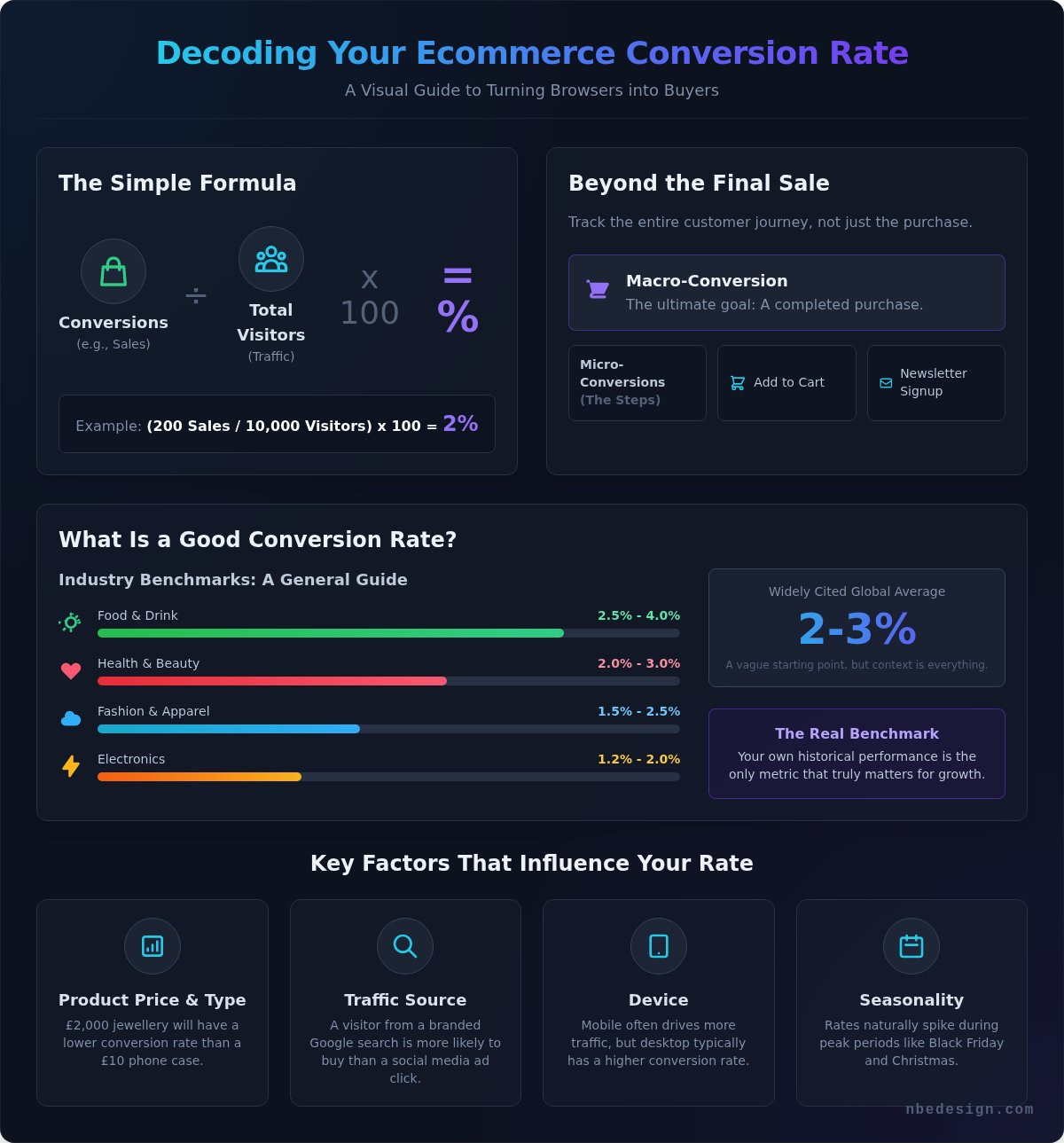
Calculating your conversion rate is straightforward. The formula is a simple but powerful tool for understanding performance:
(Number of Conversions / Total Visitors) x 100 = Conversion Rate (%)
For example, if your UK-based Shopify store had 10,000 visitors in a month and generated 200 sales, your calculation would be: (200 / 10,000) x 100 = 2%. You can easily find this data within your Shopify Analytics dashboard under 'Online store conversion rate' or by setting up e-commerce tracking in Google Analytics 4.
Defining a 'Conversion': Beyond Just the Final Sale
While the final sale is the ultimate goal (a 'macro-conversion'), it's not the only action worth tracking. Smaller steps, or 'micro-conversions', are crucial indicators of customer interest. These include actions like:
- Adding a product to the cart
- Signing up for your email newsletter
- Creating a customer account
Tracking both macro and micro-conversions gives you a complete picture of the customer journey, helping you identify where potential buyers might be dropping off before the final checkout.
Why Conversion Rate is the True Test of Your Store's Health
Your conversion rate is more than just a number; it's a direct reflection of your entire business strategy. It reveals the effectiveness of your marketing, the clarity of your website design, the appeal of your products, and the trust you've built with your audience. A consistently low rate can signal underlying issues with pricing, user experience, or product-market fit. This is where the discipline of Conversion Rate Optimization (CRO) comes into play, providing a structured approach to improving these elements. Conversely, a strong ecommerce conversion rate indicates you're attracting the right traffic and delivering an experience that effectively meets their needs, turning browsers into buyers and driving sustainable growth.
What is a Good Ecommerce Conversion Rate? Benchmarks vs. Reality
So, what ecommerce conversion rate should you be aiming for? It’s the single most common question we hear from retailers. The widely cited global average hovers around 2-3%, but relying solely on this figure can be misleading. While it provides a vague starting point, the truth is that a 'good' conversion rate is highly contextual and unique to your business.
The most powerful way to use the business metric known as conversion rate is not to compare your store to a global average, but to measure your own progress over time. Your historical performance is the only benchmark that truly matters because it accounts for your specific products, audience, and brand positioning.
Industry Benchmarks: A General Guide
Industry averages can offer a more relevant snapshot. A high-consideration purchase, like luxury furniture, will naturally have a lower conversion rate than a weekly grocery order. Here are some recent benchmarks to provide context:
| Industry | Average Conversion Rate |
|---|---|
| Fashion & Apparel | 1.5% - 2.5% |
| Health & Beauty | 2.0% - 3.0% |
| Electronics | 1.2% - 2.0% |
| Food & Drink | 2.5% - 4.0% |
Data compiled from recent reports by IRP Commerce and Littledata.
Key Factors That Influence Your 'Good' Rate
Several critical factors directly impact what you should consider a strong conversion rate for your store:
- Product Price & Type: A store selling bespoke jewellery for over £2,000 will have a much lower conversion rate than one selling £10 phone cases. The higher the cost and consideration, the lower the typical rate.
- Traffic Source: A visitor arriving from a branded Google search is primed to buy and converts at a high rate. In contrast, a user scrolling on social media who clicks an ad out of curiosity is much less likely to purchase immediately. Managing these paid traffic sources effectively is a specialty, and you can learn more about HOT IRON Digital to see how performance marketing agencies tackle this challenge.
- Device: While mobile often drives the most traffic, desktop users traditionally convert at a higher rate due to the ease of navigating and completing checkout on a larger screen.
- Seasonality: Your conversion rate will naturally spike during peak periods like Black Friday or the run-up to Christmas, and dip during quieter months.
How to Benchmark Against Yourself for Real Growth
The most effective strategy is to focus on internal growth. Track your conversion rate on a month-over-month and year-over-year basis. This approach automatically controls for your unique business factors and provides a clear view of whether your marketing and site improvements are working. Instead of chasing an arbitrary industry average, set a realistic goal to improve your own baseline-a 10-20% increase from your current rate is a fantastic target for a quarter.
The Four Pillars of a High-Converting Shopify Store
Understanding your ecommerce conversion rate is one thing; actively improving it is another. A high-performing Shopify store isn't built on guesswork-it's engineered around the customer journey. By mastering four foundational pillars, you can transform casual browsers into loyal customers and drive sustainable growth for your business.
Pillar 1: Crystal-Clear Homepage & Navigation
You have less than five seconds to make a first impression. Your homepage must immediately answer a visitor's primary question: "What's in it for me?" A powerful value proposition, professional design, and clear branding build instant trust. This must be supported by intuitive navigation, allowing users to effortlessly find product categories, use the search bar, and locate contact information. If a user is confused, they will leave.
Pillar 2: Compelling Product Detail Pages (PDPs)
This is where the purchase decision is made. Your product pages must do the selling for you with persuasive, benefit-driven copy and stunning visuals. A robust PDP includes:
- High-Quality Media: Multiple professional photos from different angles, product videos, and 360-degree views.
- Persuasive Copy: Focus on how the product solves a problem or improves the customer's life, not just its technical features. For a specialized item, this is critical; for instance, you can explore Bob Beck Device to understand how its benefits are communicated.
- Social Proof: Prominently display customer reviews, star ratings, and user-generated content to build confidence.
- Clear Call-to-Action: A bold, unmissable 'Add to Cart' button that stands out on the page.
Pillar 3: A Frictionless Checkout Experience
A complicated checkout is the number one conversion killer. Every unnecessary field or confusing step increases the risk of cart abandonment. To streamline this critical phase, you must offer guest checkout, display all costs upfront (including shipping in £), and provide multiple payment options like Shop Pay, PayPal, and credit cards. Reinforce trust with security badges and clear links to your return policy.
Pillar 4: Mobile-First Design and Performance
While most UK traffic now comes from mobile devices, conversions often lag behind desktop. This gap, highlighted in many ecommerce conversion rate benchmarks, is almost always due to a poor mobile experience. A truly responsive design isn't just about fitting on a small screen; it's about being fast and easy to use with a thumb. Slow page-loading times are especially damaging on mobile, as users are far less patient. Optimising for speed is essential for improving your mobile ecommerce conversion rate.
How to Start Improving Your Conversion Rate: An Introduction to CRO
Understanding your benchmarks is the first step, but actively improving your ecommerce conversion rate is how you drive sustainable growth. This is achieved through Conversion Rate Optimisation (CRO), a structured, data-led methodology designed to increase the percentage of website visitors who take a desired action-like making a purchase.
Forget guesswork and making changes based on gut feelings. True CRO is a scientific process focused on understanding your users and making incremental improvements. It follows a continuous cycle: Analyse, Hypothesise, Test, and Learn.
Step 1: Uncover Opportunities with Analytics
Your journey begins with quantitative data. Dive into your Shopify or Google Analytics to find the "what" and "where" of your conversion problems. Start by identifying your biggest drop-off points in the customer journey-is it from the product page to the cart, or from the cart to checkout? Pinpoint your most valuable pages (high traffic, high conversion) and your worst-performing pages to focus your efforts where they will have the most impact.
Step 2: Understand the 'Why' with User Research
Analytics tell you what is happening, but qualitative user research tells you why. Go beyond the numbers to understand user behaviour and motivations. Use tools like heatmaps and session recordings to see exactly where users click, scroll, and get stuck. Gather direct feedback through customer surveys, post-purchase questionnaires, and by reviewing customer service logs for recurring questions or complaints that signal friction on your site.
Step 3: Develop a Hypothesis and Prioritise Tests
With insights from your data, you can formulate a clear, testable hypothesis. This should follow a simple structure: "By changing X, we believe Y will happen, because of Z." For example: "By adding trust badges to the checkout page (X), we believe we will reduce cart abandonment (Y), because users are concerned about payment security (Z)."
You can then validate this with an A/B test, showing one version to half your audience and the original to the other half to measure the impact accurately. Prioritise tests based on their potential impact and how easy they are to implement. Feeling overwhelmed? A CRO audit from a Shopify Expert can pinpoint your biggest opportunities.
From Insights to Action: Elevating Your Ecommerce Conversion Rate
Mastering your store's performance isn't about chasing elusive industry benchmarks; it's about systematically turning more visitors into loyal customers. By understanding that your conversion rate is your most vital health metric and focusing on the core pillars of user experience and trust, you build a resilient foundation for sustainable growth.
But knowing where to start can be the most daunting step. As a UK-based, certified Shopify Expert agency with global experience, we specialise in conversion-focused web design that delivers tangible results. We help retailers uncover hidden friction points and implement strategies that drive real revenue. Don't let potential sales slip away.
Book a CRO Audit with Our Shopify Experts to Uncover Your Growth Potential. The path to a higher ecommerce conversion rate begins with this single, informed step. Your journey to scaling your business starts now.
Frequently Asked Questions
Is a 5% ecommerce conversion rate considered good?
Yes, a 5% conversion rate is excellent for most UK retailers. The average ecommerce conversion rate typically sits between 1% and 3%, so achieving 5% places you in the top tier of online stores. However, context is key. Niche industries with high-intent buyers might see higher rates, while sectors with longer consideration periods, like luxury goods, may have lower benchmarks. Ultimately, it’s a strong indicator of a well-optimised, conversion-focussed website that resonates with its target audience.
How is conversion rate different from click-through rate (CTR)?
Click-through rate (CTR) measures the percentage of people who click your ad or link after seeing it; it gauges the effectiveness of your initial marketing message. In contrast, conversion rate measures the percentage of website visitors who complete a desired action, such as making a purchase. Think of CTR as getting customers through the door of your shop, while conversion rate is the percentage of those customers who actually buy something. Both are crucial for measuring online success.
Why is my mobile conversion rate so much lower than my desktop rate?
This is a common challenge. Mobile users often face more friction: smaller screens make navigation tricky, and complex checkout forms are frustrating. Shoppers also use mobiles for initial research, intending to buy later on a desktop. This behaviour naturally lowers the mobile ecommerce conversion rate. A non-responsive design, slow page speed, or a cumbersome payment process are the most significant barriers to improving your mobile performance and securing those sales from customers on the go.
How long does it take to see a meaningful improvement in my conversion rate?
The timeline for seeing meaningful improvement varies. Simple, high-impact changes like streamlining your checkout process could show positive results within a few weeks, provided you have sufficient traffic for statistical significance. Broader changes, such as a complete theme redesign, may take one to three months to yield measurable data. Consistent testing and incremental improvements are the most reliable path to sustainable growth, not overnight fixes. Patience and data-driven decisions are key to success.
What is the single most important area to fix first to improve conversions?
While every store is unique, the most impactful area to investigate first is almost always the checkout process. This is the final hurdle where you can lose a sale. Look for unnecessary steps, hidden shipping costs, or a lack of guest checkout options. Following that, analyse your product pages. Are your images high-quality? Is the 'Add to Cart' button prominent? Is the product description compelling? Fixing friction in these two critical areas typically yields the fastest and most significant returns.
Can I have a high conversion rate but still not be profitable?
Yes, it is entirely possible. Profitability depends on your margins, not just your conversion rate. For example, you might convert 10% of visitors, but if your average order value is only £15 and your customer acquisition cost is £5, with a product cost of £12, you are losing money on every single sale. A high conversion rate is a fantastic sign of an effective website, but it must be paired with a healthy average order value to ensure genuine business growth.

- Posted in:
- conversion optimization
- CRO
- ecommerce
- ecommerce conversion rate
- increase sales
- online sales
- retail marketing
- shopify