Skip to content
How to Choose a CRO Agency in the UK: The Ultimate Guide for E-commerce Growth
-
3043 words · 15 min read

For many Shopify store owners, healthy visitor numbers without a corresponding rise in sales is a common and deeply frustrating challenge. You see the traffic, but the conversions just aren't happening, and a high cart abandonment rate leaves you questioning what's going wrong. This is where a strategic partnership with a skilled cro agency uk can transform your business, turning casual browsers into loyal customers. But with so many options, choosing the right partner can feel daunting-a wrong move could be a costly mistake.
We're here to help you make that decision with confidence. This ultimate guide provides a complete framework for vetting and selecting the right UK-based CRO agency to increase your e-commerce revenue. We'll walk you through the essential criteria, from understanding their data-driven processes to ensuring they have proven expertise with Shopify stores like yours. By the end, you'll have a clear, actionable plan to find a long-term growth partner who can help you unlock the full potential of your existing traffic.
What Does a Conversion Rate Optimisation (CRO) Agency Actually Do?
Beyond the industry buzzwords, the core function of a Conversion Rate Optimisation (CRO) agency is straightforward: to turn more of your website visitors into valuable customers. It’s not about guesswork or randomly changing button colours. A professional Conversion Rate Optimisation (CRO) strategy is a systematic, data-driven process designed to understand user behaviour and remove barriers to purchase. The ultimate goal isn't just a small percentage lift; it's to create a more efficient, user-friendly experience that drives sustainable revenue growth for your business.
To better understand the value an agency brings, this short video outlines some key considerations:
A capable CRO agency in the UK will guide you through a continuous improvement cycle. This proven methodology ensures that every change is a calculated step towards better performance, typically following this core loop:
- Research: Gathering data to understand user behaviour.
- Hypothesis: Forming an educated, testable idea for improvement.
- Prioritisation: Deciding which tests will have the most impact.
- Testing: Running controlled experiments to validate the hypothesis.
- Analysis: Learning from the results to inform the next steps.
Data-Driven Research & Analysis
This foundational stage is about discovering opportunities. It involves a blend of quantitative analysis (using tools like Google Analytics to find where users are dropping off), qualitative analysis (using heatmaps, surveys, and user recordings to understand why), and technical analysis to check for issues with site speed, mobile usability, or browser compatibility that could be costing you sales.
Formulating a Hypothesis and Prioritising Tests
With solid research in hand, the next step is to create a clear, testable hypothesis, such as: "If we simplify the checkout form, then we will increase completed orders because it will reduce user friction." Ideas are then prioritised using frameworks like PIE (Potential, Importance, Ease) to ensure the team focuses on changes that offer the most significant potential for growth, from small tweaks to major strategic shifts.
Experimentation and Testing
This is where hypotheses are proven or disproven. The most common methods include A/B Testing, where one variation is tested against the original (the control); Multivariate Testing, which tests multiple combinations of changes at once; and Split URL Testing, used for comparing two completely different versions of a page, such as a full redesign of a product page.
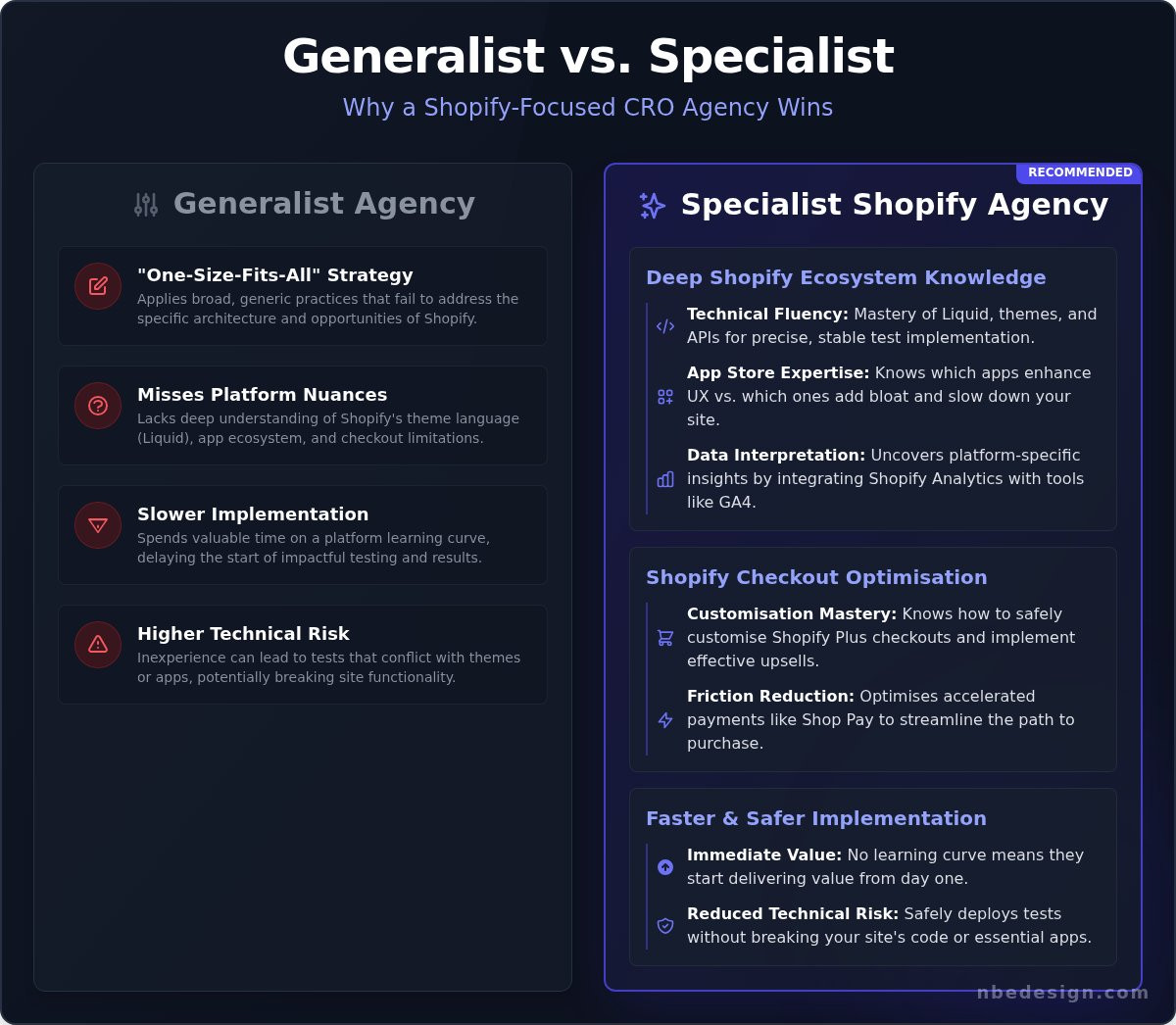
Generalist vs. Specialist: Why a Shopify-Focused CRO Agency Wins
When searching for a partner to drive growth, you face a critical choice: do you opt for a generalist agency that works across all eCommerce platforms, or a specialist that lives and breathes Shopify? While a generalist may have broad digital marketing knowledge, their approach to Conversion Rate Optimisation (CRO) can be a one-size-fits-all strategy. This often fails to account for the specific architecture, opportunities, and limitations of your platform. True optimisation requires more than just best practices; a deep understanding conversion rates shows it's about mastering the user journey within a specific technical environment.
Deep Knowledge of the Shopify Ecosystem
A Shopify-focused CRO agency in the UK doesn't just know CRO; they know CRO for Shopify. This granular expertise is a significant advantage, providing an immediate understanding of how to leverage the platform for maximum impact. This includes:
- Technical Fluency: A rock-solid grasp of Shopify themes, the Liquid templating language, and the nuances of the theme editor, enabling precise and stable test implementation.
- App Store Expertise: The ability to distinguish between apps that genuinely enhance user experience and those that add code bloat, slow down your site, and ultimately hinder conversions.
- Data Interpretation: Familiarity with Shopify’s native analytics and how to integrate them with tools like Google Analytics 4 to uncover platform-specific insights that a generalist might miss.
Expertise in Shopify Checkout Optimisation
The Shopify checkout is famously robust but has its own set of rules. A specialist knows how to work within this framework to streamline the path to purchase. They can confidently implement strategies for Shopify Plus merchants to customise their checkout, optimise accelerated payment options like Shop Pay to reduce friction, and effectively integrate upsells or post-purchase offers without disrupting the core transaction flow.
Faster Implementation and Reduced Technical Risk
Ultimately, specialisation translates to efficiency and security. A Shopify expert eliminates the platform learning curve, allowing them to start delivering value from day one. They understand how to deploy A/B tests and implement changes without conflicting with your theme's code or essential apps, significantly reducing the risk of breaking your site. This focused approach ensures that every optimisation effort is not only effective but also implemented safely and swiftly, future-proofing your store's performance. When you partner with a specialist cro agency UK merchants gain a team that is already an expert on their foundational technology.
See how our Shopify expertise drives real results for UK businesses.
The Hallmarks of a Top UK CRO Agency: A Vetting Checklist
Choosing a partner for conversion rate optimisation is a significant investment for any e-commerce business. The right agency can unlock substantial growth and deliver a rock-solid return, while the wrong one can lead to wasted budgets and missed opportunities. To ensure you make the right choice, it's crucial to perform thorough due diligence.
Use this checklist to vet potential partners and score them against the essential hallmarks of a professional and effective cro agency uk. This structured approach will help you move forward with confidence.
A Transparent and Structured Process
A top-tier agency doesn’t rely on guesswork; they operate with a clear, scientific methodology. They should be able to walk you through their entire process, from initial data analysis and user research to forming a hypothesis, A/B testing, and reporting on results. This data-first approach is the foundation of true Conversion rate optimization (CRO), distinguishing it from simply applying generic 'best practices'. Ask how they manage communication and how frequently you can expect updates.
Verifiable Case Studies with Real Metrics
Vague testimonials are not enough. A credible agency will have detailed case studies showcasing specific, measurable results. Look for proof that is relevant to your industry and platform (e.g., Shopify Plus for a fashion retailer). Pay close attention to the metrics they highlight, as they reveal what the agency truly values. Look for evidence of impact on key business drivers, such as:
- Direct Revenue Uplift: The ultimate measure of success, showing a clear return on investment.
- Increase in Average Order Value (AOV): Demonstrating they can encourage customers to spend more per transaction.
- Improved Customer Lifetime Value (CLV): Proving their changes have a lasting positive impact on profitability.
An In-House, UK-Based Team
Does the agency have its core team of strategists, designers, and developers based in the UK? A local team provides significant advantages, including seamless communication during your business hours and a deep, nuanced understanding of the British consumer market. Don't hesitate to ask directly if they outsource any core functions. A transparent partner will be upfront about their team structure and capabilities.
Technical and Platform Expertise
Modern CRO is deeply technical and requires more than just good design. The agency must have proven expertise with your specific e-commerce platform and technology stack. For instance, if you run on Shopify, are they certified Shopify Experts? Can they confidently discuss their experience with your key apps for email, reviews, or subscriptions? They should be able to articulate how their work intersects with crucial areas like site speed and technical SEO, proving they see the full picture of your online performance. Some agencies integrate these disciplines from the start; for instance, you can learn more about AHS Digital and their cohesive suite of creative services.
Key Questions to Ask a CRO Agency Before You Hire Them
Once you’ve shortlisted potential partners, the discovery call is your opportunity to look beyond the marketing pitch. A transparent and experienced cro agency uk will welcome detailed questions. Use this checklist to probe deeper into their methodology, experience, and commercial terms to ensure you find a genuine partner committed to your growth.
Questions About Their Process & Strategy
Understanding an agency's strategic approach is crucial. You're not just buying A/B tests; you're investing in a data-driven process designed to deliver sustainable growth.
- What is your research process before you suggest the first test? Look for answers that include both quantitative (e.g., Google Analytics 4 deep-dive) and qualitative (e.g., heatmaps, user session recordings, customer surveys) data analysis.
- How do you decide what to test first? A strong answer will reference a prioritisation framework (like PIE or ICE models) that balances potential impact, importance, and ease of implementation.
- How much of my team's time will be required? This practical question helps you understand the workflow and ensures the partnership can fit smoothly within your own operational capacity.
Questions About Their Experience (Especially with Shopify)
General CRO experience is good, but platform-specific expertise is better. For Shopify merchants, it's vital to find a team that understands the platform's unique architecture and opportunities.
- Can you show me a case study for a Shopify store similar to mine? Ask for examples in your niche or with a similar business model to verify their relevant experience.
- What is the biggest challenge you've faced optimising a Shopify store? This question tests their honesty and problem-solving skills. A good answer reveals their depth of knowledge about the platform's limitations and how to work around them.
- Which CRO and analytics tools are you most proficient with? Expect to hear names like Google Analytics 4, Hotjar, VWO, Google Optimize, or Optimizely.
Questions About Results & Reporting
Clarity on performance measurement and communication is non-negotiable. You need to know how success is defined and how you'll be kept in the loop.
- How do you measure the success of a CRO programme? A sophisticated agency will talk about statistical significance, primary and secondary KPIs (like Revenue Per User and Average Order Value), not just conversion rate uplifts.
- What does a typical monthly report look like? Ask for a sample. It should be clear, concise, and focus on test results, key learnings, and the plan for the next month.
- What happens if a test fails or has a negative impact? The only wrong answer is "that never happens." A great partner will explain how they extract valuable learnings from every result to inform future strategy.
Questions About Commercials & Contracts
Finally, ensure there are no surprises when it comes to the financial and legal aspects of your partnership. A professional cro agency uk will be upfront about all costs and terms.
- What is your pricing model? Common models include a fixed monthly retainer (e.g., starting from £2,000+ per month), project-based fees, or a performance-based model.
- Are there any additional costs for tools or software? Clarify if subscriptions for testing or analytics platforms are included in their fee or billed separately.
- What is the typical contract length and what are the notice periods? Understand the commitment you're making and the flexibility you have if circumstances change.
Understanding the CRO Journey: What to Expect After You Sign
Partnering with a Conversion Rate Optimisation specialist is the beginning of a strategic journey, not a one-time fix. Choosing the right cro agency uk is the first step; understanding the collaborative process that follows is crucial for long-term success. To demystify the process and set clear expectations, here is a typical roadmap for the first 90 days and beyond.
Month 1: Onboarding and Deep-Dive Research
The initial month is dedicated to building a rock-solid foundation. Your agency will immerse themselves in your business to understand your customers, goals, and technical landscape. This phase is about discovery and alignment, ensuring every future action is data-driven and purposeful. Expect a lot of communication as we get everything in place.
- Kick-off & Goal Setting: We'll hold initial meetings to align on your primary business objectives and define the key performance indicators (KPIs) we will measure.
- Technical Setup: Our team will install and configure essential tools like heatmaps, session recording software, analytics platforms, and A/B testing software.
- Data Collection: We begin quantitative analysis of your site data alongside qualitative research, such as user surveys and heuristic analysis, to identify friction points.
Month 2: First Hypotheses and Test Implementation
With a foundation of data and insight, we move from research to action. This is where the first concrete ideas for improvement take shape and are prepared for launch. Close collaboration is key during this phase to ensure tests are implemented smoothly and align with your brand and technical requirements. The goal is to get the first meaningful experiments live on your site.
Month 3 and Beyond: Continuous Optimisation and Learning
CRO is a continuous cycle of testing, learning, and iterating. From the third month onwards, we establish a rhythm of optimisation that builds momentum. We will analyse the results from the first tests, sharing key learnings-both from winning and losing variations-to inform the next steps. This process builds a long-term optimisation programme, where cumulative data leads to increasingly impactful improvements and sustainable growth for your business.
This methodical approach ensures your investment delivers continuous returns, transforming your website into a powerful, efficient engine for growth. Ready to start your optimisation journey? Talk to a UK Shopify expert today.
Choosing Your Partner for E-commerce Growth
Selecting the right partner for conversion rate optimisation is one of the most impactful decisions you can make for your brand. As this guide has shown, the key lies in prioritising specialist expertise-especially for Shopify stores-and understanding the data-driven journey ahead. By using a clear vetting process, you can confidently choose the right cro agency uk to act as a true extension of your team, driving tangible results.
At NB eCommerce & Design, we don't just optimise websites; we build growth partnerships. As a Certified Shopify Select Partner, our UK-based team has a proven track record of helping retailers scale through meticulous, conversion-focused strategies. We combine our global experience with a deep understanding of the Shopify platform to deliver success you can measure.
Ready to see what's possible for your store? Book a free consultation with our Shopify CRO experts. Let's begin the conversation that will unlock your brand's full potential.
Frequently Asked Questions about CRO
How much does a CRO agency cost in the UK?
The investment for a CRO agency in the UK varies based on the scope of work. Typically, you can expect monthly retainers to start from £2,500 to £5,000 for a comprehensive programme of research, testing, and analysis. Some agencies may offer one-off projects, such as a conversion audit, which could range from £4,000 to £8,000+. Always ensure you understand what is included, such as the number of A/B tests per month and the depth of user research provided.
How long does it take to see results from CRO?
While some quick wins can be identified early, meaningful CRO is a long-term strategy. The initial discovery and research phase often takes 4-6 weeks. You may see the results from the first A/B tests within 2-3 months. However, to achieve significant and sustainable growth in your conversion rate, you should plan for a commitment of at least 6-12 months. This allows for iterative testing and learning, which compounds over time to produce the best results.
What is a good conversion rate for an e-commerce store in the UK?
Across the UK, a typical e-commerce conversion rate falls between 1.5% and 3%. However, this figure is highly dependent on your industry, price point, and traffic source. For example, a low-cost fashion retailer might see higher rates than a luxury furniture store. Rather than fixating on a single number, the goal of CRO is to establish your current baseline and focus on achieving consistent, incremental improvements month after month for sustainable business growth.
What's the difference between CRO and SEO?
The two disciplines work together but have different goals. Search Engine Optimisation (SEO) focuses on increasing the quantity and quality of organic traffic to your website from search engines like Google. Conversion Rate Optimisation (CRO) focuses on improving your website to persuade more of that existing traffic to take a desired action, such as making a purchase or signing up. In short, SEO gets more people to your store, while CRO helps more of them become customers.
Can CRO hurt my website's SEO performance?
When implemented correctly, CRO should actually enhance your SEO performance. A professional CRO agency UK will use testing methods that don't negatively impact search engine crawlers. By improving user experience, CRO often leads to better engagement metrics like lower bounce rates and longer time on site. These are positive signals to Google that your site is valuable, which can indirectly support your SEO efforts. The key is to partner with an experienced agency that understands the technical implications.
Do I need a certain amount of traffic to start with CRO?
To run statistically significant A/B tests, a healthy amount of traffic is necessary. A good benchmark is to have at least 1,000 conversions per month, or 5,000+ unique visitors to the specific pages you intend to test. If your traffic is below this level, a CRO programme can still be highly valuable. It will simply focus more on foundational work like heuristic analysis, user research, and implementing proven best practices to prepare your site for growth and future testing.

- Posted in:
- Conversion Rate Optimisation
- CRO
- CRO Agency
- cro agency uk
- E-commerce Growth
- Increase Sales
- Shopify
- UK Business