Skip to content
How to Migrate from EKM to Shopify: The 2026 UK Retailer’s Guide
-
3375 words · 16 min read

Paying more for a "managed" service like EKM might actually be costing your business its freedom to scale. If you feel restricted by legacy features or the lack of modern integrations, you aren't alone. Many UK retailers now find that the decision to migrate from EKM to Shopify is the essential step needed to reclaim control over their digital storefront. It's completely understandable to feel a sense of anxiety about such a significant technical move. The fear of site downtime or the potential loss of your hard-earned SEO authority can make even the most ambitious business owner hesitate.
We're here to reassure you that a transition doesn't have to be a source of stress. This guide will show you how to move your store while protecting your vital customer history and search engine rankings. You'll discover how a managed migration allows you to trade technical limitations for a high-converting Shopify store and unified sales via Shopify POS. We'll walk through the exact steps to ensure your business is positioned for long-term growth in the 2026 UK retail market. You deserve a platform that works as hard as you do.
Key Takeaways
- Understand why moving from a rigid, "managed" legacy model to Shopify’s flexible architecture provides the scalability required for the 2026 retail landscape.
- Learn how to migrate from ekm to shopify while safeguarding your SEO authority and customer data through a structured audit and mapping process.
- Compare platform costs and transaction fees to see how Shopify’s ecosystem offers better long-term value and customisation for growing UK businesses.
- Discover how to unify your Darlington or Newcastle physical storefront with your online sales using a seamless Shopify POS integration.
- Gain peace of mind by understanding how a certified Shopify Expert manages the technical complexities to ensure a low-stress, professional transition.
Why UK Retailers are Choosing to Migrate from EKM to Shopify in 2026
In 2026, the UK retail market is more competitive than ever. Staying on a legacy platform that feels like a "closed shop" is no longer a viable strategy for growth. Many business owners find that the decision to migrate from EKM to Shopify isn't just about changing a website; it's about moving to a merchant-first architecture that prioritises flexibility. While EKM served many well in the past, its current managed model can feel restrictive for those who want to own their digital destiny. Retailers are now looking for a system that empowers them to make rapid changes without technical bottlenecks.
Overcoming the Limitations of Legacy eCommerce
Legacy systems often rely on older codebases and restricted templates that stifle conversion rates. If you can't make rapid site updates or test new marketing strategies without waiting for a support ticket, you're losing money. Modern retailers require deeper third-party integrations for everything from advanced loyalty schemes to sophisticated email automation. Shopify provides this autonomy, allowing you to tap into a world-class app ecosystem and use 2026’s latest AI-driven commerce tools to personalise the shopping experience for every visitor. This shift ensures you aren't just keeping up with the competition but actively leading it.
Merchant autonomy is essential in the current fast-paced environment. When you migrate from EKM to Shopify, you gain the ability to manage your stock, pricing, and promotions with ease. You no longer have to worry about the limitations of a "done-for-you" service that might not align with your specific brand vision. Instead, you get a platform that supports complex distribution avenues and provides the tools necessary for modern performance optimisation.
The Scalability Advantage of Shopify
Scalability is the cornerstone of a successful online business. When traffic surges during Black Friday or a viral social media campaign, your site must remain lightning-fast. The Shopify infrastructure is engineered to handle these high-pressure moments with ease, ensuring no customer is met with a slow-loading page or a checkout error. This reliability is why so many established brands have moved away from disconnected systems. By choosing to work with a Shopify Expert UK for your transition, you ensure that your store isn't just migrated, but fully optimised for future expansion.
The platform evolves alongside global retail trends, meaning you'll always have access to the latest mobile-first design standards. In 2026, mobile shopping accounts for the vast majority of UK e-commerce transactions, and Shopify’s focus on speed and mobile usability is unmatched. This transition allows you to move from a rigid system to one that is built for the future of global trade, providing a secure and stable foundation for your business to flourish over the long term.
EKM vs. Shopify: Comparing Costs, Ecosystem, and Flexibility
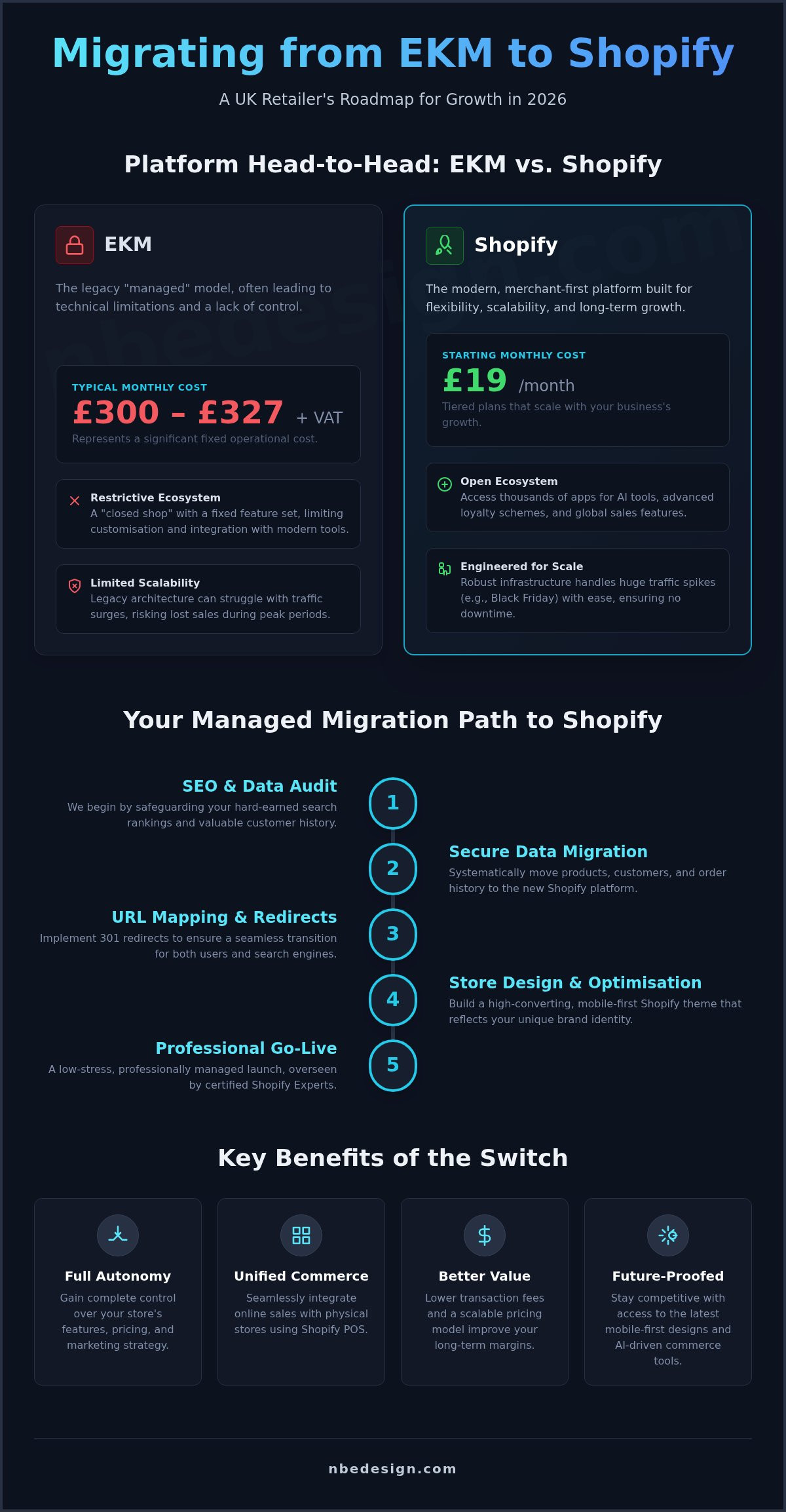
Choosing to migrate from ekm to shopify is often a decision driven by the bottom line. In 2026, EKM has pivoted toward a managed "Evolve" plan, typically costing between £300 and £327 plus VAT per month. While this includes management, it represents a significant fixed cost that may not suit every business model. In contrast, Shopify offers a tiered approach that scales with you. The Basic plan starts at £19 per month when billed annually, while the Grow plan sits at £49. Transaction fees are also a key factor; using Shopify Payments can reduce online transaction costs to as low as 1.5% plus 25p on the Advanced plan, providing a clear path to better margins as you grow.
When you migrate from ekm to shopify, you're moving from a platform with a fixed feature set to an open ecosystem. EKM provides many tools out of the box, but these can become limiting as your business needs evolve. The Shopify App Store contains thousands of specialised tools for everything from AI-powered product recommendations to advanced VAT handling for international sales. This extensibility ensures your site can adapt to any new market trend without requiring a total rebuild or a change in your service plan.
Total Cost of Ownership (TCO) Analysis
A true cost comparison goes beyond monthly fees. Shopify includes world-class hosting, SSL certificates, and PCI compliance within its subscription. You don't have to worry about server maintenance or security patches. While some might view a premium Shopify theme as an extra expense, it's a strategic investment. These themes are built for conversion, often paying for themselves through increased sales. By automating backend tasks like inventory syncing and shipping labels, you reduce the hours spent on manual admin, significantly lowering your long-term operational overhead.
User Experience and Conversion Rate Optimisation
The UK e-commerce market is highly sophisticated, and shoppers expect a frictionless checkout. Shopify's "Shop Pay" is a global leader in checkout speed, significantly outperforming EKM’s standard checkout process. In 2026, data-driven design is non-negotiable. Shopify’s Liquid-based themes allow for deep customisation and rigorous A/B testing that EKM’s editor simply cannot match. This level of control ensures you can constantly refine the customer journey based on real-time analytics.
Shopify's global infrastructure is another major advantage for UK retailers looking beyond our borders. It handles international currencies, local payment methods, and duties automatically. If you're planning to expand your reach, the stability of a platform used by millions of merchants worldwide provides a level of security that smaller platforms struggle to match. If you're feeling overwhelmed by these technical choices, you can always reach out for a professional assessment of your current setup.
The Managed Migration Process: Protecting Your Data and SEO
Moving your business is a significant undertaking. We understand that the technicalities of how to migrate from ekm to shopify can feel overwhelming. However, a structured, managed process turns this complexity into a series of manageable steps. It begins with a comprehensive audit of your current EKM store. We examine your existing data, URL structures, and categorisation to ensure nothing is overlooked. This preparation is vital for maintaining the integrity of your brand during the transition. Our goal is to provide a low-stress experience that allows you to focus on running your business while we handle the heavy lifting.
Preserving Your SEO Authority
Your search engine rankings are a result of years of hard work. An SEO audit is the most important step in any migration because it prevents the loss of years of organic search rankings and visibility. We implement a non-negotiable strategy for 301 redirect mapping. This ensures that every old EKM URL points directly to its new Shopify equivalent. Without this, your customers will encounter "404 Not Found" errors, and Google will penalise your site. Post-launch, we monitor Google Search Console closely to catch and resolve any crawl errors immediately. This proactive approach keeps your traffic steady during the transition to your new Shopify store.
Managing Customer and Order History
Data security is paramount. Recent UK e-commerce statistics highlight that millions of shoppers now rely on secure online platforms for their daily needs. Protecting personal information is both a legal and ethical necessity. We ensure full GDPR compliance during the transfer of your UK customer records. Migrating complex product variants and historical order data requires precise mapping to Shopify’s database to maintain accurate stock and sales records. Once the new store is live, we help you invite existing customers to activate their new accounts. This ensures a seamless experience for your loyal fans and keeps your historical data as a valuable asset for future marketing.
Design, Development, and Quality Assurance
Safe data extraction is only half the battle. We also focus on custom Shopify theme development that aligns perfectly with your brand identity. This stage involves mapping your existing EKM features to superior Shopify alternatives that offer better performance. Before anything goes live, we conduct rigorous quality assurance and pre-launch testing. We check everything from mobile responsiveness to the checkout flow. This ensures that when your new store debuts, it is high-converting and error-free from day one. By choosing a managed migration, you're not just moving data; you're upgrading your entire business infrastructure for the 2026 retail landscape.
Unifying Online and Offline: Transitioning to Shopify POS
For many UK retailers, the physical storefront remains the heart of the brand. If you're currently managing a boutique in Newcastle or a busy shop in Darlington, you've likely experienced the frustration of disconnected systems. When your online store doesn't communicate with your till, stock errors and disappointed customers are inevitable. The decision to migrate from ekm to shopify offers a direct solution to these inefficiencies. By moving to a unified platform, you can retire isolated till systems and embrace a modern, integrated approach to retail management.
In 2026, the high street is evolving toward "Unified Commerce." Customers expect a seamless transition between browsing on their phones and walking through your shop door. Shopify’s sleek POS hardware doesn't just look professional; it provides the technical backbone for a truly modern shopping experience. It allows you to manage every aspect of your business from a single dashboard, whether you're selling a product over the counter or shipping an order to a customer in another city.
Multi-Channel Inventory Management
Preventing overselling is one of the most immediate benefits of a unified system. When you migrate from ekm to shopify, your inventory levels sync in real-time across all locations. If the last item is sold in your Darlington shop, it's instantly marked as out of stock on your website. This level of accuracy is essential for implementing services like "Buy Online, Pick Up In-Store" (BOPIS). This service is increasingly popular among UK shoppers who value the convenience of local collection. Having a single source of truth for your stock levels reduces admin time and eliminates the stress of manual inventory checks.
Personalising the Retail Experience
A single customer view is an essential tool for modern marketing. Shopify POS allows your in-store staff to see a customer’s online browsing history and previous purchases. This data enables highly personalised service, allowing staff to make relevant recommendations based on a customer's real interests. You can also set up digital receipts and use integrated UK payment providers to streamline the checkout process. This creates a frictionless experience that builds long-term loyalty and encourages repeat visits.
We believe that seeing this technology in action is the best way to understand its power for your business. We regularly host Shopify POS demos in the North East to show local business owners how they can modernise their operations. If you're ready to bridge the gap between your physical and digital presence, contact our team to discuss your POS integration.
Why Partner with a Certified Shopify Expert for Your Migration?
While DIY migration tools often promise a quick fix, they rarely account for the complexities of a bespoke retail operation. Attempting to migrate from ekm to shopify using automated scripts can lead to broken layouts, missing data, or catastrophic SEO drops. Choosing a certified professional ensures that every nuance of your business is handled with care. We provide a managed, low-stress experience that allows you to focus on your daily operations while we navigate the technical shift. You aren't just hiring a service provider; you're gaining a trusted guide for your brand's next chapter.
Local UK support is vital for effective communication and a deep understanding of our specific market conditions. We speak the language of British retailers, from handling complex VAT requirements to understanding the nuances of UK shipping and distribution. This specialized knowledge ensures that your new store isn't just a copy of the old one, but a high-performance upgrade designed for growth.
The Vetting Process of a Shopify Partner
Shopify Expert status isn't just a badge; it's a mark of proven results and technical capability. To maintain this status, partners must adhere to rigorous standards of craftsmanship and reliability. This high level of accountability means you can trust the quality of the work being delivered. Specialized platform knowledge leads to significantly better store performance in several key areas:
- Optimised Codebases: Cleaner, faster themes that improve both user experience and search rankings.
- Advanced Customisation: Tailoring the Liquid-based architecture to meet your exact business needs.
- Strategic Integration: Selecting the right apps from the ecosystem to drive loyalty and sales.
Working with a Shopify Expert UK gives you access to a wealth of experience gained from hundreds of successful builds. We understand how to push the platform to its limits while maintaining a stable, secure environment for your customers.
Your Local North East Migration Partner
We're proud of our Darlington and Newcastle roots, combining a down-to-earth approach with global reach. Being local allows us to offer something that distant agencies cannot: face-to-face strategy sessions and onsite POS training. If you're moving your physical shop to a unified system, having a partner who can visit your storefront to set up hardware is invaluable. It reduces the anxiety often associated with technical transitions and builds a foundation of security.
Our partnership doesn't end on launch day. We provide ongoing support and consulting to help you scale your sales once the move is complete. We invite you to view our portfolio of successful Shopify builds to see how we've helped other retailers thrive. When you're ready to migrate from ekm to shopify with confidence, our team is here to ensure your transition is seamless and successful.
Take the Next Step Toward Scalable Growth
Choosing to migrate from ekm to shopify is a strategic commitment to the long-term success of your business. By moving away from rigid legacy structures, you gain the flexibility to adapt to changing market trends and the power to unify your online and offline sales. We've explored how a managed transition protects your hard-earned SEO authority and ensures your customer data remains secure. This process isn't just about changing platforms; it's about upgrading your entire operational infrastructure for the 2026 retail landscape.
As a Certified Shopify Partner and Expert based in Darlington and Newcastle, we bring decades of experience in managed e-commerce replatforming to every project. We understand the local UK market and the technical complexities involved in a seamless switch. Our goal is to provide a low-stress, professional experience that allows you to focus on what you do best. If you're ready to unlock the full potential of your brand, book a free migration consultation with our Shopify Experts today. Your future store is closer than you think. We look forward to helping you build it.
Frequently Asked Questions
How long does it typically take to migrate from EKM to Shopify?
A standard managed migration typically takes between four and eight weeks to complete. This timeline depends on the volume of products, the complexity of your customer data, and the level of custom theme development required. We prioritise a thorough audit and rigorous testing phase to ensure your launch is flawless. Rushing the process can lead to technical errors, so we follow a methodical schedule to safeguard your business operations.
Will I lose my Google rankings when moving from EKM to Shopify?
You won't lose your rankings if the transition is managed by experts who prioritise SEO preservation. The key is implementing a comprehensive 301 redirect map that points every old EKM URL to its new Shopify equivalent. This process tells search engines that your content has moved, maintaining your authority and organic traffic. We monitor your site closely post-launch to resolve any crawl errors that might appear in Google Search Console.
Can I migrate my EKM customer passwords to Shopify?
Customer passwords cannot be migrated because they are securely encrypted on EKM’s servers for privacy. When you migrate from ekm to shopify, we transfer all customer records, including names, addresses, and order histories. Once the new store is live, we send out an automated invitation to your existing customers. This allows them to activate their accounts on the new platform and set a fresh, secure password for their future purchases.
Is Shopify more expensive than EKM once you add apps?
While some apps carry monthly fees, Shopify is often more cost-effective because it drives higher conversion rates and reduces manual admin. Many features that require third-party tools on other platforms are built directly into Shopify’s core. By automating tasks like stock syncing and shipping labels, you save significant staff hours. The platform’s ability to scale without requiring expensive custom development often results in a lower total cost of ownership over time.
Can I keep my existing domain name and email addresses?
You can certainly keep your existing domain name. During the launch phase, we simply update your DNS settings to point your domain toward Shopify’s secure servers. Your professional email addresses, such as those hosted through Microsoft 365 or Google Workspace, will continue to function as normal. We ensure this transition is handled during a low-traffic period to minimise any potential disruption to your customer communications or business operations.
Do I need a developer to manage my Shopify store after migration?
One of the primary reasons retailers migrate from ekm to shopify is the platform’s intuitive, user-friendly interface. You don't need technical knowledge to update products, manage orders, or change your homepage content. While we handle the complex initial setup and custom development, your team will be able to manage daily operations with ease. We provide comprehensive training as part of our managed migration service to ensure you feel confident using your new tools.
Can Shopify handle complex multi-warehouse inventory?
Shopify has robust native support for managing inventory across multiple warehouses and physical storefronts. You can assign stock levels to specific locations and set fulfilment priorities to ensure orders are shipped from the most efficient site. This is particularly beneficial for UK retailers with both a physical shop in Darlington or Newcastle and a separate distribution centre. The system updates in real-time, preventing overselling and providing a clear view of your global stock levels.
Is Shopify Plus necessary for an EKM migration?
Shopify Plus is not a requirement for most businesses moving from EKM. The standard Basic, Grow, and Advanced plans provide all the essential tools needed to run a successful, high-growth retail operation in the UK. Plus is generally reserved for enterprise-level businesses with very high transaction volumes or complex international requirements. We assess your specific turnover and functional needs during our initial consultation to recommend the most cost-effective plan for your current business stage.

- Posted in:
- eCommerce Migration
- EKM
- migrate from ekm to shopify
- Platform Migration
- SEO Migration
- Shopify
- Shopify Expert
- Shopify POS
- UK Retail