Skip to content
UK Shopify Guide 2026: Building and Scaling Your British eCommerce Store
-
3626 words · 18 min read

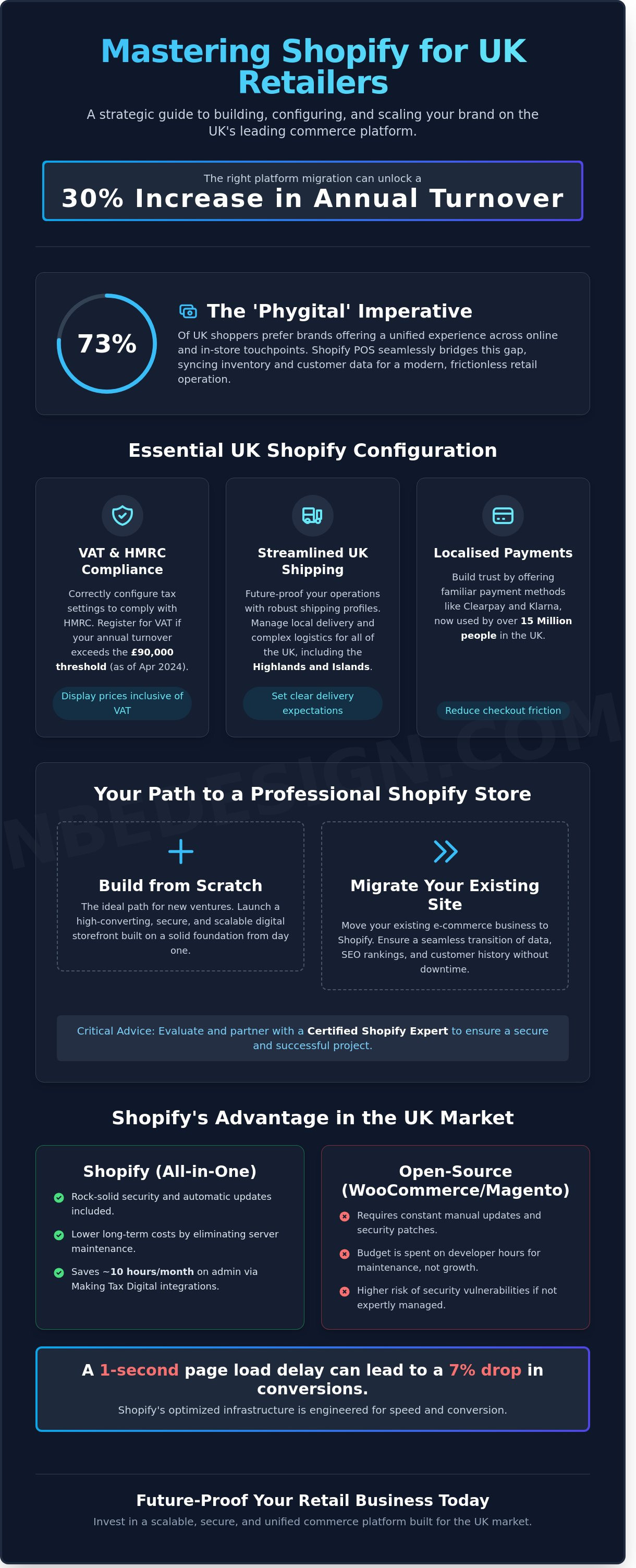
What if the only thing standing between your business and a 30% increase in annual turnover is the fear of a complex technical migration? Many retailers we speak with in the North East and across the country feel paralysed by the thought of managing a uk shopify store alongside in-store stock, especially when HMRC compliance and UK VAT rules are constantly evolving. It's a daunting prospect to move data or launch a new venture when you aren't 100% sure the foundation is secure.
We understand these pressures because we've been working extensively with the platform since its early days in 2006. This guide is designed to help you master the essentials of building and scaling your brand, from seamless POS integration to crafting a high-converting digital storefront. You'll learn how to future-proof your operations and scale with the confidence that only a professional, unified system can provide. We'll explore the specific strategies needed to streamline your retail business and ensure your transition to a modern eCommerce setup is completely hassle-free.
Key Takeaways
- Master the complexities of HMRC compliance by correctly configuring VAT and shipping profiles tailored specifically for your uk shopify store.
- Bridge the gap between online and in-store sales by implementing Shopify POS hardware to create a unified 'phygital' experience for British shoppers.
- Evaluate whether to build from scratch or migrate your existing site with a certified Shopify Expert to ensure a secure, scalable transition.
- Discover how to select the right UK web design agency by identifying the marks of a Shopify Partner and reviewing real-world British portfolios.
- Future-proof your retail operations by streamlining inventory management and local delivery nuances across the UK, including the Highlands and Islands.
Why Shopify is the Leading Choice for UK Retailers in 2026
Shopify has evolved from its humble beginnings in 2006 to become the world's most versatile commerce platform. For British SMEs and enterprise brands, it provides a rock-solid foundation that supports rapid growth and stability. As a Shopify Expert and Partner based in the North East, we've literally grown up with the platform. We've seen it transform from a simple storefront tool into a comprehensive ecosystem that handles everything from global logistics to hyper-local sales. Mastering uk shopify for your brand is about more than just picking a template; it's about leveraging a system designed for the specific rigours of the British market.
The retail environment in 2026 is defined by 'phygital' shopping. This is the seamless blend of online and in-person experiences that modern customers demand. Data from 2024 indicated that 73% of UK shoppers prefer brands that offer a unified experience across all touchpoints. Shopify makes this easy. Whether you're running a boutique in Middlesbrough or managing a warehouse in Darlington, the platform ensures your inventory and customer data stay perfectly in sync. This unified approach is essential for any e-commerce strategy aiming for long-term success.
In the competitive UK landscape, a conversion-focussed design is your greatest asset. British consumers are discerning and have little patience for slow or confusing websites. Recent industry benchmarks show that a one-second delay in page load times can lead to a 7% reduction in conversions. We focus on building stores that are clean, fast, and engineered to guide the user toward the checkout. By using the latest uk shopify features, we help retailers strip away friction and build lasting trust with their audience.
The Benefits of a UK-Centric eCommerce Strategy
Building trust with British shoppers requires a localized touch. This starts with offering familiar payment methods like Clearpay and Klarna, which are now used by over 15 million people in the UK. Your store should also reflect British English spelling and cultural nuances to avoid looking like a generic international site. We understand the importance of clear delivery expectations, especially with the complexities of post-Brexit logistics. Being grounded in the North East allows us to help brands scale effectively. We've proven that you can grow from a local startup to a global powerhouse while maintaining a relatable, British identity.
Shopify vs. Other Platforms in the UK Market
When you compare Shopify to platforms like WooCommerce or Magento, the differences in maintenance and security are stark. Open-source platforms often require constant manual updates and expensive developer hours just to keep the site secure. Shopify's all-in-one nature simplifies these technical burdens. It's particularly effective for HMRC reporting through Making Tax Digital (MTD) integrations, which can save business owners roughly 10 hours of admin work every month. The long-term cost-efficiency is undeniable. Instead of sinking your budget into server maintenance, you can invest it into marketing and product development. If you want to move your business forward, you can get in touch with our team to discuss a seamless migration.
Configuring Your UK Shopify Store: VAT, Shipping, and Payments
Setting up your uk shopify store correctly from the start prevents a mountain of administrative debt later. British shoppers expect a seamless, transparent checkout experience. According to this UK eCommerce market overview, the United Kingdom has the most advanced e-commerce market in Europe, which means consumers here have zero patience for hidden costs or clunky payment flows. Success on the platform requires a precise configuration that respects local regulations and buyer habits.
Mastering UK VAT and Tax Settings
HMRC compliance is non-negotiable. If your annual taxable turnover exceeds the £90,000 threshold (as of April 2024), you must register for VAT and ensure your store reflects this. Most British retailers should display prices inclusive of VAT to avoid "sticker shock" at the final stage of the journey. In your Shopify admin under Settings and then Taxes and Duties, you must select the United Kingdom as your tax region. The 'All prices include tax' checkbox in Shopify settings tells the system to work backwards from your retail price to calculate the 20% VAT portion for your accounting records without adding extra costs at checkout.
Post-Brexit trade has added layers of complexity for international sales. For orders sent to the EU under €150, you might use the Import One-Stop Shop (IOSS) scheme to simplify tax collection. If you're selling to the USA or Australia, Shopify Markets can automatically remove VAT for those customers, keeping your pricing competitive globally. If you find these settings daunting, you can speak with our experts to ensure your tax logic is rock-solid.
UK Shipping and Logistics Integration
Shipping to a flat in London is vastly different from delivering to the Scottish Highlands or the Channel Islands. You must organise your shipping profiles to account for these "out of area" surcharges. Many couriers charge a premium for postcodes like IV, HS, or ZE. If you offer a flat £4.99 rate across the whole UK, these deliveries will quickly erode your margins. Use Shopify's shipping zones to create specific rates for these regions.
- Carrier Choice: Integrate Royal Mail for letterbox-friendly items, while using DPD or Evri for larger parcels that require robust tracking.
- Local Pickup: For retailers with a physical presence in Darlington or Newcastle, 'Click and Collect' is a vital tool. It drives footfall to your brick-and-mortar site and eliminates shipping costs for the customer.
- Sustainability: Modern British consumers are eco-conscious. A 2023 study showed that 52% of UK shoppers value sustainable packaging. Switching to FSC-certified cardboard or compostable mailers isn't just good for the planet; it's a powerful marketing angle.
Payment gateways are the final hurdle. While Shopify Payments is the most efficient choice for most, you should also consider Buy Now Pay Later (BNPL) options. Klarna and Clearpay now account for approximately 15% of all UK online transactions. Offering these can increase your average order value by giving customers more flexibility. Finally, ensure your store is GDPR compliant by using a dedicated cookie consent banner that meets Information Commissioner's Office (ICO) standards. Protecting customer data is just as important as processing their payment.
Building vs. Migrating: Your Path to a Professional Shopify Store
Deciding whether to build a fresh store or migrate your existing business is the first major hurdle in mastering your uk shopify presence. Many retailers feel tempted by a DIY approach to save on initial costs, but this often leads to technical debt that stifles growth. Data from 2023 suggests that professional builds see a 15% higher conversion rate compared to self-made templates. If you're struggling with a slow site or limited functionality, hiring a certified Shopify Expert UK provides the rock-solid foundation needed to scale. We've been working with the platform since its birth in 2006, helping businesses avoid common pitfalls that lead to abandoned carts and lost revenue.
A conversion-focussed design audit is your best tool for identifying what's missing. You might have a beautiful site, but if the checkout flow is clunky for British shoppers, you're losing money. Compliance is equally vital; ensure you follow the UK government guidance on VAT to keep your store aligned with local tax regulations during your transition. This grounded, methodical approach ensures your new or migrated store isn't just a digital brochure, but a high-performing sales engine.
The Shopify Migration Process
Moving from platforms like WooCommerce or Magento requires precision to protect your hard-earned SEO rankings. Data mapping is the first priority. You must ensure customers, historical orders, and product variants transfer without loss. We use a rigorous pre-launch checklist to verify every data point. A robust redirect strategy is the second pillar. By implementing 301 redirects for every old URL, you avoid the dreaded 404 errors that frustrate users and penalise your search ranking. Testing and QA shouldn't be rushed. A hassle-free transition only happens when you've stress-tested the checkout and payment gateways under real-world conditions.
Custom Design and Brand Identity
Your store needs to move beyond basic templates to establish true professional credibility. British shoppers are discerning; they expect a seamless, polished experience that reflects your unique brand values. Investing in high-quality business graphic design ensures your visuals match the quality of your products. With 82% of UK retail site visits now occurring on mobile devices, optimising your favourite theme for a mobile-first audience is mandatory. We don't just tweak colours; we craft bespoke layouts that streamline the user journey from the landing page to the thank you screen. This focus on uk shopify customisation helps you stand out in a crowded marketplace.
Don't let technical anxiety hold your business back from its full potential. Whether you're in Teesside or trading globally, a structured migration or build can simplify your operations and future-proof your brand. If you're ready to improve your current setup or need a partner to handle the heavy lifting of a platform switch, get in touch with our team today. We'll help you find the best setup for your specific needs and ensure your transition is efficient and profitable.
Unifying Retail: Implementing Shopify POS for UK Shops
Managing a physical shop alongside an online store shouldn't feel like running two separate businesses. For retailers using a uk shopify setup, the goal is a single source of truth where every sale, whether it happens on a high street in Darlington or through a smartphone in London, updates your records instantly. Achieving this requires moving beyond basic card machines to a fully integrated point of sale system.
The All-in-One Retail Solution
Shopify POS unifies your inventory, customer profiles, and sales data into one dashboard. This eliminates the manual task of reconciling stock levels at the end of a busy Saturday. When a customer buys the last hand-poured candle in your Newcastle boutique, your website automatically marks it as out of stock. This prevents overselling and the customer frustration that follows. According to 2023 retail data, 73% of shoppers use multiple channels during their purchase journey. Providing a consistent experience across those channels is no longer optional; it's a requirement for growth.
- Inventory Syncing: Real-time updates across all locations, including warehouses and pop-up stalls.
- Customer Profiles: Staff can see a customer's online order history to provide personalised recommendations in-store.
- Unified Reporting: View total revenue without exporting multiple spreadsheets from different platforms.
UK-Specific POS Hardware and Payments
Success on the British high street relies on speed and reliability. You need to assess your current hardware to determine if you need a specific POS system for small shops. In 2024, contactless payments accounted for over 92% of all UK card transactions. Your setup must handle these "tap and go" payments flawlessly while remaining "rock-solid" during peak trading periods like Black Friday.
Connecting your online store to the Shopify POS app on an iPad or Android tablet is the first step toward a mobile retail environment. This allows your team to bust queues by taking payments anywhere on the shop floor. For a professional finish, invest in a "rock-solid" till setup that includes a secure tablet stand, a reliable receipt printer, and a cash drawer. This hardware creates a permanent anchor for your retail space while mobile units provide the flexibility to scale up during busy seasons.
Training your team is just as vital as the hardware itself. Staff must feel confident processing returns and exchanges that bridge the online and offline gap. For example, a customer who bought an item on your website should be able to return it to your Darlington shop without friction. This "buy online, return in-store" model is a proven driver of footfall; 60% of shoppers who return an item in-person make a new purchase during that same visit. You should also launch integrated loyalty programmes. When a customer earns points online, they should be able to spend them at your physical checkout immediately.
Mastering the uk shopify POS ecosystem allows you to stop worrying about technical glitches and start focusing on your customers. By syncing your inventory across multiple North East locations and empowering your staff with the right tools, you create a professional, future-proof retail environment.
Ready to streamline your retail operations and connect your sales channels? Get in touch with our Shopify experts today to find the perfect POS setup for your business.
Choosing the Right Shopify Web Design Agency in the UK
Finding a partner who understands the nuances of the uk shopify landscape is the difference between a static website and a high-growth sales engine. You shouldn't settle for a generalist agency that treats e-commerce as an afterthought. Instead, look for the 'Certified Shopify Partner' status as your primary benchmark. This designation isn't just a badge; it's a mark of proven results and technical capability vetted by Shopify itself. Since 2006, our team has helped retailers navigate this ecosystem, ensuring their stores are built on a rock-solid foundation that's ready to scale.
You should examine the portfolio of Shopify Experts to see real-world UK examples before making a commitment. A diverse portfolio reveals if an agency can handle complex requirements, such as bespoke app integrations or multi-currency setups for international trade. Look for evidence of conversion-focussed design and fast loading times. A site that looks beautiful but takes five seconds to load will frustrate the 67% of UK shoppers who now complete purchases on mobile devices.
Don't treat your store build as a one-off transaction. E-commerce is a continuous journey that requires constant refinement. You need to prioritise agencies that offer ongoing support and strategic consulting rather than just a "launch and leave" service. Digital trends move quickly; what worked in 2023 might be outdated by mid-2024. A long-term partner helps you stay ahead of the curve by suggesting new features, optimising your checkout flow, and troubleshooting technical issues before they impact your bottom line.
Success in the British market also requires a deep understanding of the local regulatory landscape. Your agency must be well-versed in GDPR compliance, UK consumer rights, and the intricacies of VAT. Whether you're dealing with domestic sales or shipping to the EU, your uk shopify store must calculate taxes accurately and protect customer data. A partner who ignores these details can leave your business vulnerable to legal risks and financial penalties.
The Value of Local Expertise
Working with a North East agency provides a grounded and approachable partnership that many London-based firms lack. We bring a "local expert, global reach" mentality to every project, helping brands in Teesside and beyond reach customers in the USA, Canada, and Australia. This proximity allows for clearer communication and a better understanding of your brand's roots. If you're ready to start the conversation about your next project, get in touch with us for a tailored quote.
Questions to Ask Your Shopify Developer
Before signing any contract, ask how they handle SEO during the migration process. A poorly managed move can result in a 25% drop in organic traffic if 301 redirects aren't mapped correctly. You should also confirm they can integrate your specific UK accounting software, such as Xero or Sage, to keep your finances streamlined. Finally, ask about their process for conversion-focussed design; they should be able to explain how they use data to guide users toward the checkout button.
Future-Proof Your British Retail Business
Success in the 2026 digital landscape requires more than just a basic website. It demands a unified system that handles UK VAT compliance, complex shipping logistics, and seamless POS integration for your physical storefronts. Whether you're planning a platform migration or building from scratch, the uk shopify ecosystem provides the rock-solid foundation needed to scale. Since 2006, NB eCommerce & Design has helped retailers navigate these transitions with confidence. We've grown alongside the platform for nearly two decades, so we understand the nuances of the British market better than most.
Based in the North East, our team combines local retail expertise with global eCommerce experience to ensure your store is conversion-focussed and ready for growth. Don't let technical hurdles stall your progress. You can streamline your operations and future-proof your sales channels by partnering with a team that's been a certified Shopify Partner since the platform's birth. Your journey to a more efficient, profitable retail business starts here.
Start your UK Shopify journey with a certified expert today
Frequently Asked Questions
Is Shopify suitable for businesses in the UK?
Shopify is perfectly suited for UK businesses, providing localised payment gateways and seamless shipping integrations with carriers like Royal Mail. Since 2006, we've seen the platform evolve to support over 150,000 UK merchants across various retail sectors. It's a rock-solid choice for brands in Teesside or across the country looking to scale. You'll find it simplifies everything from inventory management to local delivery zones, making it an efficient choice for growth.
How much does it cost to hire a Shopify agency in the UK?
Hiring a Shopify agency in the UK typically costs between £5,000 and £20,000 for a comprehensive build or migration project. Smaller design tweaks or specific optimization tasks might start from £2,500. These figures reflect the level of expertise required to build a conversion focussed store that delivers a tangible return on investment. If you're looking for a specific quote for your project, please get in touch with our team.
Can I use my existing UK domain name with Shopify?
You can absolutely use your existing .co.uk or .uk domain name with Shopify without any technical issues. The process involves updating your DNS settings to point to Shopify's servers, which usually takes less than 24 hours to propagate fully. Our team has managed hundreds of domain transfers since Shopify’s birth in 2006. We ensure your transition is seamless and doesn't impact your existing email services or your current SEO rankings.
How does Shopify handle UK VAT and HMRC requirements?
Shopify automates the calculation of the 20% standard UK VAT rate at checkout based on your customer's specific location. You can easily generate detailed tax reports that align with HMRC requirements for Making Tax Digital. This built-in functionality reduces the administrative burden on your finance team. It ensures your uk shopify store remains compliant with current tax laws without needing manual adjustments for every single sale you make.
What is the best POS system for a small retail shop in the UK?
Shopify POS is the best all-in-one retail solution for small UK shops because it offers 100% real-time inventory sync between your physical store and online site. It allows you to accept payments via chip and pin or contactless devices using the Shopify Tap & Chip Reader. This system streamlines your operations and provides a unified view of your customers. We've helped retailers in Middlesbrough and Darlington make the POS switch with confidence.
How long does it take to migrate a store to Shopify?
Migrating a store to Shopify typically takes between 4 and 12 weeks depending on the volume of data and design complexity. This timeline includes the transfer of product catalogues, customer records, and historical order data. We follow a methodical process to ensure no data is lost during the move. A well-planned migration future-proofs your business and sets the stage for rapid growth, so it's a project that shouldn't be rushed.
Do I need a UK-based Shopify Expert for my project?
Working with a UK-based Shopify Expert is highly recommended because they understand local market nuances, UK consumer laws, and regional shipping logistics. As a Shopify Select Partner based in the North East, we provide a grounded and approachable service for local brands. While we work with global clients, our deep roots in the UK market since 2006 allow us to offer tailored advice that overseas agencies often miss.
Can Shopify handle multi-currency sales for UK brands selling abroad?
Shopify Markets enables UK brands to sell in 133 different currencies while receiving payouts in British Pounds. This feature automatically displays prices in the customer’s local currency, which can increase international conversion rates by up to 40%. It’s an essential tool for uk shopify stores aiming to scale globally. You can manage multiple regions from a single dashboard, making international expansion efficient and manageable for your entire team.
- Posted in:
- uk shopify