Skip to content
7 Telltale Signs You Need a New eCommerce Website in 2026
-
3079 words · 15 min read

Your online store isn't just showing its age; it's likely costing you over £2,500 in lost revenue for every second your pages lag behind the competition in 2026. Recognising the clear signs you need a new ecommerce website is the first step toward reclaiming your profit margins and your peace of mind. You've probably felt the frustration of paying high developer fees for tiny tweaks or watching mobile bounce rates climb while desktop sales stall. It's exhausting when inventory doesn't sync with your warehouse, leaving you to apologise to disappointed customers. We understand these transitions feel daunting, but clinging to an outdated platform is a silent growth killer.
As Shopify Experts since 2006, we've helped retailers across the North East and globally move away from clunky, expensive systems. Our promise is simple. You'll discover the critical performance indicators and technical red flags that signal it's time to upgrade to stay competitive. We'll preview seven telltale signs that you're ready for a faster, conversion focussed store that streamlines your operations and integrates seamlessly with your physical sales. If you're feeling the strain of a site that won't scale, it's time to future-proof your business.
Key Takeaways
- Identify why your marketing ROI is stalling and how a refreshed user journey can slash bounce rates to reignite growth.
- Recognise the technical signs you need a new ecommerce website, including the dangers of "legacy debt" and the fear of making simple site updates.
- Discover how to eliminate the "silo" problem by synchronising your warehouse, POS, and online store for a more efficient operation.
- Access a structured 10-point checklist to audit your current performance and determine if your back-end systems are holding you back.
- Learn why migrating to a rock-solid Shopify setup is the most effective way to future-proof your retail brand and streamline your sales.
Recognising the Performance Plateau: Is Your Growth Stagnating?
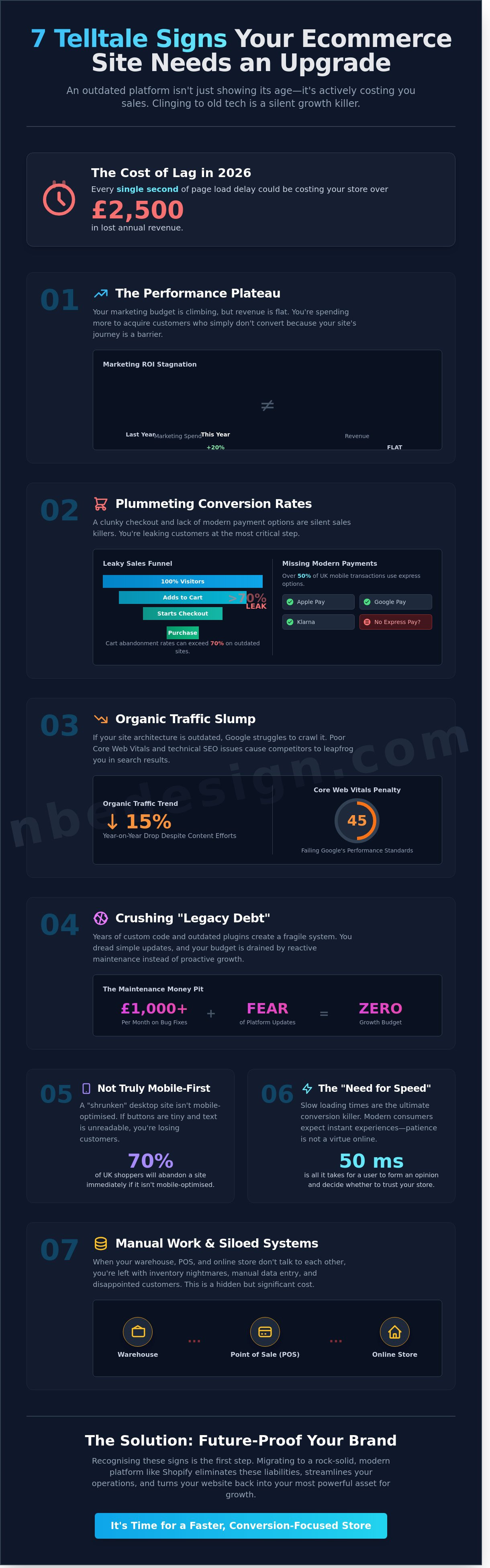
Growth isn't always a straight line, but when your marketing budget increases by 20% while your revenue stays flat, you've hit the "eCommerce Performance Plateau". This stagnation often stems from a fundamental disconnect between your brand's ambitions and your site's technical capabilities. It's one of the most common signs you need a new ecommerce website. When you're spending more to acquire customers who simply don't convert, the problem isn't your traffic; it's the destination.
In 2026, a dated user journey acts as a silent barrier to entry. Modern UK consumers decide whether to trust a shop in less than 50 milliseconds. If your site feels like a relic from several years ago, that lack of visual and functional polish translates directly into high bounce rates. Site age is now a primary metric for consumer trust. If your platform can't keep up with the sleek, instant experiences offered by major retailers, shoppers will find someone who can. Conversion Rate Optimisation is the process of refining a site to turn more visitors into customers.
Declining Conversion Rates and High Cart Abandonment
UK retailers often see cart abandonment rates spike above 70% when their checkout process is cumbersome. If your customers have to navigate through multiple pages and endless form fields just to pay, they'll leave. It's a major red flag that costs you sales every single day. You're also at a disadvantage if you don't offer modern payment gateways. Over 50% of mobile transactions in the UK now rely on express options like Apple Pay or "Buy Now, Pay Later" services like Klarna. To fix these leaks in your funnel, you must focus on conversion rate optimisation to ensure the path to purchase is frictionless.
SEO Performance and Organic Traffic Slumps
Your site's architecture is its foundation. If that foundation is outdated, search engines struggle to crawl and index your product pages effectively. You might notice your keyword rankings have plateaued, or that competitors are leapfrogging you in search results purely on technical merit rather than product quality. This often happens because older site structures don't meet the rigorous Core Web Vitals standards that Google prioritises. A Shopify Expert UK can help you identify if your site architecture is holding you back. When organic traffic drops by 15% year-on-year despite your best content efforts, it's a clear signal that your technical SEO needs a total refresh through a new build.
Technical Red Flags: When Your Platform Becomes a Liability
Your website should be a high-performing asset, not a source of constant anxiety. Many UK retailers find themselves trapped by "legacy debt," where years of custom code and outdated plugins create a fragile ecosystem. If you feel a sense of dread every time a platform update is released, it's a clear indicator that your current setup is failing you. This fear often stems from the knowledge that one small change could break your entire checkout process, leading to hours of expensive downtime and lost revenue.
Maintaining these monolithic systems is becoming increasingly unsustainable. We've seen businesses spending upwards of £1,000 a month just on reactive maintenance and "bug fixing" rather than actual growth. Transitioning to a Shopify Expert backed infrastructure eliminates this burden. You need a future-proof system that scales automatically, allowing you to focus on your products instead of managing server patches. Identifying these technical signs you need a new ecommerce website is the first step toward reclaiming your time and marketing budget.
Mobile-First is No Longer Optional
A site that looks "fine" on a desktop but feels clunky on a smartphone is costing you money. Test your site by checking if elements are truly responsive or simply shrunk to fit the screen. If buttons are too close together or text is unreadable without zooming, you're failing the mobile test. Since Google switched to mobile-first indexing, your search visibility depends entirely on your mobile performance. Data shows that 70% of UK shoppers will abandon a store immediately if it isn't mobile-optimised. Don't let a "shrunken" desktop design drive your customers to a competitor's app.
The "Need for Speed" in 2026
Slow loading times are the ultimate conversion killer. Modern standards, defined by Google's Core Web Vitals, require your site to be interactive in under 2.5 seconds. If your design is "heavy" with unoptimised images and bloated scripts, your bounce rate will soar. Research from 2023 confirms that every single second of delay reduces your conversion rate by up to 7%. A three-second lag could mean losing nearly a quarter of your potential sales before the customer even sees your products. If you're worried about your current performance, get in touch with our team for a technical review.
The Invisible Cost of Manual Work and Siloed Systems
Managing a growing shop shouldn't feel like a full-time data entry job. If your team spends over five hours every week reconciling weekend sales from your physical till with your website stock, you're losing money. This manual grind is one of the clearest signs you need a new ecommerce website. We've seen UK retailers save up to 15 hours of administrative work per week simply by moving to a platform that handles these updates automatically. When your warehouse, POS, and online store exist in silos, errors are inevitable. Efficiency isn't just a buzzword; it's the difference between a scalable business and one that's stuck in the mud.
The "silo" problem occurs when your systems don't talk to each other, leading to several operational bottlenecks:
- Double-handling of data across different spreadsheets and platforms.
- Inaccurate financial reporting due to fragmented sales records.
- Delayed shipping times as staff wait for manual order confirmation.
- Increased labour costs for tasks that could be automated in seconds.
Inventory Mismatches and Fulfilment Friction
There's nothing more damaging to your brand's reputation than a customer ordering a £75 gift only for you to email them hours later saying it's actually out of stock. This happens when your data syncing lags behind real-world sales. Modern retail requires a unified experience where every sale, whether in-person or online, updates your master inventory instantly. By using a system like Shopify POS, brick-and-mortar shops ensure their physical and digital shelves are always in sync. It eliminates the friction of manual stock takes and prevents the embarrassment of overselling to your loyal customers.
Third-Party Integration Failures
Legacy systems often have restricted APIs that won't play nicely with modern apps. If you're struggling to connect your email marketing or your CRM because your current platform is "closed," it's holding your growth back. Modern retailers need plug-and-play compatibility to stay competitive. A 2023 industry report found that 64% of retailers cited poor software integration as their biggest barrier to increasing revenue. Outgrowing your current setup is a mark of your success, but staying on a limited platform is a massive operational risk. Switching to a modern, open ecosystem allows you to add new features in minutes rather than weeks of expensive custom coding.
A 10-Point Checklist for Your eCommerce Website Redesign
Auditing your current digital storefront requires a shift in perspective. It's easy to get distracted by a "pretty" design, but aesthetics alone don't pay the bills. A truly effective site balances front-end user experience with back-end administrative efficiency. Use this checklist to determine if your current platform supports your growth or if it's holding you back. If you find yourself ticking fewer than seven of these boxes, it's one of the definitive signs you need a new ecommerce website to remain competitive in the UK market.
User Experience (UX) and Visual Identity
- Brand Consistency: Does your visual identity feel seamless across Instagram, your email marketing, and your website? A disjointed brand experience erodes trust.
- The 60-Second Rule: Can a new visitor find a specific product and complete the checkout process in under 60 seconds? Speed is the ultimate currency in retail.
- Competitor Benchmarking: How does your site look next to your top three niche competitors? If they look like 2026 and you look like 2016, your conversion rate will suffer.
- Mobile-First Logic: Since over 70% of UK online purchases now happen on mobile devices, is your mobile site a primary thought or an afterthought?
- Search and Navigation: Can users find what they need through intuitive filtering, or is your search bar returning "no results" for common queries?
Operational and Security Requirements
- 2026 Security Standards: Is your site fully PCI compliant? With PCI DSS 4.0 standards becoming the benchmark, your legacy system might be a liability.
- Admin Autonomy: Can you swap homepage banners, launch a sale, or add new products without waiting for a developer to respond to an email?
- Data and ROI Tracking: Do you have rock-solid analytics that show exactly where your traffic drops off? Without accurate tracking, you're guessing, not growing.
- Inventory Synchronisation: Does your website talk to your physical stock levels in real-time? Manual updates lead to overselling and frustrated customers.
- Future-Proof Scalability: Can your current setup handle a 300% spike in traffic during a Black Friday event without crashing?
Relying on an outdated system creates friction for both your team and your customers. If your audit reveals significant gaps, it's time to consult a Shopify Expert UK to conduct a professional review of your site's performance and conversion potential. We focus on conversion focussed design that turns browsers into buyers, ensuring every pound you spend on marketing delivers a measurable return.
Don't let technical debt stifle your business growth. If you're ready to move from a dated site to a high-performing retail engine, get in touch with our team today for a tailored consultation.
Future-Proofing Your Retail Brand with a Shopify Expert
Identifying the signs you need a new ecommerce website is only the first step toward long-term growth. To truly future-proof your business, you need a platform that scales without the constant technical debt associated with high-maintenance systems like Magento or WooCommerce. Retailers switching from self-hosted platforms to Shopify frequently report a 15% reduction in monthly maintenance costs and significantly improved site reliability during peak periods like Black Friday. Shopify provides a rock-solid infrastructure that lets you focus on sales rather than server patches.
At NB eCommerce & Design, we've literally grown up with the platform. We've been a Shopify Expert since their birth in 2006, giving us a unique historical perspective on how to build conversion focussed online stores. Whether you're a local boutique or a global retailer, we ensure your migration is handled with precision. We take care of the technical heavy lifting so your transition is entirely hassle-free.
Why a Certified Shopify Partner Makes the Difference
Working with an agency that understands the North East UK retail landscape provides a distinct advantage. We've helped brands across Middlesbrough, Darlington, and Durham navigate the complexities of digital transformation while avoiding common pitfalls like broken URL redirects or lost SEO equity. Our expertise is visible in our portfolio of successful store designs, where we've helped clients achieve cleaner, faster, and more efficient user journeys that drive real revenue.
Taking the Next Step for Your Business
Transitioning to a new site shouldn't feel daunting. To prepare for a discovery call, consider your primary objectives for the coming year. Are you aiming for a 20% increase in conversion rates, or do you need to streamline your inventory management across multiple channels? Having clear, data-driven goals allows us to craft a bespoke strategy for your brand. If you've recognised the signs you need a new ecommerce website, don't wait for your current platform to fail. Contact our Shopify Experts today to plan your 2026 growth and ensure your retail business remains competitive.
Future-Proof Your Retail Growth for 2026
Don't let a performance plateau or a siloed POS system hold your business back. Recognising the signs you need a new ecommerce website is the first step toward reclaiming your time and boosting your conversion rates. If your team is still drowning in manual data entry or your platform has become a technical liability, it's time to streamline. Since 2006, we've helped global brands and local North East retailers unify their online and brick-and-mortar operations into one rock-solid system. We've literally grown up with Shopify; we know exactly how to craft a setup that scales across every channel. Whether you're based in Middlesbrough or Melbourne, your retail brand deserves a platform that works as hard as you do. By following our 10-point checklist, you can turn those technical red flags into a clear competitive advantage. We'll help you navigate this transition with confidence, ensuring your migration is hassle-free and built for long-term success. It's time to stop fighting your software and start growing your sales.
Book a discovery call with our Shopify Experts
Frequently Asked Questions
How often should a business redesign its eCommerce website?
Most successful retailers refresh their online presence every 2 to 3 years to stay competitive. Technology evolves rapidly; consumer expectations for speed and usability increase every single year. A study by Toptal shows that 88% of online consumers are less likely to return to a site after a single bad experience. Regular updates ensure your store remains secure, fast, and aligned with the latest shopping trends.
Will a new website help improve my conversion rates?
A well-executed redesign often leads to a conversion rate increase of 20% to 50% for established brands. By addressing the signs you need a new ecommerce website, such as slow loading times or a confusing checkout, you remove friction from the buyer's journey. We focus on conversion-optimised design to ensure every click counts. If your current conversion rate sits below the UK average of 1.8%, it's time for a change.
Can I keep my existing product data when moving to a new platform?
You can absolutely migrate your existing product data, customer records, and order history to a new platform. As Shopify Experts, we use specialised tools like Matrixify to ensure 100% of your data transfers accurately. This process includes preserving your product descriptions, SKU numbers, and pricing structures. We handle the technical heavy lifting so you don't lose any valuable business information during the transition.
How long does it typically take to build a new Shopify store?
A standard Shopify store build typically takes between 8 and 16 weeks from the initial discovery phase to launch. Simple setups using existing themes might be ready in 30 days; bespoke enterprise solutions require more time for custom development and integration. We follow a structured project timeline to keep your launch on track. This ensures all features, from inventory sync to payment gateways, work perfectly on day one.
What is the average cost of an eCommerce website redesign in the UK?
In the UK market, a professional eCommerce redesign usually costs between £5,000 for a basic setup and over £50,000 for a complex, custom-built solution. Mid-market retailers typically invest around £15,000 to £25,000 to achieve a high-performing, scalable store. These figures vary based on your specific requirements for third-party integrations and custom functionality. Investing in a quality build now prevents costly technical debt in the future.
Will my SEO rankings drop if I get a new website?
Your SEO rankings won't drop if you implement a robust 301 redirect strategy and maintain your site's technical health. In fact, many clients see a 15% increase in organic traffic within 3 months due to improved site speed and mobile performance. We carefully map every old URL to its new equivalent to preserve your link equity. Identifying the signs you need a new ecommerce website early allows us to plan a seamless migration that protects your Google visibility.
Do I need a new website if my current one is not mobile-friendly?
You definitely need a new website if your current store isn't fully responsive, as mobile devices now account for over 70% of UK eCommerce traffic. Google uses mobile-first indexing, meaning a non-responsive site will actively hurt your search rankings. A modern Shopify store provides a "thumb-friendly" experience that caters to the 45 million mobile shoppers in the UK. Don't let a dated interface drive your customers to a competitor's site.
What is the difference between a website redesign and a replatform?
A redesign focuses on the visual look and user experience of your site, while a replatform involves moving your store to a completely different software system. You might choose to redesign your Shopify store to keep it fresh; you might replatform from a system like Magento to Shopify to gain better reliability. If you're unsure which path is right for your business, you can get in touch with our team for an expert audit.

- Posted in:
- signs you need a new ecommerce website