Skip to content
What Is Shopify Used For? A Complete Guide for Every Business
-
2869 words · 14 min read

Thinking about launching or scaling your business, but feeling uncertain if Shopify is the right platform for your unique vision? Perhaps you're running a bustling UK high-street shop and wondering if it can truly replace your current POS system, or maybe you sell digital products and are questioning its capabilities beyond physical goods. It's a common challenge for ambitious entrepreneurs to fully grasp what is Shopify used for beyond its reputation as a simple online storefront.
As Shopify Experts who have grown with the platform since its early days, we're here to provide clarity. This comprehensive guide will demystify the platform's full potential. We will explore the powerful ways businesses of every size-from startups to established enterprises-use Shopify to not only sell products online and in-person but also to run sophisticated dropshipping models, manage subscriptions, and streamline their entire retail operation. By the end, you'll have the confidence to know exactly how Shopify can be the rock-solid foundation for your business growth.
The Core Function: Building and Running an Online Store
At its heart, the answer to the question "what is shopify used for?" is straightforward: Shopify is a comprehensive e-commerce platform designed to help you build, manage, and grow an online business. It provides entrepreneurs and established brands with a complete toolkit to sell goods and services directly to customers. Rather than juggling separate services for hosting, payments, and design, Shopify acts as a central, streamlined hub for all your online sales activities. Since its founding, the Canadian company Shopify Inc. has evolved into a global leader, empowering millions of businesses to create their own professional digital storefronts.
For a clear visual breakdown of how the platform works, the video below offers an excellent overview for beginners:
Creating a Professional Storefront
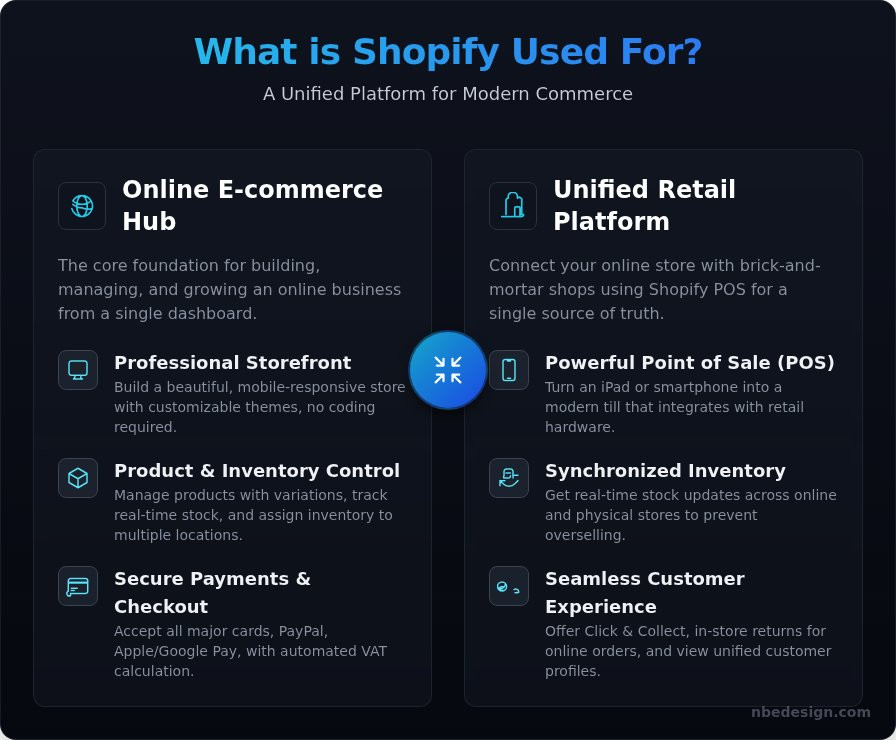
First impressions are critical in e-commerce. Shopify excels at helping you build a beautiful, conversion-focussed website that inspires trust. You can select from a wide range of customisable themes to match your brand's aesthetic without needing any coding knowledge to get started. The platform makes it simple to showcase your products with high-quality images, videos, and detailed descriptions. Crucially, every Shopify store is mobile-responsive by default, ensuring a seamless shopping experience for customers whether they are on a desktop, tablet, or smartphone.
Managing Products and Inventory
Beyond the customer-facing website, Shopify provides a powerful backend to manage your operations efficiently. You can easily add, edit, and organise products into collections. The system automatically tracks stock levels in real-time, helping you avoid the frustration of overselling popular items. Managing complex products is also simplified, with built-in support for variations like size, colour, and material-a crucial feature for UK brands like SoftplayToys4kids selling equipment in various sets or StudioDesk offering workstations in different finishes. For businesses with multiple warehouses or brick-and-mortar shops, you can even assign inventory to specific locations to streamline fulfilment.
Accepting Payments and Handling Checkout
A smooth and secure checkout is fundamental to online sales. Shopify simplifies this with its integrated solution, Shopify Payments, allowing you to accept all major credit cards with ease. You can also offer customers a variety of other popular payment options, including PayPal, Apple Pay, and Google Pay. The platform provides a secure, streamlined checkout experience that builds customer confidence and helps reduce abandoned carts. Furthermore, it can automatically handle complex VAT calculations based on your customer's location, simplifying your accounting and ensuring compliance.
Unifying Retail: Selling Online and In-Person with Shopify POS
While Shopify is renowned as a powerful e-commerce website builder, its capabilities extend far beyond the digital storefront. For retailers with a physical presence, one of the most transformative answers to the question "what is Shopify used for?" is creating a single, unified commerce platform that connects every sale, whether it happens online or in a brick-and-mortar shop.
This is a crucial tool for existing retailers looking to modernise their operations and eliminate the headaches of running separate systems. The goal is to create one source of truth for your entire business, from inventory and sales data to customer profiles, streamlining how you sell everywhere.
What is Shopify POS?
At its core, Shopify Point of Sale (POS) is a versatile app that turns an iPad or smartphone into a modern, powerful till. It replaces clunky, traditional cash registers with an intuitive system that manages in-person transactions. With Shopify POS, you can process payments, manage refunds, and capture customer information right at the counter. It integrates seamlessly with essential retail hardware, including card readers, receipt printers, and barcode scanners, to create a professional and efficient checkout experience.
Synchronising Your Inventory Everywhere
The most significant benefit of using Shopify for both online and in-person sales is the automatic, real-time inventory synchronisation. When you sell a product in your physical store using Shopify POS, the stock level is instantly updated on your online store, and vice versa. This simple but powerful feature prevents the frustrating scenario of selling an out-of-stock item to an online customer. From one central dashboard, you can view accurate stock levels across all your locations, making inventory management simpler and more reliable than ever.
Creating a Seamless Customer Experience
A unified system doesn't just simplify back-end operations; it directly enhances the customer journey. By connecting your online and physical stores, you can offer the flexible, modern services that shoppers now expect. This includes:
- Click and Collect: Allow customers to buy online and pick up their order in-store at their convenience.
- Effortless Returns: Process returns or exchanges for online orders in your physical shop, providing a hassle-free experience.
- Unified Customer Profiles: Access a single customer view that includes their entire purchase history, both online and in-store, enabling personalised service and marketing.
This cohesive approach builds customer loyalty and demonstrates a commitment to convenience. It shows that you understand how your customers shop today-fluidly, across all channels.
Let our experts unify your retail and online stores.
Powering Modern Business Models
When people ask what is Shopify used for, the answer extends far beyond a simple online shop. While the platform provides a rock-solid foundation for businesses that want to sell products online and in-person, its true power lies in its profound flexibility. Shopify is engineered to support a new generation of e-commerce business models, empowering entrepreneurs to launch and scale ventures with significantly lower overheads and less financial risk. This adaptability is largely powered by the thousands of apps in the Shopify App Store, which provide specialist tools to streamline these innovative approaches to retail.
Dropshipping Businesses
Dropshipping allows you to sell products without ever holding or shipping inventory yourself. By integrating your store with apps like DSers, you can source products directly from suppliers. When a customer places an order on your site, the details are sent straight to the supplier, who then ships the product directly to the customer. Your role is to manage the professional storefront, marketing, and customer service, all streamlined through the Shopify dashboard.
Print-on-Demand (POD) Services
For creatives and designers, print-on-demand is a game-changer. This model lets you sell custom-designed products such as t-shirts, mugs, and art prints without any upfront investment. By connecting your store to a POD service like Printful or Printify, products are only printed and shipped after an order is placed. This eliminates the financial risk of buying bulk inventory that might not sell, making it an efficient way to launch a merchandise brand.
Subscription Box Models
Creating predictable, recurring revenue is a key goal for many businesses, and Shopify makes this achievable through subscription models. Using specialised apps, you can offer products on a weekly, monthly, or quarterly basis. This model is perfect for consumables like coffee, beauty products, or curated lifestyle boxes. Shopify handles the complexities of recurring billing and customer account management, allowing you to focus on delivering value to your loyal subscribers.
These models demonstrate how Shopify serves as more than just a storefront; it's a versatile command centre for diverse e-commerce operations. By leveraging these strategies, entrepreneurs can build efficient, scalable, and future-proof businesses tailored to modern consumer demands.
Selling More Than Just Physical Products
A common misconception is that Shopify is exclusively for businesses that ship physical goods from a warehouse. While it excels at that, this view barely scratches the surface of the platform's capabilities. When clients ask us what is Shopify used for beyond traditional retail, they are often surprised by its incredible versatility. The platform provides a rock-solid foundation for a diverse range of digital commerce, opening up powerful opportunities for creators, consultants, and service-based entrepreneurs.
Shopify's robust infrastructure is expertly designed to handle transactions, customer management, and marketing, regardless of whether the final product is a physical item or a digital experience. This flexibility allows you to build and scale a business model that perfectly suits your unique offerings.
Digital Products and Downloads
For creators and educators, Shopify is an efficient engine for selling non-tangible goods. You can effortlessly sell a wide array of digital items directly to a global audience, with delivery happening instantly upon purchase. Popular examples include:
- Ebooks and digital guides
- Music, audio files, and podcasts
- Software and applications
- Design assets like templates, fonts, and stock photos
- Online courses and video tutorials
Using trusted apps from the Shopify App Store, you can automate the delivery of secure, unique download links to customers. This model eliminates the complexities of shipping and inventory management, allowing you to focus entirely on creating and marketing your products.
Services and Consultations
If your business sells time and expertise, Shopify can streamline how you manage bookings and process payments. It's an ideal solution for professionals like coaches, consultants, designers, and personal trainers. By integrating with calendar and booking apps, you can allow clients to view your availability and purchase consultation packages or appointments directly through your website. This professionalises your service delivery and ensures all payments are handled securely through Shopify's trusted checkout.
For example, a local service provider like Blues City Home Remodeling and Construction could use the platform to showcase their project portfolio and allow clients to book and pay for initial design consultations online.
Event Tickets and Memberships
Shopify is also a powerful tool for managing access and attendance. You can use it to sell tickets for workshops, webinars, or even in-person events, complete with automated digital ticket delivery and attendee list management. Furthermore, for businesses built on community and exclusive content, Shopify supports membership models. Specialised apps enable you to create members-only sections of your site, manage recurring subscription fees, and deliver exclusive perks, building a reliable stream of revenue for your brand.
Exploring what is Shopify used for reveals a platform ready to support almost any business idea. If you need help configuring a store for digital products or services, our team of Shopify Experts can help you build the perfect setup.
A Central Hub for Business Management and Growth
While Shopify excels at creating beautiful, conversion-focused online stores, its true power lies in its role as a complete business command centre. It moves beyond a simple storefront to centralise every aspect of your operations, from marketing to fulfilment. This integrated approach provides a clear, real-time view of your business, empowering you to make informed, data-driven decisions. Crucially, what is Shopify used for is not just starting a business, but scaling it-the platform is engineered to grow with you, from your first sale to becoming a large-scale enterprise.
Marketing and SEO
Attracting the right customers is fundamental to growth. Shopify simplifies this with powerful, built-in tools and seamless integrations. You can:
- Drive organic traffic using the integrated blogging platform and user-friendly SEO tools to optimise your pages and products.
- Connect with leading email marketing services like Klaviyo or Mailchimp to build customer relationships and automate campaigns.
- Launch and track social media and Google ad campaigns directly from your Shopify dashboard.
- Create compelling discount codes, gift cards, and promotions to boost sales and customer loyalty.
- Expand your reach by selling through established online marketplaces. For UK businesses, a platform like Anglia Market can introduce your brand to a new, built-in audience.
Order Fulfilment and Shipping
An efficient fulfilment process is key to customer satisfaction. Shopify streamlines this entire workflow from a single, organised dashboard. It allows you to manage orders, print packing slips, and purchase and print shipping labels with major UK carriers like Royal Mail and DPD. Automated shipping confirmation emails keep your customers informed every step of the way, building trust and reducing support queries.
This is particularly useful for businesses handling diverse product sizes; for instance, a specialist trade supplier like Romford Fencing Ltd can efficiently manage shipments ranging from small hardware packs to large fence panels.
Analytics and Reporting
Knowledge is power in eCommerce. Shopify’s comprehensive analytics dashboard gives you the insights needed to optimise your strategy. Track essential metrics like sales, store traffic, and conversion rates at a glance. You can easily identify your bestselling products, understand customer behaviour patterns, and see which marketing channels are delivering the best return. These insights are invaluable for refining your approach and driving sustainable growth.
Ultimately, by unifying these critical functions into one rock-solid platform, Shopify frees you to focus on what matters most-growing your brand. If you're ready to harness this power for your business, our team of Shopify Experts can help you craft the perfect setup.
Bringing It All Together: Shopify as Your Growth Partner
As we've explored, the answer to what is shopify used for extends far beyond a simple online shop. It’s a comprehensive command centre designed for modern commerce, seamlessly unifying your brick-and-mortar sales with a powerful online store through Shopify POS. Whether you're selling physical goods, digital products, or services, this versatile platform provides the essential tools to manage inventory, process payments, and run marketing campaigns from one central hub. It's built to streamline your operations and help you scale effectively.
Understanding this potential is the first step; harnessing it for your unique business is the next. As a certified Shopify Partner & Expert agency, we have been helping UK businesses grow using this very platform since 2006. We specialise in unifying online and in-person retail to create efficient, future-proof systems that drive real results. If you're ready to see how Shopify can transform your vision into a thriving reality, speak to a UK-based Shopify Expert to discuss your business idea. We're here to help you build with confidence.
Frequently Asked Questions
Can I use Shopify if I don't sell any products?
Yes, absolutely. While Shopify is a world-class eCommerce platform, its powerful website builder is versatile enough for businesses that don't sell physical goods. You can create a professional website to showcase a portfolio, promote services, take bookings, or publish content. It provides a rock-solid and secure foundation for any business needing a polished online presence, even without a traditional product catalogue.
Is Shopify a good choice for a complete beginner with no tech skills?
Shopify is an excellent choice for beginners. The platform is intentionally designed to be intuitive, with a drag-and-drop editor and clear dashboard that allow you to build a beautiful, functional store without writing any code. For any challenges you might face, there is extensive support from Shopify's help centre and a global community of Shopify Experts ready to help you streamline the process and build with confidence.
What are the main alternatives to Shopify?
While we believe Shopify offers the best all-in-one commerce solution, other platforms are available in the UK market. BigCommerce is a strong competitor for enterprise-level businesses, while Wix and Squarespace are known for their design simplicity but can be less scalable for ambitious retailers. For those with significant technical resources, WooCommerce offers deep customisation but requires far more hands-on management for hosting, security, and updates.
Can Shopify be used for a B2B (business-to-business) or wholesale business?
Definitely. Shopify has powerful, native B2B functionality built directly into its Shopify Plus plans. This allows you to create a password-protected storefront, set custom pricing lists, and assign specific payment terms for wholesale clients. For businesses on other plans, the Shopify App Store offers a wide range of robust B2B apps that can add this functionality, helping you manage both retail and wholesale operations efficiently from a single platform.
What are the key limitations of what Shopify can do?
While incredibly capable, Shopify does have some constraints. Advanced design customisation often requires knowledge of Shopify's 'Liquid' coding language or the help of a Shopify Expert. Transaction fees are applied if you use a third-party payment gateway instead of Shopify Payments. Understanding what Shopify is used for at its core-driving commerce-is key, as its blogging and content features are functional but not as advanced as a dedicated platform like WordPress.
Do I need my own website to use Shopify?
No, you do not. Shopify is a fully hosted, all-in-one platform, which means it provides the software and hosting needed to build and run your entire website. When you sign up, you can purchase a new domain name directly through Shopify or easily connect one you already own. This setup simplifies the technical side of running a business, allowing you to focus your energy on growth and sales.

- Posted in:
- Dropshipping
- E-commerce
- Online Store
- Retail Business
- Sell Online
- Shopify
- Shopify POS
- what is shopify used for