Skip to content
How to Set Up Email Marketing for Your Shopify Store: A Complete Guide
-
2644 words · 13 min read

Are you looking at your Shopify dashboard, knowing you should be leveraging the power of email, but feeling overwhelmed by where to even begin? From choosing the right platform to figuring out what to send, the path to effective email marketing can feel daunting. Many retailers worry about building a subscriber list from scratch or, worse, annoying the very customers they’re trying to connect with. This uncertainty often leads to inaction, leaving a powerful channel for growth untapped.
It doesn’t have to be this complex. In this complete guide, we’ll demystify the entire process. As Shopify Experts, we will provide a clear, step-by-step plan to help you launch and automate powerful email campaigns that drive sales and build lasting customer loyalty. You'll learn how to choose the right tools, build your list seamlessly, and craft automated emails that generate revenue on autopilot. Prepare to build a direct, profitable relationship with your customers with confidence.
Why Email Marketing is a Non-Negotiable for Shopify Stores
In the competitive world of e-commerce, Shopify store owners are constantly searching for marketing channels that deliver real, measurable results. While social media and paid advertising play a role, one channel consistently outperforms all others in terms of return on investment: email marketing. The fundamental difference is ownership. With social media, you are essentially 'renting' an audience, subject to the whims of unpredictable algorithms. Your email list, however, is a direct-to-consumer asset that you own and control, giving you a reliable way to communicate with your most valuable customers. For those new to the concept, it's helpful to understand what email marketing is at its core: a direct, digital marketing channel for growth.
To see how these foundational principles translate into a powerful strategy, the video below offers a clear walkthrough for getting started:
Drive Repeat Purchases and Increase Customer Lifetime Value (LTV)
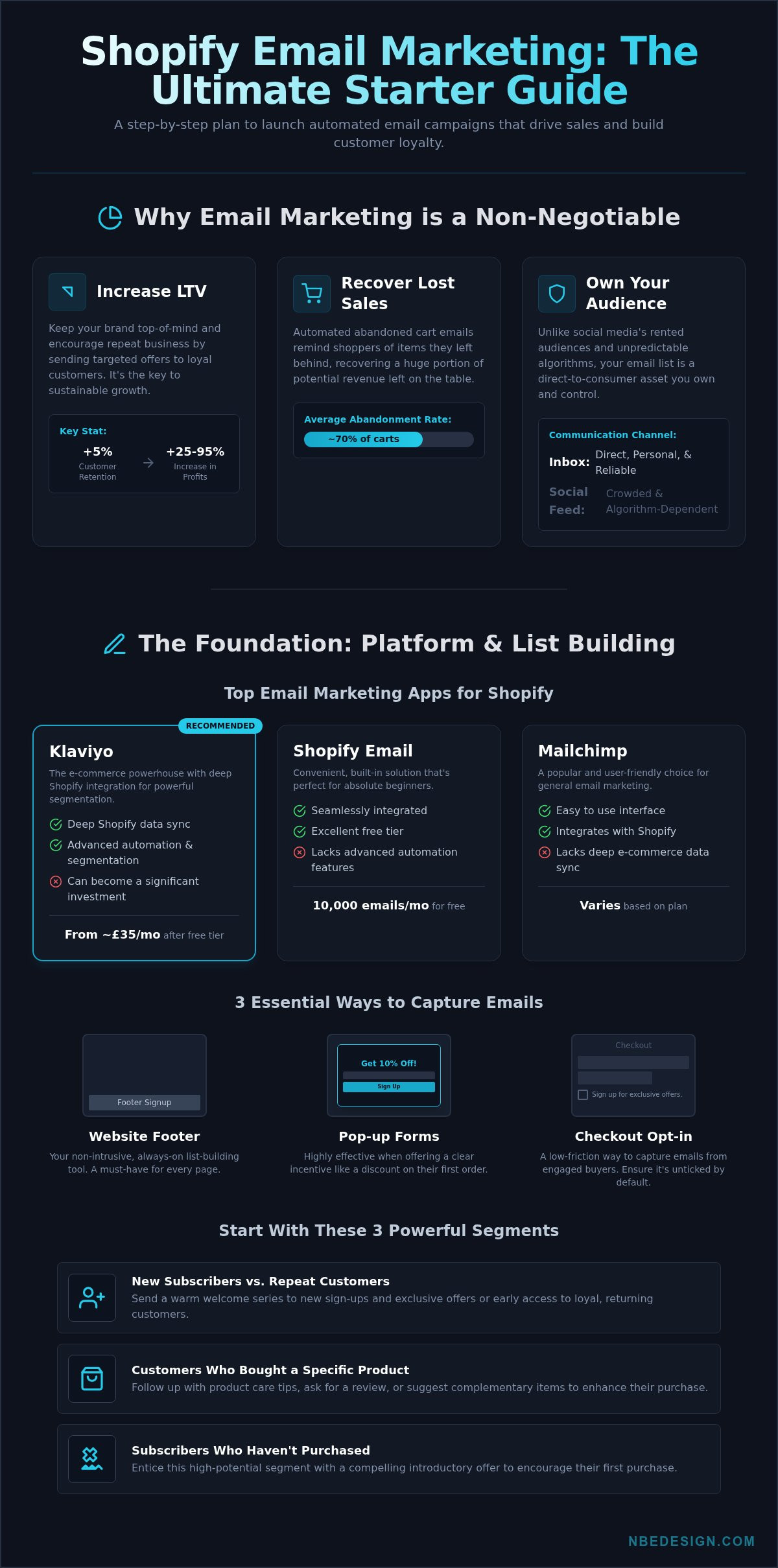
Customer Lifetime Value (LTV) is the total revenue you can expect from a single customer over the course of your business relationship. A higher LTV is the key to sustainable growth. Email is your most effective tool for this, keeping your brand top-of-mind long after the first purchase. By segmenting your list, you can send targeted offers to loyal customers, introduce new products they'll love, and build a relationship that encourages repeat business. Remember, increasing customer retention by just 5% can boost profits by 25% to 95%.
Recover Lost Sales with Abandoned Cart Automations
Did you know that, on average, nearly 70% of online shopping carts are abandoned? That represents a huge amount of potential revenue left on the table. This is where email automation provides an immediate financial impact. By setting up a simple, automated email sequence to remind shoppers of the items they left behind, you can effectively recover a significant portion of these lost sales. It’s one of the quickest, most tangible ways to generate more revenue from your existing store traffic.
Build a Direct Line of Communication with Your Customers
Unlike a crowded social media feed, the inbox is a personal space. Effective email communication allows you to cut through the noise and build genuine trust and community around your brand. It’s not just for promotions; use it to share your brand story, offer valuable content, and ask for feedback. Sending requests for product reviews or customer surveys via email not only provides you with crucial insights but also makes your customers feel heard and valued, strengthening their loyalty for the long term.
The Foundation: Choosing a Platform and Building Your List
A successful email marketing strategy begins with a rock-solid foundation. For Shopify retailers, this means choosing a platform that deeply integrates with your store. A true integration seamlessly syncs customer data, purchase history, and browsing behaviour, allowing you to create highly targeted and effective campaigns that drive growth.
Crucially, building your list must be done legally and ethically. Gaining explicit consent is non-negotiable. It's essential to understand UK GDPR and PECR rules, and it's also wise to familiarise yourself with established global standards detailed in core email marketing regulations to ensure you build customer trust from day one.
Top Email Marketing Apps for Shopify: A Quick Comparison
Choosing the right tool can feel daunting, but these three are excellent starting points for any Shopify store owner:
- Klaviyo: The e-commerce powerhouse. Its deep integration pulls in a wealth of Shopify data, enabling powerful segmentation. The trade-off is its cost, which scales with your list size and can become a significant investment, often starting from around £35/month after the free tier.
- Shopify Email: The convenient, built-in solution. It's perfect for beginners, allowing you to send 10,000 emails per month for free. However, its features are basic, lacking the advanced automation needed to truly scale.
- Mailchimp: A popular and user-friendly choice. While it integrates with Shopify, it doesn't offer the same depth of e-commerce-specific data as a platform like Klaviyo, which can limit your targeting potential.
How to Capture Emails on Your Shopify Store
Once your platform is chosen, you need to actively and legally collect email addresses. Implement these three methods to build a healthy list:
- Website Footer Signup: This is your non-intrusive, always-on list-building tool. A simple, clear call-to-action in your site's footer is a must-have.
- Pop-up Forms: Highly effective when used correctly. Offer a clear incentive, such as "Get 10% off your first order," to encourage sign-ups.
- Checkout Opt-in: A low-friction way to capture emails from engaged buyers. Ensure the checkbox for marketing consent is clear, optional, and unticked by default to comply with GDPR.
Understanding Basic E-commerce Segmentation
Segmentation is the practice of dividing your email list into smaller groups based on shared characteristics. This allows you to send far more relevant messages. Start with these simple but powerful segments:
- New Subscribers vs. Repeat Customers: Send a welcome series to new sign-ups and exclusive offers to your loyal, returning customers.
- Customers Who Bought a Specific Product: Follow up with care tips or complementary product suggestions.
- Subscribers Who Haven't Purchased: Entice this segment with a special introductory offer to encourage their first purchase.
Your First 3 Automated Campaigns: The Money-Makers
Once you have a strategy for collecting email addresses, the next step is to put them to work. This is where automated email marketing campaigns-often called 'flows' or 'journeys'-become your most valuable asset. Think of these not as one-off emails, but as your automated sales team, working around the clock to engage customers at critical moments. While there are many potential flows you can build, a topic covered well in this comprehensive guide to e-commerce email marketing, these three are the non-negotiable starting point for any ambitious Shopify store. They are designed to drive revenue, build trust, and streamline your customer communication from day one.
The Welcome Series: Making a Great First Impression
Your welcome series is your first, best chance to convert a curious subscriber into a paying customer. The goal is to nurture this new relationship, introduce your brand, and guide them confidently towards their first purchase.
- Email 1: Deliver the Goods. Immediately send the discount code or offer you promised. Pair this with a warm welcome and a brief introduction to your brand's story and mission.
- Email 2: Build Confidence. Showcase your best-selling products or powerful social proof like customer testimonials and five-star reviews. Let others do the selling for you.
- Email 3: Overcome Objections. Address common questions (FAQs) or highlight your unique value proposition, such as free UK delivery, sustainable materials, or your returns policy.
The Abandoned Cart Flow: Winning Back Customers
Did you know that nearly 70% of online shopping carts are abandoned? This automated flow is your most direct tool for recovering that lost revenue. The goal is to remind shoppers what they left behind and provide a compelling reason to return and complete their purchase.
- Email 1 (1-4 hours later): A simple, helpful reminder. Include images of the items in their cart and a clear, direct link back to complete their order.
- Email 2 (24 hours later): Create a sense of urgency. Mention that stock is limited or showcase a review for one of the items they've chosen.
- Email 3 (48 hours later): The final nudge. If it aligns with your brand strategy, consider offering a small incentive like a 10% discount or free shipping to seal the deal.
The Post-Purchase Follow-Up: Creating Brand Advocates
The customer journey doesn't end at the checkout. A strong post-purchase flow is essential for reducing buyer's remorse, building excitement, and turning a one-time buyer into a loyal advocate for your brand. This is where you build long-term value.
- Email 1 (Immediately): The order confirmation. Thank the customer sincerely for their purchase and provide a clear summary of their order.
- Email 2 (When item ships/delivers): Build anticipation. Let them know their order is on its way and provide tracking information so they can follow its journey.
- Email 3 (1-2 weeks later): Ask for feedback. Once they've had time to experience the product, politely request a product review to build social proof for future customers.
Planning Your Manual Campaigns and Measuring Success
While automated flows work tirelessly in the background, manual campaigns are your direct line of communication for timely news and promotions. These are the one-off "broadcast" emails you create and send to a specific segment of your list, like a weekly newsletter or a flash sale announcement. The key to success isn't sending an email every day; it's establishing a consistent, predictable rhythm that your audience can look forward to. This builds trust and keeps you top-of-mind without overwhelming inboxes.
Simple Campaign Ideas for Shopify Stores
Unsure what to send? Start with a simple, repeatable framework to build your content calendar. These foundational campaigns are perfect for engaging your audience and driving sales:
- Weekly/Bi-weekly Newsletter: Keep your subscribers engaged with new product arrivals, curated collections, or a behind-the-scenes look at your brand. For example, a boutique like Villarosa Maison could showcase a new collection of French-inspired homewares, telling the story behind their curation.
- Sales and Promotions: This is your primary tool for driving revenue. Announce seasonal discounts, holiday offers like Black Friday or Bank Holiday specials, and exclusive deals for your subscribers.
- Product Education: Go beyond the sale by showing customers how to get the most from their purchase. Share user guides, style tips, or highlight the unique benefits of a best-selling product.
Key Metrics to Track for E-commerce
To ensure your efforts are paying off, you must track performance. Analysing the data is the only way to refine and improve your email marketing strategy. Focus on these four crucial metrics:
- Open Rate: The percentage of people who opened your email. This is a direct measure of how effective and enticing your subject line was.
- Click-Through Rate (CTR): Of those who opened the email, what percentage clicked a link? This shows if your content, imagery, and call-to-action were engaging.
- Conversion Rate: The ultimate goal. This tracks the percentage of email recipients who clicked through and completed a purchase.
- Revenue Per Email: The most important e-commerce metric. This calculates exactly how much revenue (in £) each email generates, directly connecting your marketing to your bottom line.
Getting Started: Your First Month's Plan
Feeling ready to begin? Follow this simple four-week plan to build a solid foundation and launch your first campaign with confidence.
- Week 1: Choose your email platform (like Klaviyo or Shopify Email) and set up your pop-up or sign-up form on your store to start collecting subscribers.
- Week 2: Build and activate your automated Welcome Series to nurture new subscribers from day one.
- Week 3: Build and activate your Abandoned Cart flow to recover potentially lost sales automatically.
- Week 4: Send your very first manual newsletter campaign to your growing list.
Of course, all this effort is most effective when it drives traffic to a high-performing website. Need a rock-solid Shopify store to support your marketing? Talk to a Shopify Expert.
Mastering Email Marketing for Long-Term Growth
As we've explored, implementing a robust email marketing strategy is a non-negotiable for scaling your Shopify store. By choosing the right platform, building a quality list, and launching those crucial first automated campaigns, you're not just sending messages; you're building valuable customer relationships that drive repeat business and long-term loyalty.
Getting the technical foundation right is paramount. A high-performing Shopify store is the engine that powers your marketing efforts, and ensuring it's optimised for conversions is the first step. With decades of experience, our team of certified Shopify Experts based in the UK specialises in building these powerful, conversion-focused stores. We craft e-commerce platforms that are not just beautiful, but built from the ground up to support and amplify your marketing.
Ready to ensure your store is primed for success? Build a powerful foundation for growth. Talk to our Shopify Experts today.
Frequently Asked Questions About Email Marketing
What's the difference between Klaviyo and Mailchimp for Shopify?
Both are powerful tools, but they serve different needs. Klaviyo is built specifically for e-commerce and offers a deep, seamless integration with Shopify. It excels at advanced segmentation and automation based on customer purchase behaviour, making it ideal for scaling businesses focused on growth. Mailchimp is a fantastic all-rounder and very user-friendly for beginners, but its Shopify integration is less robust. For most Shopify store owners, Klaviyo offers a more powerful, conversion-focused solution.
How often should I send marketing emails to my customers?
There is no single correct answer, as frequency depends on your audience and industry. A great starting point for most retail businesses is one high-value email per week. This keeps your brand top-of-mind without overwhelming subscribers. You can then test different cadences or send more frequent, targeted emails to specific segments, such as new product alerts for VIP customers. The key is to always provide value, not just to sell.
Is email marketing expensive for a small business?
Quite the opposite. Effective email marketing delivers one of the highest returns on investment of any digital marketing channel. Most leading platforms, including Klaviyo, offer free plans for businesses with a small number of subscribers. As your list grows, paid plans are very scalable and can start from as little as £20-£30 per month. Compared to paid advertising, it is an incredibly cost-efficient way to drive repeat sales and build customer loyalty.
How many subscribers do I need to start email marketing?
You can and should start from day one, even with zero subscribers. The most important step is to set up sign-up forms on your Shopify store to begin collecting email addresses from interested visitors immediately. Building a list takes time, and starting early ensures you don't miss any opportunities. A small, engaged list of 50 people who genuinely want to hear from you is far more valuable than a large, unengaged one.
Can I get in trouble for sending marketing emails?
Yes, compliance is essential, but it’s straightforward if you follow the rules. In the UK and Europe, the key regulation is GDPR. This requires you to get explicit consent from individuals before you email them (e.g., through a checkbox on your sign-up form). You must also clearly identify your business and provide a simple, one-click unsubscribe link in every email. Following these best practices not only keeps you compliant but also builds trust with your audience.
What is a good open rate for an e-commerce store?
While this can vary by industry, a healthy open rate for an e-commerce business typically falls between 15% and 25%. However, don't fixate solely on this metric. A high open rate is great, but the more important indicators of a successful campaign are your click-through rate (people clicking links) and, ultimately, your conversion rate (people making a purchase). Focus on creating compelling subject lines to improve opens and valuable content to drive clicks and sales.

- Posted in:
- Customer Loyalty
- E-commerce
- Email Automation
- email marketing
- List Building
- Shopify
- Shopify Apps
- Shopify Guide