Skip to content
DIY Shopify Store vs Professional Design: Which is Right for Your Business in 2026?
-
3181 words · 15 min read

Is your current e-commerce setup actually a digital glass ceiling for your brand's growth? It's a question many retailers face as they move into 2026, especially when the gap between a hobbyist site and a high-performance engine is wider than it looks. You've likely felt the appeal of the DIY route; it's cost-effective and gives you total control over your initial launch. However, as your business matures, that initial pride can quickly turn into technical overwhelm and a nagging fear that your site looks amateurish compared to the competition.
In this guide, we'll help you settle the debate of a diy shopify store vs professional design by uncovering the critical differences that impact your bottom line. You'll discover how a tailored approach ensures your brand scales effectively while avoiding the common pitfalls of theme customisation. We'll explore everything from conversion rate optimisation to seamless POS integration, providing the clarity you need to choose a path that transforms visitors into loyal customers and supports long-term stability.
Key Takeaways
- Learn when a DIY approach is a practical starting point for micro-budgets and identify the exact moment it begins to hinder your business growth.
- Understand why professional UX and UI design are essential for moving beyond basic aesthetics to create a store that actually converts visitors into customers.
- Evaluate the real financial impact of a diy shopify store vs professional design by analysing hidden opportunity costs and long-term return on investment.
- Discover how to manage complex technical requirements, such as Shopify POS integration and multi-channel inventory, to ensure your operations remain scalable.
- Explore the strategic advantages of partnering with a certified Shopify Expert to gain industry-leading insights and dedicated support for your retail venture.
The DIY Shopify Journey: What You Can Actually Achieve Alone
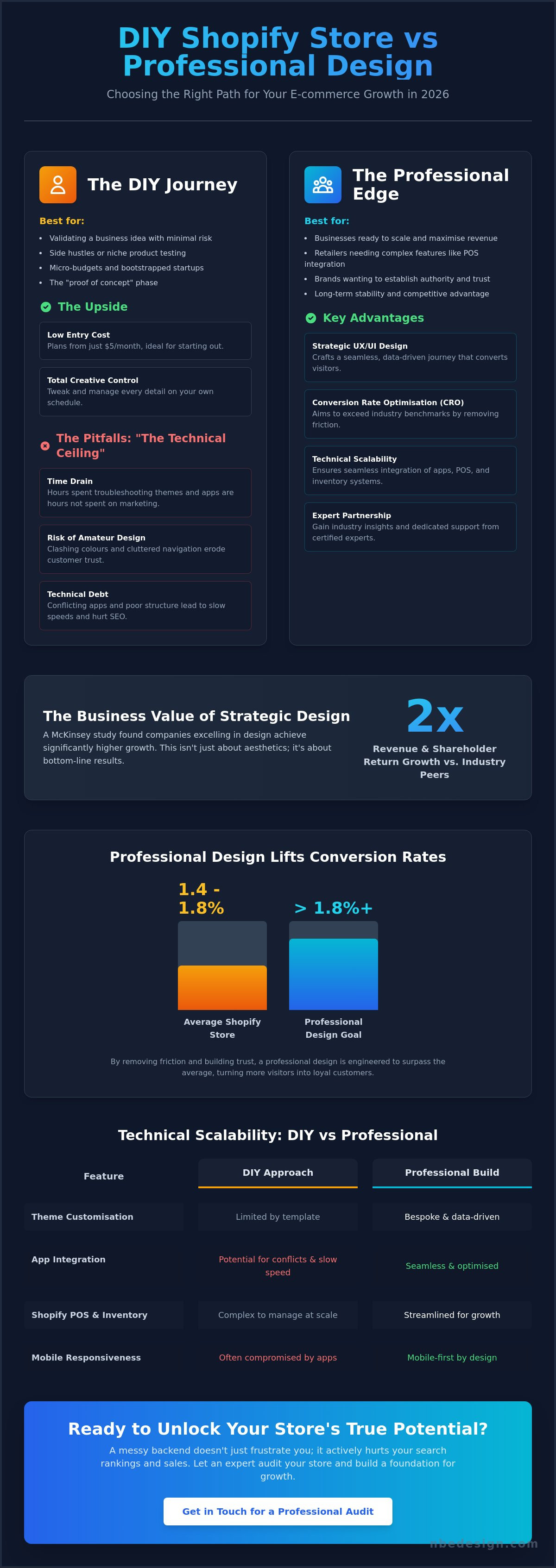
Shopify has evolved into a powerhouse of accessibility. In 2026, the platform supports over 5.6 million active stores, many of which began as simple, self-built projects. If you're launching a side hustle or testing a niche product, the DIY approach is a sensible starting point. It allows you to validate your business idea with minimal financial risk. You don't need a massive capital injection to get your first few sales, making it the ideal choice for those with micro-budgets or a "proof of concept" phase.
When considering a diy shopify store vs professional design, the primary draw of building it yourself is the low entry cost. Shopify's "Starter" plan at just $5 per month or the "Basic" plan at $29 (billed annually) provides the essential tools to start selling. However, this accessibility often creates a false sense of security. While putting products on a page is easy, building a high-converting retail environment requires a deeper understanding of key principles of web design, such as user journey mapping and visual hierarchy. Without these foundations, your store might look functional but fail to inspire the confidence needed to close a sale.
The Pros and Cons of Building Your Own Store
The most obvious benefit is cost. You aren't paying for professional hours, which is vital for bootstrapped startups. You also gain total creative control, allowing you to tweak every detail at 2 am if you wish. But this control comes at a price. The time you spend troubleshooting a theme or resizing images is time taken away from marketing and operations. It's easy to fall into the trap of "amateur" design choices, such as clashing colours or cluttered navigation, which can erode customer trust before they've even seen your products. You save money upfront, but you pay with your own limited time.
The DIY Technical Ceiling
Most beginners start with free themes. While these are robust, they offer limited customisation. As you try to add advanced features, you'll likely rely on third-party apps. Without developer knowledge, these apps often conflict, leading to slow site speeds and poor mobile responsiveness. This creates what experts call "technical debt." A store that's poorly structured from day one will eventually need a complete overhaul to scale. If you're finding the technical side too much, it might be time to get in touch for a professional audit. A messy backend doesn't just frustrate you; it actively hurts your search rankings and conversion rates.
The Professional Edge: Why 'Good Enough' Isn't Enough for Conversion
While a DIY setup helps you launch, a professional build is what helps you scale. The fundamental difference in the debate of a diy shopify store vs professional design lies in the transition from simple aesthetics to strategic User Experience (UX). Professional designers don't just pick colours; they craft a User Interface (UI) that guides customers through a seamless journey. This isn't just a matter of opinion. A McKinsey study on design ROI found that companies excelling in design grew their revenue and shareholder returns at nearly twice the rate of their industry peers. When your store looks and functions with high-level authority, customer trust follows naturally.
Conversion Rate Optimisation (CRO) by Design
Effective design removes friction. In 2026, the average Shopify store converts between 1.4% and 1.8% of its visitors. A professional designer aims to exceed these benchmarks by refining the checkout journey and reducing the psychological hurdles that lead to abandoned baskets. By strategically placing calls-to-action and simplifying navigation, you create a frictionless path to purchase. For a deeper dive into these techniques, read our Ultimate Guide to Conversion Rate Optimisation for Shopify Stores in 2026. Small adjustments to button placement or form fields can lead to significant revenue gains over time.
Custom Functionality vs. App Bloat
App bloat is a silent killer for many DIY stores. Every extra app adds third-party code that can slow down your site, negatively impacting your SEO and frustrating mobile users. Professionals solve this by building features directly into the Shopify theme. Custom-coded sections allow for unique product displays and advanced functionality without the performance penalty of a bloated app stack. This keeps your site speed high and your user retention even higher. If you're concerned about your current site's performance, it might be time to discuss a custom theme build to streamline your operations.
Calculating the Real Cost: Time, Opportunity, and Long-Term ROI
When weighing up a diy shopify store vs professional design, it's tempting to focus solely on the upfront price tag. However, the true cost of an e-commerce project includes your own time and the potential revenue lost during a slow, fragmented build. If you spend three months building a store yourself, that's a quarter of the year where you aren't actively marketing or selling at full capacity. A professional team typically delivers a refined, launch-ready store in a fraction of that time, allowing you to start generating a return much sooner. Time is your most finite resource; spending it on technical troubleshooting rather than business growth is a significant opportunity cost.
The financial impact of a low-converting store is often the most overlooked factor. As previously noted, the average Shopify store converts between 1.4% and 1.8% of its visitors. A DIY store that lacks professional UX might only convert at 0.5% or lower. On a monthly turnover of £10,000, that 1% gap represents thousands of pounds in missed revenue every single month. Over a year, the money "saved" on design costs becomes an incredibly expensive mistake. Professional design isn't just an expense; it's a strategic revenue driver that pays for itself through improved performance and higher average order values.
DIY vs Professional: A Cost-Benefit Comparison
The differences between these two paths become stark when you look at the lifecycle of a business. A DIY build often leads to a cycle of "patchwork" fixes. You might save money today, but you'll likely pay more later to unpick messy code or conflicting apps. Professional stores generally have lower long-term maintenance costs because they're built on a stable, clean foundation from the start. Consider these points:
- Setup Speed: Experts launch in weeks; DIY projects often drag on for months.
- Error Reduction: Professionals avoid the common pitfalls that lead to broken checkouts and lost sales.
- Scalability: A professional store handles growth without needing a complete rebuild every year.
Future-Proofing Your Business Investment
Clean code is the backbone of a stable online presence. When a certified expert handles your build, they ensure every section follows Shopify's best practices. This means your site won't break when Shopify releases platform updates or when you decide to integrate new sales channels like POS. It creates a foundation that grows with your brand rather than becoming a technical bottleneck. If you're ready to see how a professional build can transform your bottom line, you can get a Shopify Store Quote from a UK Expert to understand exactly how we can help you scale effectively.
Beyond the Homepage: Technical Scalability and Shopify POS Integration
A successful e-commerce business in 2026 requires more than just a polished storefront; it needs a robust technical engine capable of handling multi-channel operations. This is where the debate of a diy shopify store vs professional design becomes a question of technical infrastructure. While a DIY build might suffice for a standalone website, it often falters when you try to synchronise online sales with a physical retail presence. Professional designers ensure your backend is configured for "phygital" retail, where inventory, customer data, and sales reports are unified across every touchpoint.
Managing multi-channel inventory is a common pain point for retailers who attempt a self-build. Without expert configuration, you risk overselling stock or creating fragmented customer records that make personalised marketing impossible. Professional implementation also ensures that your store is ready for modern regulatory requirements, such as the Digital Product Passports (DPP) becoming mandatory for certain categories in 2026 and 2027. These technical layers require a level of precision that goes beyond basic theme settings, protecting your business from future compliance hurdles.
Unifying Your Retail Channels
For retailers with a physical presence in Darlington or Newcastle, connecting your high street shop to your digital store is essential for long-term growth. We specialise in creating a seamless bridge between these worlds, ensuring your stock levels update in real-time across all locations. For a deeper look at this technology, explore our guide on Shopify POS: The Ultimate Guide to Unifying Your Retail and Online Store. This unification allows for modern services like click-and-collect and unified customer profiles, providing a consistent brand experience that DIY builds rarely achieve.
The Complexity of Migration
If you're moving from platforms like WooCommerce or Magento, the stakes are even higher. DIY migrations are notorious for causing sudden drops in SEO rankings due to poorly managed 301 redirects and broken links. Our Shopify Migration Services provide a managed, low-stress transition that protects your historical data and search visibility. We handle the complex data transfer and launch day protocols, ensuring your transition is handled with calm expertise. If you're planning a platform move, book a migration consultation with our team to ensure your brand's momentum remains uninterrupted.
Partnering for Growth: Why Choosing a Certified Shopify Expert UK Matters
Choosing the right path for your e-commerce journey eventually leads to a single, defining question: who will help you maintain your momentum? While the debate of a diy shopify store vs professional design often centres on technical features, the human element of partnership is what determines long-term success. A certified Shopify Expert isn't just a web designer; they're a strategic guide who understands the platform's nuances, from liquid code to the latest AI-driven checkout features. This expertise provides a managed, low-stress experience that allows you to focus on your core business operations while we handle the technical complexities.
The distinction between a generalist agency and a certified expert is significant. Generalists often apply a one-size-fits-all approach to various platforms, which can lead to inefficient store structures and missed opportunities for optimisation. In contrast, our singular focus on the Shopify ecosystem means we've evolved alongside the technology. We understand how to leverage every tool in the Shopify arsenal to ensure your store isn't just a static website, but a high-performance retail engine. This specialised knowledge bridges the gap between your initial vision and the practical realities of modern retail.
The Advantage of a Certified Shopify Partner
Working with an official partner gives you a distinct competitive edge. We have access to exclusive Shopify resources, priority support, and early feature releases that aren't available to the general public. This means your store can adopt new technologies before your competitors even know they exist. Our history within the niche serves as a definitive statement of our experience, providing a mark of proven results for high-growth UK brands. You can view our portfolio of Shopify Expert projects to see how we've helped diverse retailers transform their digital presence into a scalable asset.
Your Growth Partner in the North East
While we support a global client base, we take immense pride in our regional roots. We believe that local knowledge adds a layer of understanding that remote agencies simply can't match. For retailers in Darlington, Newcastle, and the wider North East, we offer a grounded, approachable partnership that includes on-site visits and face-to-face consultations. This local expert, global reach positioning allows us to provide bespoke support tailored to your specific market challenges. If you're looking to unify your physical and digital storefronts, you can book a Shopify POS demo in the North East. We'll help you craft a long-term roadmap that ensures your e-commerce venture remains stable, profitable, and ready for whatever the future of retail holds.
Choosing a Path for Long-Term E-commerce Success
The choice between a diy shopify store vs professional design isn't just about how your site looks today; it's about where your business will be in three years. While a self-build serves as a useful entry point for testing new ideas, scaling a retail brand in 2026 requires a level of technical precision that standard templates cannot provide. By investing in professional UX, clean code, and seamless POS integration, you remove the digital glass ceiling that often limits DIY projects.
As Certified Shopify Experts and Partners based in North East England, we specialise in bridging the gap between your retail vision and technical reality. Whether you need a complex migration from a legacy platform or a unified system for your physical shops, our team provides the calm expertise needed to manage your transition. We've helped brands across the globe achieve stable, high-performance growth by focusing on what truly matters: conversion and scalability.
Ready to build a high-growth store? Contact our Shopify Experts today. Your journey towards a more professional, profitable brand starts with a single conversation. We're here to guide you every step of the way.
Frequently Asked Questions
Is it better to build a Shopify store myself or hire an expert?
Hiring an expert is generally the better option if you want to scale quickly and ensure a professional brand image from day one. While the diy shopify store vs professional design debate often comes down to budget, an expert setup avoids the "technical debt" that hampers growth. If you're just testing a concept with a micro-budget, DIY is a practical start. However, for established retailers, a professional build ensures your infrastructure is secure and conversion-ready.
How much does a professional Shopify store design cost in the UK?
UK pricing for professional Shopify services depends entirely on your specific project scope and the level of customisation required. A simple theme setup will differ significantly from a full-scale migration or a bespoke design with complex integrations. Rather than looking for a fixed price, consider the long-term return on investment. A professionally designed store is built to convert, often paying for itself through increased sales and reduced maintenance costs over time.
Can I start with a DIY Shopify store and upgrade to a professional design later?
You can certainly begin with a DIY store and transition to a professional design as your business matures. Many successful retailers use the initial DIY phase to validate their products and generate early revenue. When you reach a point where technical limitations or poor conversion rates are holding you back, a Shopify Expert can step in. They'll help you migrate your data and redesign the store to support your next stage of growth.
How long does it take for a professional to build a Shopify store compared to DIY?
Professionals can often launch a fully optimised store in four to eight weeks, whereas a DIY build can take several months of trial and error. Experts follow a methodical process that covers design, development, and testing simultaneously. As a business owner, your time is often better spent on marketing and operations. By outsourcing the build, you reduce your time-to-market and start generating revenue much faster than you would by troubleshooting the platform alone.
Will a professional Shopify design help with my SEO rankings?
A professional build provides a much stronger foundation for SEO than a standard DIY template. Experts ensure your site uses clean, semantic code and adheres to the latest core web vitals for speed. They also manage technical details like schema markup and proper URL structures that are often overlooked in self-built stores. This technical accuracy makes it much easier for search engines to crawl and rank your pages effectively in 2026.
Do I need a Shopify Expert if I am only selling a few products?
You don't necessarily need an expert for a small inventory, but the decision should be based on your growth ambitions rather than product count. Even a single-product store needs a frictionless checkout and a trustworthy design to convert at a high level. If you intend to run paid advertising or build a premium brand, the professional edge is vital. It ensures that every visitor has a seamless experience, regardless of how many items you sell.
What is the difference between a Shopify developer and a Shopify designer?
A Shopify designer focuses on the visual aesthetics, user interface (UI), and the overall customer experience (UX). In contrast, a Shopify developer works with Liquid code and APIs to build custom functionality and handle complex data integrations. When you work with a certified agency, you typically get the benefit of both skill sets. This ensures your store looks exceptional and functions perfectly, bridging the gap between creative vision and technical retail reality.
How does professional design improve my Shopify conversion rate?
Professional design increases conversion rates by using data-driven layouts that guide users naturally toward the checkout. Experts analyse user behaviour to place calls-to-action strategically and remove any friction points that cause basket abandonment. By creating a mobile-first experience and instilling trust through professional branding, you provide a shopping environment that encourages visitors to buy. This strategic approach typically results in a much higher conversion rate than a standard, unmodified theme.

- Posted in:
- conversion rate optimisation
- DIY Shopify
- diy shopify store vs professional design
- e-commerce
- professional web design
- Shopify
- Shopify design
- Shopify expert
- Shopify POS