Skip to content
Shopify Page Builder vs Custom Shopify Design: Which is Best for Your Store in 2026?
-
3187 words · 15 min read

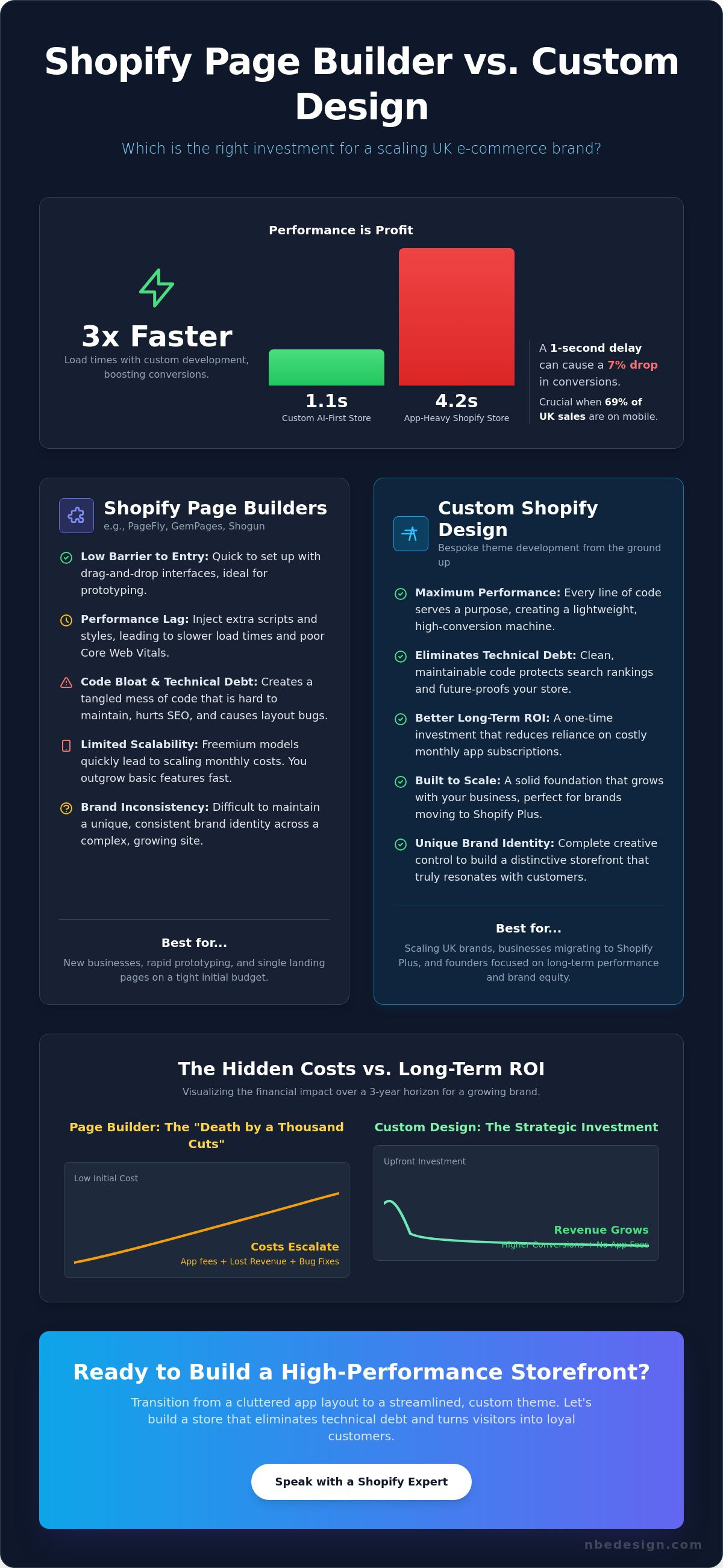
Did you know that a custom-built, AI-first e-commerce store can load up to three times faster than an app-heavy Shopify store; specifically 1.1 seconds compared to 4.2 seconds? When weighing up a Shopify page builder vs custom Shopify design, this performance gap is often the deciding factor for scaling UK brands. We understand the frustration of feeling trapped by "cookie-cutter" templates or watching your profit margins dwindle under the weight of high monthly app subscriptions. You want a unique brand identity that truly resonates with your customers, yet the technical complexity of choosing the right path can feel overwhelming.
To see how a professional digital agency approaches these custom builds, you can explore Webdesign options from specialists like BDMNL, who focus on creating high-performance, bespoke webshops.
This guide will help you determine which investment is right for your growth, ensuring you don't sacrifice speed for aesthetics. We'll explore how bespoke development eliminates code bloat, improves Core Web Vitals, and provides the scalability needed as more British retailers migrate to Shopify Plus. By the end, you'll have a clear roadmap to building a fast, distinctive storefront that turns visitors into loyal customers and supports your long-term business goals.
Key Takeaways
- Understand why custom designs can load up to three times faster than app-dependent stores, directly boosting your conversion rates and mobile performance.
- Compare the long-term ROI of a shopify page builder vs custom shopify design to see how bespoke development reduces technical debt and monthly subscription costs.
- Identify the limitations of "forever free" page builder tiers and when your scaling UK business will likely outgrow their basic functionality.
- Learn how to protect your search rankings by eliminating the "code bloat" and render-blocking scripts that often accompany drag-and-drop apps.
- Discover a managed approach to transitioning from cluttered app layouts to a streamlined, high-performance custom theme using Shopify OS 2.0 features.
The Great Shopify Design Debate: Speed vs Scalability
Choosing how to build your storefront is one of the most critical decisions you'll make for your e-commerce journey. The choice between a shopify page builder vs custom shopify design often feels like a trade-off between immediate convenience and long-term performance. While an app might get you online by tomorrow morning, the architectural choices you make today will ripple through your profit and loss statements for years to come. Retailers often find themselves at a crossroads: do they prioritise the low barrier to entry of a drag-and-drop tool, or the lean, high-performance foundation of a bespoke build?
If you look at your business over a three-year horizon, the financial impact becomes clear. Page builders often carry monthly fees that scale as you need more features, sometimes reaching hundreds of pounds per year. However, the true hidden cost is the performance lag. Since mobile traffic accounts for 69% of UK sales on the Shopify platform, a slow store is a direct drain on your bottom line. A one-second delay in loading can lead to a 7% reduction in conversions, meaning the "cheaper" app could actually cost you thousands in lost revenue.
Many founders fall for the "ease of use" promise. It’s true that dragging a block into place is simple at first. But as you add more apps for reviews, loyalty programmes, and advanced search, the code becomes a tangled mess. This is what we call technical debt. It's the cumulative cost of choosing an easy, short-term fix instead of a professional solution. Eventually, the debt comes due; you'll likely spend more time fixing layout bugs and performance issues than actually growing your brand.
What is a Shopify Page Builder?
These are third-party apps like PageFly, GemPages, or Shogun that provide a visual interface for designing pages without touching code. They function by injecting additional layers of scripts and styles onto your existing theme. For a new business in the prototyping phase, they offer a low-risk way to test a product idea. They are excellent for "quick and dirty" landing pages, but they often struggle to maintain brand consistency as your site grows in complexity.
What is Custom Shopify Design?
Custom design involves building your store’s theme from the ground up using Shopify’s native language, Liquid. By partnering with a Shopify expert UK, you ensure that every line of code serves a specific purpose. This bespoke approach isn't just about aesthetics. It’s about creating a lightweight, high-conversion machine tailored to your specific brand requirements, ensuring your site remains fast, secure, and easy to scale without the bloat of unnecessary third-party apps.
Best Free Shopify Page Builder Apps in 2026: A Comparative Roundup
For many new UK entrepreneurs, the initial hurdle of launching a store involves balancing a limited budget with high design expectations. When navigating the shopify page builder vs custom shopify design choice, the "forever free" tiers offered by popular apps often seem like the perfect middle ground. Understanding how Shopify works within its vast app ecosystem reveals that these tools are designed for rapid prototyping, allowing you to test market fit without a large upfront investment.
While these apps provide a low barrier to entry, they operate on a "freemium" model. This means you get a taste of the functionality, but the most powerful features are locked behind monthly subscriptions. For a scaling brand, the transition from a free app to a paid plan can happen sooner than expected, often as soon as you need a second custom landing page or advanced mobile customisation. If you find yourself overwhelmed by these choices, you can always speak with our team for a professional perspective on your store's architecture.
Top 3 Free Builders for New Stores
PageFly remains a leading choice in 2026, offering one published page "slot" for free. It’s highly versatile for creating a single, high-converting product page. GemPages, now on version 7, also provides a single-page free tier with a focus on version history and intuitive editing. Tapita has gained traction by offering speed-optimised templates specifically designed to reduce the performance lag often associated with drag-and-drop tools, making it a strong contender for those prioritising Core Web Vitals on a budget.
The Limitations of Free Builder Tiers
A free app is rarely truly "free" when you consider the impact on your site's performance. Most free tiers include "Powered by" branding, which can detract from a premium brand image. More critically, these apps inject scripts that contribute to code bloat, potentially slowing your mobile load times. When comparing a shopify page builder vs custom shopify design, remember that free builders often lack the A/B testing and deep analytics required to truly optimise a store for high-volume sales. They are excellent for starting, but they rarely provide the lean, efficient foundation needed for long-term UK e-commerce growth.
The Hidden Costs of Easy: Performance, SEO, and Code Bloat
Choosing between a shopify page builder vs custom shopify design is essentially a choice between short-term speed to market and long-term search engine dominance. While drag-and-drop tools promise a shortcut to a beautiful storefront, they often leave a trail of invisible problems. These apps work by injecting massive amounts of JavaScript and CSS on top of your existing theme. This "code bloat" creates a heavy burden for browsers to download and process. Since Google uses Core Web Vitals as a direct ranking factor, a bloated site doesn't just annoy users; it actively harms your visibility in UK search results. If your site takes too long to become interactive, Google will likely deprioritise your pages in favour of leaner competitors.
The SEO penalty for a slow site is significant. Research shows that a one-second delay in page load time can lead to a 7% reduction in conversions. For a business turning over £500,000 a year, that is a £35,000 loss simply because of a sluggish design choice. Professional ecommerce website design focuses on eliminating these bottlenecks from the start. Beyond speed, maintenance becomes a headache when Shopify updates its core engine. Custom themes are built to evolve with the platform, whereas app-based layouts can break unexpectedly when the underlying code changes, leaving you with a broken storefront and lost sales.
Mobile Performance: The Builder Achilles Heel
Mobile devices drive 78% of all e-commerce traffic globally. In the UK, mobile commerce represents 69% of online sales during peak events on Shopify. Many retailers mistake a "responsive" design for an "optimised" one. A responsive page simply moves elements around to fit a screen, but an optimised page ensures those elements load instantly. App-generated pages often fail mobile-first indexing because they load too many render-blocking scripts. This directly impacts your conversion rate optimisation, as mobile shoppers are notoriously impatient and will bounce if a page takes more than a few seconds to stabilise.
Long-term Maintenance and App Conflict
When you use multiple page builder apps, they often fight for control over the Shopify Liquid engine. This creates "app conflict," where scripts from different tools interfere with one another. This instability can cause your site to lag or display elements incorrectly. Even worse, if you decide to uninstall a page builder, they frequently leave behind "ghost code" in your theme files. This residual code continues to slow down your site even after the app is gone. A custom build offers a cleaner, more stable environment for growth, ensuring every line of code is documented and purposeful.
Custom Shopify Design: Why Serious UK Retailers are Moving Away from Apps
The e-commerce landscape has shifted significantly with the maturity of Shopify Online Store 2.0. In previous years, retailers often felt forced to rely on apps to gain layout flexibility. Today, bespoke themes offer "Sections Everywhere" functionality as standard. This means you get the best of both worlds: the high performance of custom code and the administrative ease of a drag-and-drop interface. When considering a shopify page builder vs custom shopify design, serious brands now realise that native Shopify features provide more power and stability than a third-party overlay.
We see this trend accelerating across the North East, from Darlington to Newcastle. Local retailers are moving away from the "app-first" mentality to build stores that reflect their unique brand heritage. For example, we've helped clients transition from Shogun-based layouts to fully custom themes with remarkable results. By stripping away unnecessary scripts, these stores achieve much faster load times. The decision between a shopify page builder vs custom shopify design isn't just about today; it's about where your brand will be in 2027 and beyond.
This transition to bespoke digital environments is a hallmark of premium brands; for example, luxury travel agencies like YAL’OOU Exclusive Yachting & More prioritize curated, high-performance websites to match the exclusivity of their yachting and villa experiences.
The Benefits of a Bespoke Shopify Theme
A bespoke theme gives you total creative control. You aren't boxed into a rigid grid system or limited by what an app developer thinks you need. This is especially vital for omnichannel retailers who require a seamless Shopify POS integration. Custom logic allows your physical and digital storefronts to communicate perfectly, ensuring stock levels and customer data are always in sync without relying on buggy middleware.
Future-Proofing Your Brand Identity
Your store should be a unique asset, not a rented layout. Custom design allows for intricate business graphic design that tells your brand story far better than a generic template ever could. As you scale towards Shopify Plus, custom code becomes a prerequisite for the advanced automations and checkout customisations that enterprise-level brands require. It’s about building a foundation that won't need to be torn down and rebuilt as you grow. If you're ready to move beyond the limitations of apps, you can book a consultation with our experts to discuss your project.
Making the Switch: How to Transition from Page Builders to Custom Development
Transitioning your store from a cluttered, app-dependent environment to a high-performance bespoke theme is a strategic move that requires careful planning. It isn't just about deleting an app; it's about reclaiming your site's performance and brand integrity. When navigating the shopify page builder vs custom shopify design transition, the first step is a comprehensive audit of your current tech stack. Identify which features are essential for your customer journey and which are simply adding weight to your page load times. You might find that many "must-have" features provided by builders can be easily replicated with a few lines of clean, native Liquid code.
For businesses not ready for a complete overhaul, a "Hybrid" approach offers an excellent middle ground. This involves keeping your core theme but replacing specific, high-traffic pages or sections with bespoke Liquid code. This strategy allows you to test the performance benefits of custom development without the immediate investment of a full rebuild. However, for those scaling towards enterprise levels, a structured Shopify migration to a dedicated custom theme is the most effective way to eliminate technical debt. When vetting a partner for this journey, ensure they are true developers who write code, rather than "integrators" who simply install another page builder on your behalf.
A Step-by-Step Transition Roadmap
- Performance Audit: Conduct a deep dive into your existing builder pages to identify render-blocking scripts and unnecessary code layers.
- Liquid Mapping: Map out custom Liquid sections to replace app functionality, ensuring your store remains easy to manage via the Shopify Theme Editor.
- Testing and QA: Run rigorous quality assurance checks to ensure zero downtime and a seamless transition for your customers during the switch.
Working with NB eCommerce & Design
At NB eCommerce & Design, we don't believe in one-size-fits-all templates. Our process is rooted in a deep understanding of the Shopify ecosystem, evolved over years of official partnership. We combine our grounded North East UK roots with global expertise to build stores that aren't just "pretty," but are engineered for profit and stability. We take pride in guiding our clients through complex digital transitions with a managed, low-stress experience. If you're ready to resolve the shopify page builder vs custom shopify design debate for your brand and invest in a high-performing future, contact our Shopify Experts today for a professional consultation.
Future-Proofing Your UK E-Commerce Success
Deciding on a shopify page builder vs custom shopify design is a pivotal moment for your brand's growth. While apps provide a quick start, the long-term benefits of a bespoke Liquid-based theme, including faster load times and improved Core Web Vitals, are undeniable. By leveraging the power of Shopify Online Store 2.0, you can maintain administrative ease without sacrificing the performance that drives conversions. Your storefront is your most valuable digital asset, and it's essential that it scales alongside your ambitions.
As a Certified Shopify Partner and Expert based in Darlington and Newcastle, we specialise in creating conversion-focused designs for global brands. We understand that technical transitions can feel daunting, but our team is here to guide you through a managed, low-stress experience. If you're ready to move away from app-heavy layouts and invest in a lean, scalable storefront, we invite you to book a consultation with our UK Shopify Experts. Let's work together to build a unique digital identity that reflects your brand's true potential and supports your journey toward Shopify Plus. Your high-performance future starts with a single step.
Frequently Asked Questions
Will using a Shopify page builder hurt my SEO?
Yes, page builders can negatively impact your SEO performance if they aren't managed carefully. These apps often introduce "code bloat" by injecting heavy JavaScript and CSS files into your theme. This extra weight can slow down your site and hurt your Core Web Vitals scores. Since Google uses page speed as a direct ranking factor, a slow store may struggle to appear in top UK search results compared to a lean custom build.
Can I switch from a page builder to a custom design without losing my data?
You can switch to a custom design without losing your core business data. Your products, customer accounts, and order history are stored within the Shopify database, not the page builder app itself. However, the specific layouts and "drag-and-drop" content created within the app will need to be rebuilt in your new theme. A professional migration ensures that your content is moved over while keeping your database intact and secure.
Is a custom Shopify theme harder to edit than a page builder?
A custom Shopify theme is often easier to manage than an app-based layout. Modern bespoke designs use Shopify Online Store 2.0 features like "Sections Everywhere," which gives you a visual drag-and-drop experience within the native theme editor. This allows you to update your storefront without touching any code. Unlike page builders, this native approach doesn't require learning a separate interface or paying for a monthly app subscription to keep your pages live.
What is the average cost of a custom Shopify design in the UK for 2026?
The investment for a custom Shopify design in the UK depends entirely on your store's complexity and specific requirements. While a shopify page builder vs custom shopify design comparison shows that builders have lower upfront costs, custom builds are priced based on the level of bespoke functionality, integration needs, and brand identity work required. For most scaling brands, the long-term ROI comes from recovered transaction fees and the conversion lift provided by a faster, unique storefront.
Are there any page builders that don’t slow down your site?
While some builders are more efficient than others, every third-party app introduces additional code to your store. Apps like GemPages or Tapita offer speed-optimised templates, but they still function as an overlay on your theme. Even the most efficient app cannot match the performance of a bespoke theme built from scratch using clean Liquid code. If performance is your top priority, minimising your reliance on third-party design apps is the most effective strategy.
Do I need Shopify Plus to have a custom-designed store?
You don't need a Shopify Plus subscription to benefit from a custom-designed store. Bespoke themes and custom development work perfectly on the Basic, Grow, and Advanced Shopify plans. While Plus offers enterprise-level features like advanced checkout customisation and lower transaction fees, the core ability to build a unique, high-performance storefront is available to every UK merchant. Custom design is a growth strategy for businesses at every stage of their journey.
How long does it typically take to build a custom Shopify store?
The timeline for a custom build usually spans several weeks to a few months, depending on the project scope. A professional build involves several phases, including a technical audit, bespoke design mockups, and rigorous development and testing. This methodical approach ensures that your store is not only beautiful but also stable and optimised for mobile performance. While page builders are faster for a "quick fix," custom development builds a stable foundation for long-term scalability.

- Posted in:
- Core Web Vitals
- Custom Shopify Design
- E-commerce SEO
- Shopify
- Shopify Page Builder
- shopify page builder vs custom shopify design
- Shopify Plus
- Shopify Themes
- Site Speed
- Web Development